
 zarkam21:
help
 Vocaloid:
|dw:1513275163598:dw| try to compare what's going on in the function to the table
Vocaloid:
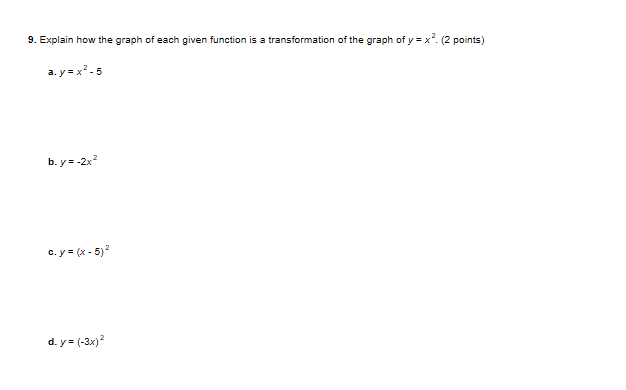
for example, y = x^2 - 5 looks like y = x^2 - c which means a shift down by c units so what happens to the graph of x^2 to get x^2 - 5?
Vocaloid:
"f(x) - c is the graph of f(x) shifted down by c units" "x^2 - 5 is the graph of ___ shifted down by __ units" try filling in the blanks
zarkam21:
f(x) 5
Vocaloid:
should be "x^2 shifted down by 5" but you're starting to get the idea ^^
Vocaloid:
try to apply a similar line of reasoning to y = -2x^2 using row 5 and row 7 of the table
Vocaloid:
|dw:1513275569852:dw|
Vocaloid:
using row 5: "the graph of -f(x) is the graph of f(x) reflected across the x-axis" now compare this to what is in the problem y = -x^2 is the graph of ___ reflected across the ___-axis try and fill in the blanks
zarkam21:
f(x) x
Vocaloid:
|dw:1513276001509:dw|
Vocaloid:
now, use row 7 to figure out how multiplying x^2 by 2 changes the function
zarkam21:
umm its reflected?
Vocaloid:
|dw:1513276199016:dw|
zarkam21:
oh okay its stretched
Vocaloid:
now let's put everything together "the graph of y = -2x^2 is the graph of x^2 stretched vertically by a factor of __ and reflected across the __-axis" try filling in the blanks
zarkam21:
y axis and factor of 2?
zarkam21:
I think :/
Vocaloid:
|dw:1513276586156:dw| refer to our earlier statements
zarkam21:
f(x) x^2
Vocaloid:
the factor is 2 the reflection is across x-axis "the graph of y = -2x^2 is the graph of x^2 stretched vertically by a factor of 2 and reflected across the x-axis"
Vocaloid:
keep in mind your description should mention x^2 not just the generic f(x)
zarkam21:
OH I think I understand a little now
Vocaloid:
now use row 4 to figure out what transformation is being applied to x^2 to get |dw:1513276720205:dw|(x-5)^2
zarkam21:
shift to the right?
zarkam21:
@Vocaloid
Vocaloid:
Good but how many units is it being shifted?
zarkam21:
5?
Vocaloid:
Excellent See if you can work out d using the table
zarkam21:
Sorry wwas on break, if you do not mind can we still continue ? =)
zarkam21:
@563blackghost @Shadow
zarkam21:
@Vocaloid
zarkam21:
would D be a stretch?
zarkam21:
@Vocaloid
zarkam21:
well by -3
Vocaloid:
horizontal or vertical? when you consider stretches and shrinks ignore the negative sign because we account for that with reflection
Vocaloid:
|dw:1514987990504:dw|
Vocaloid:
*** should be a shrink since it's inside the parentheses and its > 1
Vocaloid:
|dw:1514988174150:dw|
Vocaloid:
now, instead of the generic "a" look at your problem and see what number you would replace "a" with
zarkam21:
3
Vocaloid:
good, now put everything together y = (-3x)^2 is a horizontal shrink by a factor of 1/3 now consider the negative sign
Vocaloid:
|dw:1514988456667:dw|
zarkam21:
\(\color{#0cbb34}{\text{Originally Posted by}}\) @Vocaloid good, now put everything together y = (-3x)^2 is a horizontal shrink by a factor of 1/3 now consider the negative sign \(\color{#0cbb34}{\text{End of Quote}}\)
zarkam21:
so this would be the answer, or are we not done yet
Vocaloid:
"now consider the negative sign"
zarkam21:
alright
Vocaloid:
|dw:1514988540829:dw|
Vocaloid:
add this statement to the answer and then you're done
zarkam21:
so reflect f(3)
Vocaloid:
across the y-axis, yes
Vocaloid:
reflect f(x) not f(3)
Vocaloid:
f(3) is a point not a graph
zarkam21:
okay so the overall answer would be y = (-3x)^2 is a horizontal shrink by a factor of 1/3. Reflect f(3) over the y-axis.
Vocaloid:
actually they use y not f(x) so let's write it as "y = (-3x)^2 is a horizontal shrink of y = x^2 by a factor of 1/3 and a reflection of y across the y-axis" done
zarkam21:
Reflection of f(3) over the y-axis.**
zarkam21:
okay i sort of get it now
zarkam21:
you just match up the problem with the table you gave right
Vocaloid:
yeah, but also think about what is happening to the graph and try to visualize the transformations
zarkam21:
okay now lets try a
Vocaloid:
\(\color{#0cbb34}{\text{Originally Posted by}}\) @Vocaloid should be "x^2 shifted down by 5" but you're starting to get the idea ^^ \(\color{#0cbb34}{\text{End of Quote}}\) a is "y shifted down 5 units"
zarkam21:
would it be shift f(x) downward c units?
zarkam21:
oh okay
Vocaloid:
that's the correct line in the table but they want you to describe what is happening in the function given in the problem not the generic f(x) and c
zarkam21:
5 units are being shifted to the right?
Vocaloid:
be careful with the parentheses, since the -5 is not inside parentheses it is being applied to the whole function not just x, making it a shift down not right
zarkam21:
oh okay
Vocaloid:
|dw:1514988941034:dw|
zarkam21:
so if it would be in the parenthesis it would be right
zarkam21:
right and we are on the second one
Vocaloid:
yeah it would have to be (x-5)^2 to be a shift right
Vocaloid:
sure
zarkam21:
because it is being applied to the entire function
Vocaloid:
yes
zarkam21:
okay so it is being shifted down 5 units?
Vocaloid:
yes
zarkam21:
so the answer would be shifted down 5 units
Vocaloid:
yes
zarkam21:
okay now for b
zarkam21:
reflect f(x) in the y-axis?
Vocaloid:
that's part of it, there's one more transformation though (consider the 2 coefficient)
zarkam21:
um shrink f(x) vertically by a factor of a
Vocaloid:
|dw:1514989351889:dw| for stretches and shrinks you can disregard the negative sign when determining whether a > 1 or < 1
zarkam21:
okay so stretch
Vocaloid:
good, so it stretches it by 2 vertically and reflects across the x-axis = ans
Vocaloid:
*meant to correct you earlier about the axis of reflection whoops
Vocaloid:
|dw:1514989455947:dw|
zarkam21:
its alright
zarkam21:
now for c it would be shift f(x) to the right c units
Vocaloid:
good, so instead of c it's 5
zarkam21:
because everything falls inside the parenthesis
Vocaloid:
yup
zarkam21:
shift f(x) to the right 5 units
Vocaloid:
good ^^ they use "y" instead of f(x) though so I would just replace f(x) with y
zarkam21:
and there is no second transformation for this one right
Vocaloid:
nope that's it
zarkam21:
thank you so much
Join our real-time social learning platform and learn together with your friends!
 VERNEISH:
Two objects are moving along separate linear paths where each path is described by position, d, and time, t.
VERNEISH:
Two objects are moving along separate linear paths where each path is described by position, d, and time, t.

 Maci:
what are the best stock apps for people who want to start investing?
Maci:
what are the best stock apps for people who want to start investing?
 Twaylor:
genuienly how do i get better self control i keep watcing youtube and theres this
Twaylor:
genuienly how do i get better self control i keep watcing youtube and theres this
 IzzyCookie:
|dw:1792074056138:dw| Uhm, I don't know where to ask this, but I'm in college welding at my community college, and I need help learning vertical welding for
IzzyCookie:
|dw:1792074056138:dw| Uhm, I don't know where to ask this, but I'm in college welding at my community college, and I need help learning vertical welding for

 thehearken:
not sure if this is considered spam, im sorry if it is, but does anyone have tips
thehearken:
not sure if this is considered spam, im sorry if it is, but does anyone have tips