
 zarkam21:
Hwlp
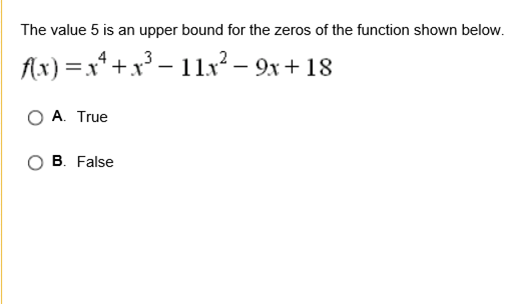
 Vocaloid:
@sillybilly123 can you take a look at this when you get a chance
zarkam21:
True
 sillybilly123:
|dw:1515464547984:dw|
sillybilly123:
there's a pattern in there try x= 1 1 + 1 - 11 - 9 + 18 = 0 then divide it out Voca - short of finding a crystal ball or a magic lamp, do you see a way round this?!?!
sillybilly123:
zarky: start dividing that by \(x-1\) and see what happens
zarkam21:
so divide 1 + 1 - 11 - 9 + 18 = 0 by x-1
sillybilly123:
divide the original quartic by (x-1) ????
zarkam21:
I got \[x^3+2x^2-9x-18\]
sillybilly123:
\(\huge \checkmark\)
zarkam21:
So it would be false?
sillybilly123:
that's just one root! you gotta solve again
zarkam21:
oh okay
sillybilly123:
so try 1, 2, 3, .... and -1, -2, -3,......
zarkam21:
like x-1,x-2,x-3 right?
sillybilly123:
i don't know what you are learning, so maybe just plotting this is an easy way round it. you know...proving that if \(x >5\) then it just keeps increasing. that requires a certaain kind of knowledge but maybe you are just learning how to find roots. so if you could show that \(f(5)>0\) and that \(f'(5) > 0\) you might be sorted.
sillybilly123:
not a mind reader, but what you say sounds sensible :)


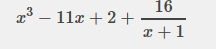
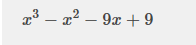
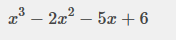 sillybilly123:
sure try this: \((x+3)(x-3)(x+1)(x-1)\)
zarkam21:
so divide the equation given by (x+3)(x−3)(x+1)(x−1)
sillybilly123:
the equation is the product of those terms
sillybilly123:
but I don't see how that is a reasonable answer to the question asked. if you could step back and show that \(f(x) >0\) for all \(x > 5\) ..... that's smarter no idea right now where to start that one though, without jumping upon Calculus. And that is off the menu
sillybilly123:
but yes, factoring the thing shows ALL the zeroes so you can see that the one furthest along the number line is actually x=3 which proves the point they want you to make.
sillybilly123:
zarky: you reasonably happy with that ?!?!
zarkam21:
so true?
sillybilly123:
tops
zarkam21:
true or false
zarkam21:
so @Vocaloid this would be true right, I don't quite understand.
Vocaloid:
I guess it's true judging by what math has been done so far ;;
zarkam21:
Okay thanks, I sometimes don't understand him ^-^
Join our real-time social learning platform and learn together with your friends!
 VERNEISH:
Two objects are moving along separate linear paths where each path is described by position, d, and time, t.
VERNEISH:
Two objects are moving along separate linear paths where each path is described by position, d, and time, t.

 Maci:
what are the best stock apps for people who want to start investing?
Maci:
what are the best stock apps for people who want to start investing?
 Twaylor:
genuienly how do i get better self control i keep watcing youtube and theres this
Twaylor:
genuienly how do i get better self control i keep watcing youtube and theres this
 IzzyCookie:
|dw:1792074056138:dw| Uhm, I don't know where to ask this, but I'm in college welding at my community college, and I need help learning vertical welding for
IzzyCookie:
|dw:1792074056138:dw| Uhm, I don't know where to ask this, but I'm in college welding at my community college, and I need help learning vertical welding for

 thehearken:
not sure if this is considered spam, im sorry if it is, but does anyone have tips
thehearken:
not sure if this is considered spam, im sorry if it is, but does anyone have tips