
 Vocaloid:
Derivation of photon momentum - just need help understanding some intermediate steps
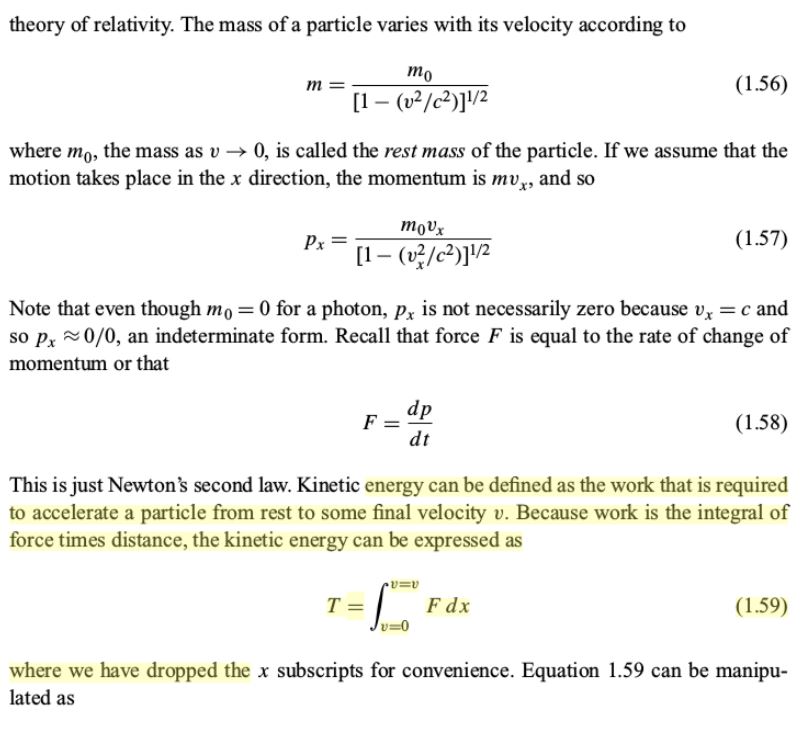
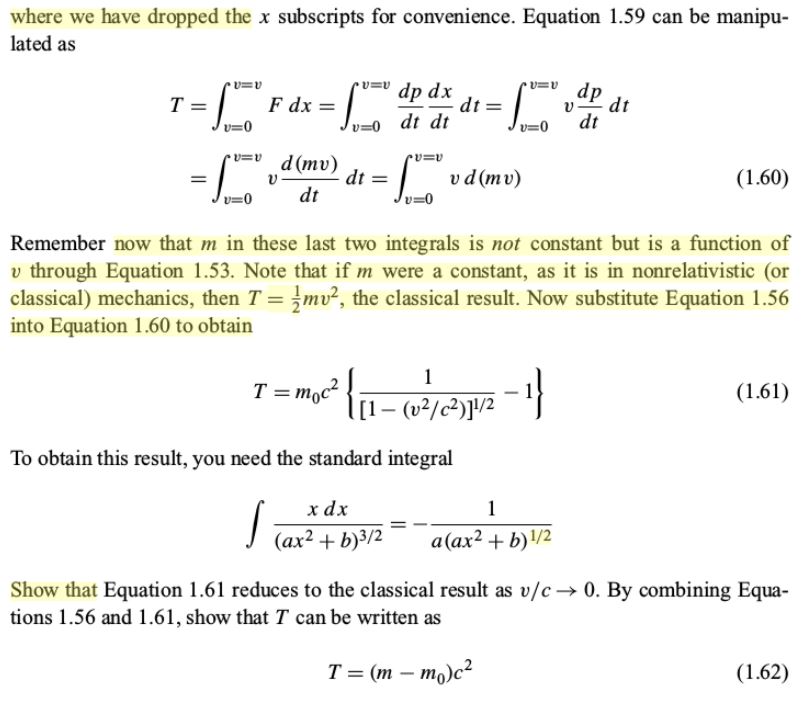 Vocaloid:
@sillybilly123 whenever you get a spare moment
 sillybilly123:
sure 1.62 is the end so you done?!
Vocaloid:
sorry I meant to get to this earlier can you explain steps 1.61 and 1.62, I'm a little lost
sillybilly123:
I'm gonna guess that it's the \(\int v ~ d(mv)\) that is unhelpful. it's lazy. well: \(d(mv) = d\left( \dfrac{m_o v}{\sqrt{1 - (v/c)^2}}\right) \) Quotient Rule: \(= m_o \dfrac{ dv \sqrt{1 - (v/c)^2} - v (1/2) (1 - (v/c)^2)^{- 1/2} (- 2v /c^2) dv}{1 - (v/c)^2 } \) \(= m_o \dfrac{ 1 }{(1 - (v/c)^2)^{3/2} } ~dv\) So: \(\int v ~ d(mv) \equiv m_o \int \dfrac{ v }{(1 - (v/c)^2)^{3/2} } ~dv\) You can now pattern match into their suggested standard integral, it works; BUT that is what Wolfram is for .... AND this is already very do-able if you notice this differentiation pattern: \(\dfrac{d}{dv} \left(\dfrac{ 1 }{(1 - (v/c)^2)^{1/2} }\right) = \dfrac{1}{c^2} \dfrac{ v }{(1 - (v/c)^2)^{3/2} }\) SO: \( m_o \int_0^v \dfrac{ v }{(1 - (v/c)^2)^{3/2} } ~dv = m_o \int_0^v c^2 \dfrac{d}{dv} \left( \dfrac{ 1 }{(1 - (v/c)^2)^{1/2} } \right)~dv\) \( = m_o c^2 \left. \dfrac{ 1 }{(1 - (v/c)^2)^{1/2} } \right|_0^v\) which falls out as: \( = m_o c^2 \left( \dfrac{ 1 }{(1 - (v/c)^2)^{1/2} } - 1 \right) \qquad \star\) For reducing to classical result bit, I would use a Taylor Expansion, AND we can just do it as a Binomial, same thing: \((1 - z)^{-1/2} = 1 + (-1/2) (-z) + (-1/2)(-3/2) (1/ 2!) (-z)^2 + ... \) \(= 1 + \frac{z}{2} + \frac{3z^2}{8} + \mathcal O (z^3)\) So with \(z = (v/c)^2\): \(\star = m_o c^2 \left(1 + \dfrac{v^2}{2c^2} + \dfrac{3v^4}{8 c^4} + ... - 1 \right) = m_o \left( v^2 + \dfrac{3v^4}{8 c^4} + ... \right)\) I hope I got that right, check the arithmetic if it actually matters, but the principle is established... For the very last bit, expand star: \(\star = \dfrac{m_o c^2 }{(1 - (v/c)^2)^{1/2} } - m_o c^2 = mc^2 - m_oc^2 = ....\)
sillybilly123:
There's a much cooler way to do this, found it in Eisberg's QM book, if you're interested. It copies from Feynman's lectures.
Join our real-time social learning platform and learn together with your friends!
 VERNEISH:
Two objects are moving along separate linear paths where each path is described by position, d, and time, t.
VERNEISH:
Two objects are moving along separate linear paths where each path is described by position, d, and time, t.

 Maci:
what are the best stock apps for people who want to start investing?
Maci:
what are the best stock apps for people who want to start investing?
 Twaylor:
genuienly how do i get better self control i keep watcing youtube and theres this
Twaylor:
genuienly how do i get better self control i keep watcing youtube and theres this
 IzzyCookie:
|dw:1792074056138:dw| Uhm, I don't know where to ask this, but I'm in college welding at my community college, and I need help learning vertical welding for
IzzyCookie:
|dw:1792074056138:dw| Uhm, I don't know where to ask this, but I'm in college welding at my community college, and I need help learning vertical welding for

 thehearken:
not sure if this is considered spam, im sorry if it is, but does anyone have tips
thehearken:
not sure if this is considered spam, im sorry if it is, but does anyone have tips