
 RawlsK29:
Can someone please explain to me how to do these problems?
 RawlsK29:
@Vocaloid @563blackghost @Shadow
 563blackghost:
SUMMONED!
563blackghost:
hi :3 i can help :D
RawlsK29:
Lol! I dont understand what i did wrong, and thanks!
563blackghost:
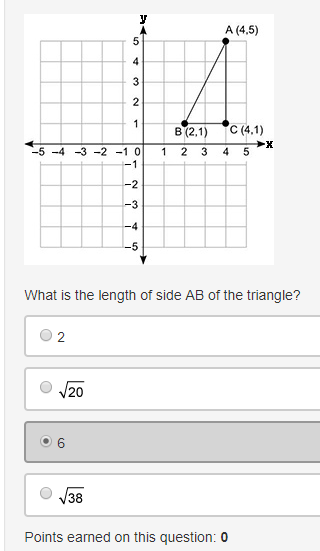
So let's do the first pic first. We would need to use distance formula for the distance between A and B. \(\large\bf{d=\sqrt{(2-4)^{2} + (1-5)^{2}}}\) Simplify this.
RawlsK29:
Ummm... i forgot. Sorry
563blackghost:
We follow by PEMDAS to solve. First we do the paranethesis... \(\large\bf{d=\sqrt{(-2)^{2} + (-4)^{2}}}\) Now we apply the exponent. \(\large\bf{d=\sqrt{(4+16)}}\) What is the distance?
RawlsK29:
oh okay. 20. Now do i square that?
563blackghost:
it would be the \(\large\bf{\sqrt{20}}\)...not just 20...that would be wrong. You cannot square this number perfectly so we keep it as it is...
563blackghost:
so it is B.
RawlsK29:
OMG that was much easier than it looks.
563blackghost:
^-^ try not to think to hard about it, cause most of the time if you do you get it wrong....
563blackghost:
So now on to 2?
RawlsK29:
Yes. the only other answer i think it would be is B, but not sure.
563blackghost:
let meh see first ;)
RawlsK29:
Okay, thx
563blackghost:
so sorry i was afk for a bit...
RawlsK29:
your fine
563blackghost:
wait..
RawlsK29:
okay
563blackghost:
im kind of confused on this one honestly...@Vocaloid can you look at this a bit...
563blackghost:
@Vocaloid
RawlsK29:
Yeah i was pretty confused too
563blackghost:
A is the answer e.e
RawlsK29:
I got it wrong though):
563blackghost:
OH I SEE
563blackghost:
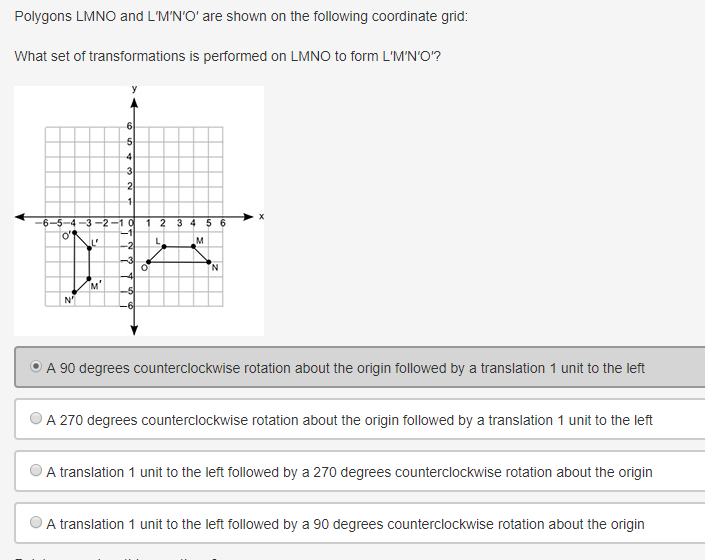
Okay the rule of a counterclockwise rotation of 270 degrees is... \(\large\bf{(x,y) \rightarrow (y,-x)}\) So the transformation of point L is \(large\bf{(2,-2) \rightarrow (-2,-2)}\) We then follow by a 1 unit translation to get `(-2,-3)` so it is B. Just like you said :3
563blackghost:
whoops latex mistake :P
RawlsK29:
Oh okay, i see now.
563blackghost:
that one was tricky >.<
563blackghost:
Next one?
RawlsK29:
Yeah, that confused me.
RawlsK29:
I know the formulas. I am just keep getting something thats not the answer
563blackghost:
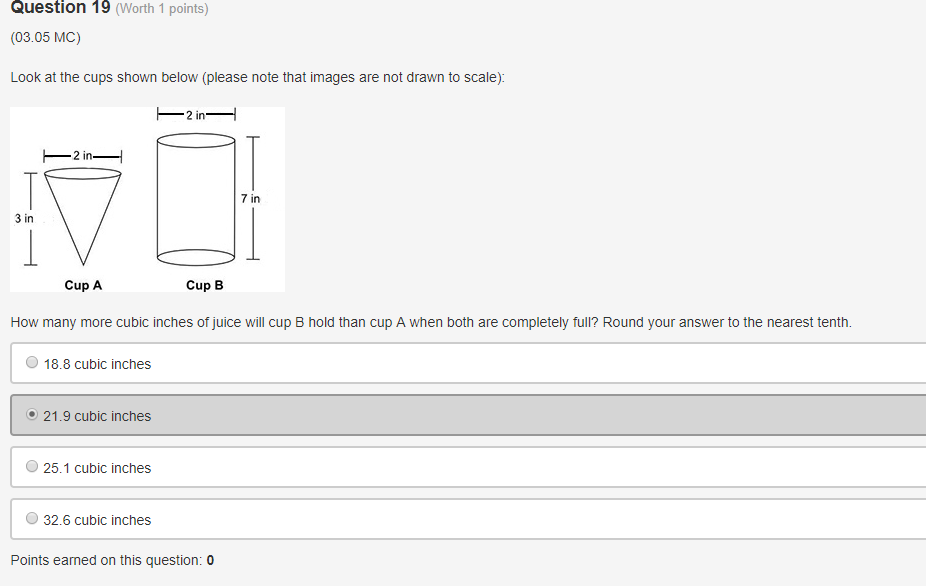
Okay so we need to first identify the volumes of both shapes.. \(\Large\bf{Volume~of~a~cone:V= \frac{1}{3} \pi r^{2} h}\) \(\Large\bf{Volume~Of~a~cylinder: V = \pi r^{2} h}\) So we plug in our information. `remember to find the radius we divide the diameter by 2` \(\Large\bf{Cone: V=\frac{1}{3} (3.14) (1)^{2} 3}\) \(\Large\bf{Cylinder" V=(3.14)1^{2}(7)}\) Can you simplify these?
RawlsK29:
Yes. The cone i got 3.17, and the Cylinder I got 21.98
563blackghost:
Cone was close! It is actually 3.14. The Cylinder volume is correct. Now we must subtract these two to find the difference. \(\large\bf{21.98-3.14=?}\)
RawlsK29:
Wait, what did i do wrong for the cone? and 18.84
RawlsK29:
Oh, i got 9.51. I have no idea how i got that though. (:
563blackghost:
The equation goes by \(\large\bf{V=\frac{1}{3}(3.14)(1^{2})3}\) The \(\large\bf{1^{2}=1}\) and \(\large\bf{\frac{1}{3} \times 3 = 1}\) so we multiply this.... \(\large\bf{V=3.14 \times 1 \times 1 = 3.14}\) Yes 18.84 is correct, so it is A. :D
RawlsK29:
18.84 is the answer. Thank you!
563blackghost:
Your welcome ^_^
Join our real-time social learning platform and learn together with your friends!
 DoltonCarlee:
what are y'all's options on S A T essays because honestly their not that bad
DoltonCarlee:
what are y'all's options on S A T essays because honestly their not that bad

 thereneelg:
Can someone give me a summary of article 231, The war guilt clause?? I need to explain what it is, but I can't find any shortened version of what it is and
thereneelg:
Can someone give me a summary of article 231, The war guilt clause?? I need to explain what it is, but I can't find any shortened version of what it is and
 luisaam2:
What should you do when the person you want to talk to the most is the one making
luisaam2:
What should you do when the person you want to talk to the most is the one making
 Breathless:
https://medal.tv/games/roblox/clips/nAYivIl6oXB6q9QAI?invite=cr-MSxCSk4sMTY4OTA4N
Breathless:
https://medal.tv/games/roblox/clips/nAYivIl6oXB6q9QAI?invite=cr-MSxCSk4sMTY4OTA4N
 Twaylor:
I'm not that good at law can someone fact check this without bias? June 29, 2026, the Supreme Court decided Chatrie v.
Twaylor:
I'm not that good at law can someone fact check this without bias? June 29, 2026, the Supreme Court decided Chatrie v.
 Demon25:
For a hoco proposal with a cheerleader and football player, what else should be a
Demon25:
For a hoco proposal with a cheerleader and football player, what else should be a
