
 zarkam21:
C?
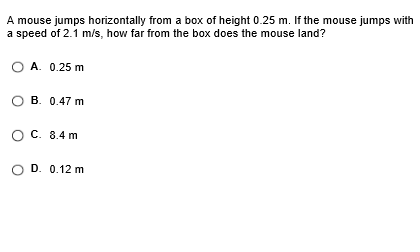 zarkam21:
Because i did 2.1/0.25=8.4
 sillybilly123:
|dw:1516319895792:dw|
 Vocaloid:
you'll have to apply the kinematics equations in both directions to find the time and horizontal distance one moment
Vocaloid:
|dw:1516320025621:dw|
Vocaloid:
you can use equation 3 to find the time spent falling since we know: the vertical distance (delta x or rather, delta y) the initial velocity (which is 0 in the y-direction) and acceleration (which is -g) solve for t
zarkam21:
0.25=0
zarkam21:
2.1 would be the initial velocity right>
Vocaloid:
\(\color{#0cbb34}{\text{Originally Posted by}}\) @Vocaloid you can use equation 3 to find the time spent falling since we know: the vertical distance (delta x or rather, delta y) the initial velocity *** (which is 0 in the y-direction) *** and acceleration (which is -g) solve for t \(\color{#0cbb34}{\text{End of Quote}}\)
Vocaloid:
2.1 is the initial velocity in the x-direction, but we are thinking in terms of the y-direction only, so 0 is your initial velocity
zarkam21:
GOt it
zarkam21:
0.25=0+1/2(-98)t^2
zarkam21:
-9.8*
Vocaloid:
good (I didn't quite get the sign convention right, so let's let 0.25 = (1/2)(9.8)t^2 so t ends up being real not imaginary then solve for t
zarkam21:
0.23
Vocaloid:
good now, since t = 0.23 seconds is the time spent jumping, we use the x-direction velocity and time to calculate distance it's just distance = rate * time = 2.1 * 0.23 = 0.483 m (we rounded up a bit so B is your answer)
zarkam21:
Oh okay so me basically dividing was incorrect
Vocaloid:
yeah the reason why that doesn't work is that the height is vertical and the initial velocity is horizontal, so you can't just divide distance/time
zarkam21:
Got it
Vocaloid:
I'm probably going to log off soon, I'll probably be online tomorrow afternoon ish
zarkam21:
That is fine =) Thank you
Join our real-time social learning platform and learn together with your friends!
 VERNEISH:
Two objects are moving along separate linear paths where each path is described by position, d, and time, t.
VERNEISH:
Two objects are moving along separate linear paths where each path is described by position, d, and time, t.

 Maci:
what are the best stock apps for people who want to start investing?
Maci:
what are the best stock apps for people who want to start investing?
 Twaylor:
genuienly how do i get better self control i keep watcing youtube and theres this
Twaylor:
genuienly how do i get better self control i keep watcing youtube and theres this
 IzzyCookie:
|dw:1792074056138:dw| Uhm, I don't know where to ask this, but I'm in college welding at my community college, and I need help learning vertical welding for
IzzyCookie:
|dw:1792074056138:dw| Uhm, I don't know where to ask this, but I'm in college welding at my community college, and I need help learning vertical welding for

 thehearken:
not sure if this is considered spam, im sorry if it is, but does anyone have tips
thehearken:
not sure if this is considered spam, im sorry if it is, but does anyone have tips