
 22west:
help
 563blackghost:
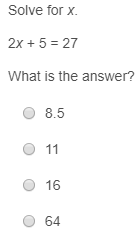
You need to work backwards. \(\large\bf{2x+5=27}\) We see 5 is added to 2x. We need to subtract 5 from both sides. \(\large\bf{2x+5\color{red}{-5} = 27 \color{red}{-5}}\) \(\large\bf{2x=22}\) We see `2` is being multiplied to `x` so we divide by 2 from each side. \(\Large\bf{\frac{2x}{\color{red}{2}} = \frac{22}{\color{red}{2}}}\) what would `x` be?
 tigerlover:
Easy xD
22west:
umm
563blackghost:
Can you see the Latex?
22west:
latex?
563blackghost:
basically can you see the bolded numbers?
22west:
the ones in red
22west:
?
563blackghost:
yea those...do you not understand the process?
22west:
no
563blackghost:
Let's break it down. We have our equation... \(\large\bf{2x+5=27}\) right? We need to solve for `x`. So we need to isolate or get it by itself. So this means we need to get all numbers to one side.
22west:
isolate?
563blackghost:
getting x by itself `x=`
 mplatt:
The answer is x=11. Hope its help.
22west:
dude ur not supposed to give direct answers
563blackghost:
>.> you can't give direct answers @mplatt
22west:
did you not read the terms and conditions?
563blackghost:
We do the opposite of what is being done in the problem. Such as the opposite of adding is subtracting, or the opposite of multiplying is dividing. If we look at our equation we see that `2x` has `+5` so this means that `5` is being `ADDED`. What is the `opposite of addition`?
mplatt:
ok first you subtract 5 for both side then divide and there is your answer.
mplatt:
Better?
 563blackghost:
What answer do you think this one is?
mplatt:
2x+5=27 -5 -5 2x=22 2 2 x=11
22west:
probably c
22west:
@mplatt, @563blackghost is helping me
563blackghost:
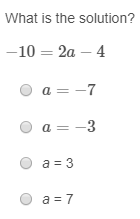
Very close! \(\large\bf{-10=2a-4}\) We add `4` to each side. \(\large\bf{-6=2a}\) Next we divide by `2` from each side. \(\large\bf{a=-3}\) `Remember: do the opposite of what is being done.`
22west:
so i just needed to put the negative there and i would've gotten it?
 mplatt:
-10=2a-4 +4 +4 -6=2a -3=a
22west:
how old are you @mplatt
mplatt:
16 yrs old
22west:
ok you are not helping at all
22west:
hi @ThisGirlPretty
563blackghost:
Well somewhat yes, it seems as though during the division you probably thought it would end in a positive instead of a negative.
22west:
yeah
mplatt:
yea im trying
563blackghost:
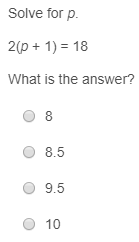
For the `2(p+1)=18` what did you get?
mplatt:
i got 8
22west:
i got 9.5
mplatt:
2(p+1)=18 2p+2=18 -2 -2 2p=16 p=8
mplatt:
\(\color{#0cbb34}{\text{Originally Posted by}}\) @mplatt 2(p+1)=18 2p+2=18 -2 -2 2p=16 p=8 \(\color{#0cbb34}{\text{End of Quote}}\)
 563blackghost:
ok. Well let's see where you went wrong. \(\large\bf{2(p+1)=18}\) Since `p+1` is contained within paranthesis we are unable to mess with that expression as of now. We see that `2` is being multiplied with `p+1` so we would divide by `2` from each side. \(\Large\bf{\frac{2(p+1)}{\color{red}{2}} = \frac{18}{\color{red}{2}}}\) \(\large\bf{p+1=9}\) We now need to subtract `1` from each side since it is being added. \(\large\bf{p=8}\)
22west:
oh ok
22west:
i went wrong at the p + 1 = 9
563blackghost:
i see.
563blackghost:
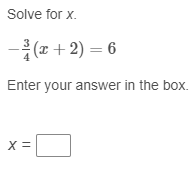
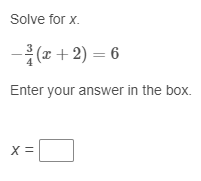
What did you get for \(\large\bf{-\frac{3}{4} (x+2)=6}\) ?
22west:
i haven't done that one yet
22west:
i wasn't sure
563blackghost:
What do you think needs to be done first?
22west:
this is where i get messed up
22west:
im perfectly fine when people are helping me but when they ask me what to do first i get confused
22west:
idk why
563blackghost:
Don't think to hard, being wrong is fine that's why we are here to help >.< What do you believe we should do first?
22west:
the parenthesis?
563blackghost:
Not quiet. You might be thinking of PEMDAS, but for these kinds of equation we go the opposite way. We first start with the fraction.
563blackghost:
Since \(\large\bf{-\frac{3}{4}}\) is being multiplied to the paranthesis what do we do?
22west:
multiply it?
563blackghost:
not quiet, we do the opposite of multiplication. So we would divide. \(\huge\bf{\frac{-\frac{3}{4} (x+2) }{\color{red}{-\frac{3}{4}}}= \frac{6}{\color{red}{-\frac{3}{4}}}}\)
563blackghost:
What does this become now?
22west:
ummmmmmmmmmmm
22west:
and equation
22west:
an*
563blackghost:
Since \(\large\bf{-\frac{3}{4}}\) is being divided by itself it cancels out. \(\LARGE\bf{(x+2) = 6 \div \color{red}{-\frac{3}{4}}}\)
563blackghost:
What is \(\large\bf{6 \div -\frac{3}{4}}\)?
22west:
i have no clue
563blackghost:
Do you have a calculator?
22west:
because i don't know how to divide whole numbers by fractions
22west:
yea
563blackghost:
You can use calculators for these kinds of problems, plug it in.
22west:
ok done
22west:
its on my desktop
563blackghost:
what did you get?
22west:
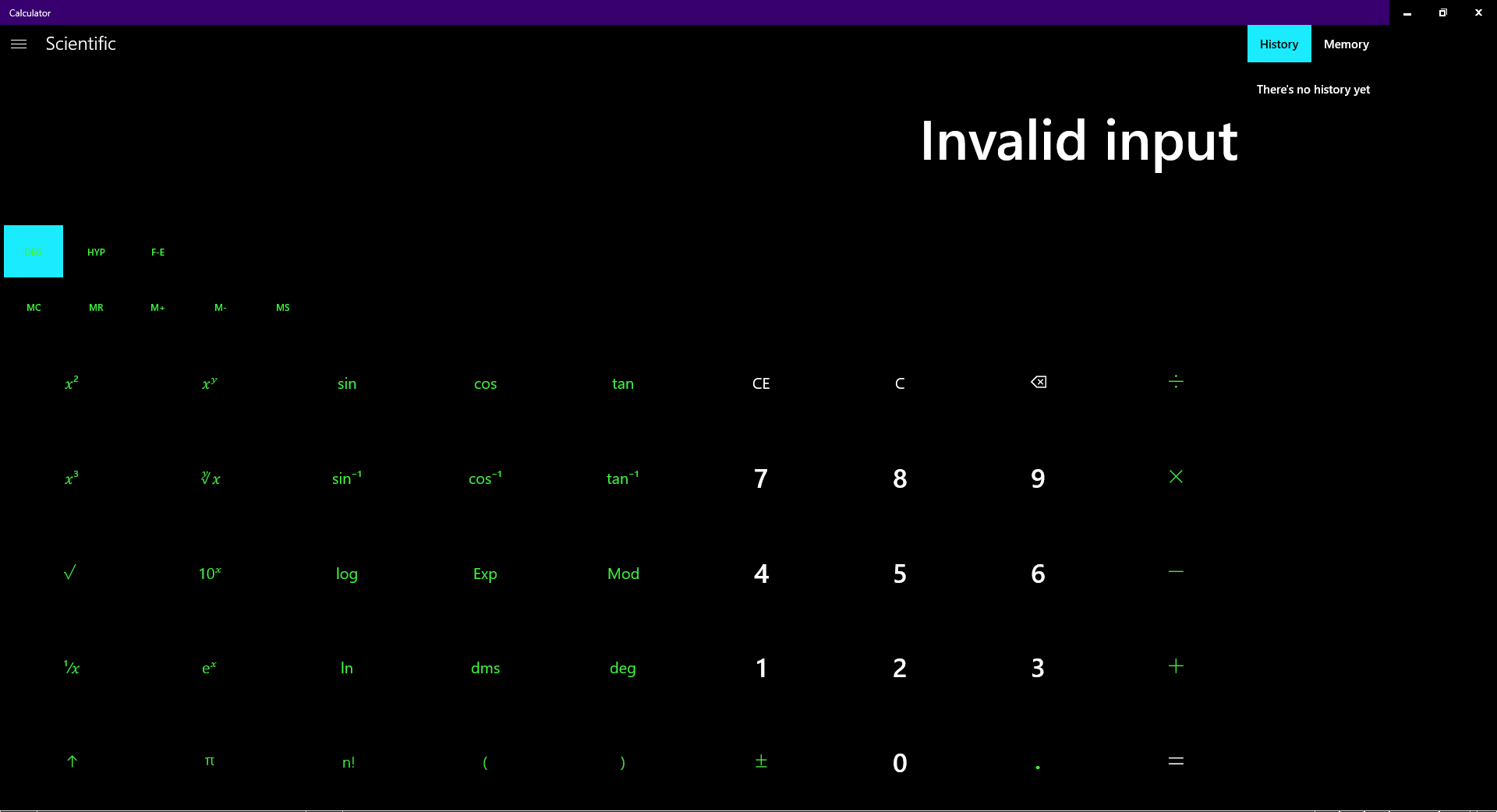
invalid input
 563blackghost:
O.O okay.... Put it as `6 (divide sign) (-3/4)` that should work...
22west:
its doing this: \[6 \div (0 - 3 \div 4)\]
22west:
DUDE YOUR HERE
 dude:
dude:
Crash course on how to divide fractions You can multiply 6 by the reciprocal of the fraction \[6\cdot \frac34 => \frac61 \cdot \frac 43\] \[=> \frac{24}{3}=\boxed{8}\]
22west:
life saver
563blackghost:
-8* we gots a negative fraction dude....
dude:
1 mistake, dont forget about the negative! \[{=-8}\]
dude:
Right
563blackghost:
XD
 563blackghost:
So now you have: \(\large\bf{x+2=-8}\) What do you do now?
22west:
subtract?
563blackghost:
yes, but what?
22west:
2 and -8
563blackghost:
Well we would indeed subtract 2 from -8. \(\large\bf{x+2 \color{red}{-2}=-8 \color{red}{-2}}\) `x` equals what?
22west:
-10
563blackghost:
Yes! Correct!
22west:
thats the answer?
563blackghost:
yup
22west:
oh thank god
563blackghost:
XD
 22west:
last one
563blackghost:
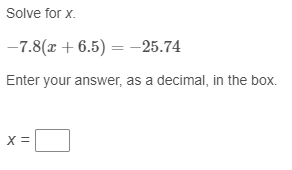
So we have \(\large\bf{-7.8(x+6.5)=-25.74}\) What do we do first? `Look at the problem before as an example.`
22west:
try to find x
563blackghost:
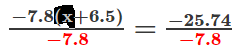
Yes we are finding x, but to do that we first need to do a step. Since `-7.8` is being multiplied to `(x+6.5)` we would need to divide from both sides. \(\LARGE\bf{\frac{-7.8(x+6.5)}{\color{red}{-7.8}} = \frac{-25.74}{\color{Red}{-7.8}}}\) Remember `-7.8/-7.8` cancel out. \(\Large\bf{x+6.5=\frac{-25.74}{\color{red}{-7.8}}}\)
22west:
i found x
563blackghost:
oh really? what is it?
 22west:
seem i found it
22west:
see*
563blackghost:
Make sure to do the division \(\Large\bf{\frac{-25.74}{-7.8}}\).
22west:
ok i really found it
22west:
@563blackghost
563blackghost:
what is the quotient?
22west:
x=-3.2
563blackghost:
correct!
 563blackghost:
WOOT WOOT nice!
22west:
UNCE UNCE UNCE UNCE
563blackghost:
XD
Join our real-time social learning platform and learn together with your friends!
 DoltonCarlee:
what are y'all's options on S A T essays because honestly their not that bad
DoltonCarlee:
what are y'all's options on S A T essays because honestly their not that bad

 thereneelg:
Can someone give me a summary of article 231, The war guilt clause?? I need to explain what it is, but I can't find any shortened version of what it is and
thereneelg:
Can someone give me a summary of article 231, The war guilt clause?? I need to explain what it is, but I can't find any shortened version of what it is and
 luisaam2:
What should you do when the person you want to talk to the most is the one making
luisaam2:
What should you do when the person you want to talk to the most is the one making
 Breathless:
https://medal.tv/games/roblox/clips/nAYivIl6oXB6q9QAI?invite=cr-MSxCSk4sMTY4OTA4N
Breathless:
https://medal.tv/games/roblox/clips/nAYivIl6oXB6q9QAI?invite=cr-MSxCSk4sMTY4OTA4N
 Twaylor:
I'm not that good at law can someone fact check this without bias? June 29, 2026, the Supreme Court decided Chatrie v.
Twaylor:
I'm not that good at law can someone fact check this without bias? June 29, 2026, the Supreme Court decided Chatrie v.
 Demon25:
For a hoco proposal with a cheerleader and football player, what else should be a
Demon25:
For a hoco proposal with a cheerleader and football player, what else should be a
