
 xXMarcelieXx:
help
 xXMarcelieXx:
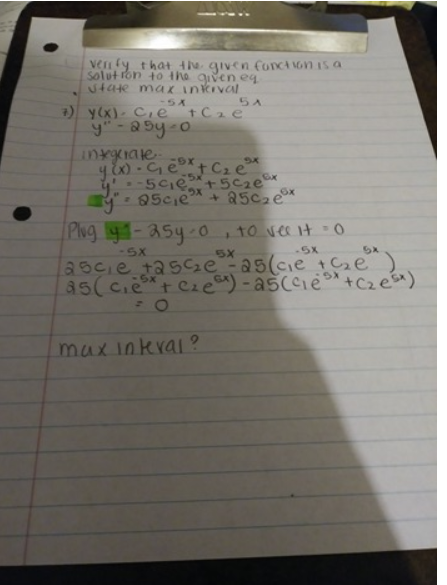
is my work right? and how do i find max
xXMarcelieXx:
@Nnesha
 Nnesha:
looks good ! o^_^o
xXMarcelieXx:
yay but how do i find the max?
Nnesha:
what chapter is t?
xXMarcelieXx:
1.2
xXMarcelieXx:
basic idea and teminology
xXMarcelieXx:
you there D:
 563blackghost:
@Vocaloid
 Zepdrix:
Looks good. I'm not sure why your paper says "integrate" though. You took some derivatives :o
xXMarcelieXx:
its suppose to say diff. lool
 Zepdrix:
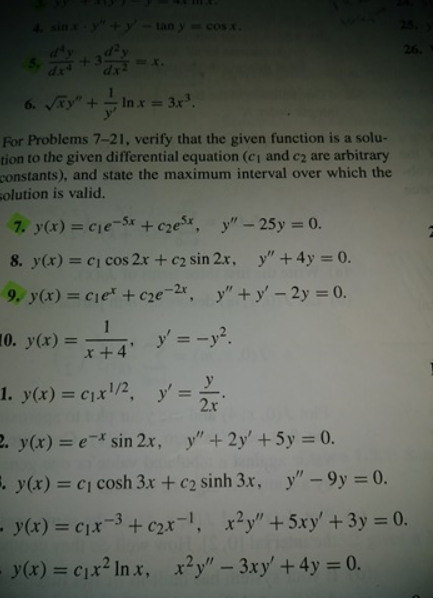
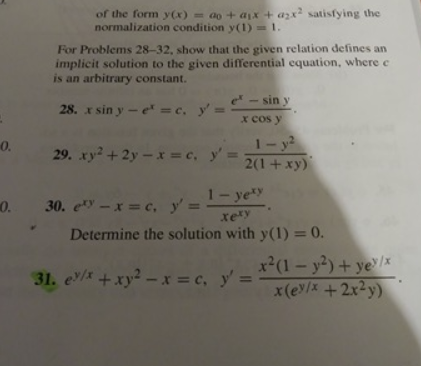
You're given a general solution (on the left) and a differential equation (on the right). Remember in the last one, you had to fill in y'' in order to verify it was a solution. Same idea here, you need to differentiate the thing on the left, and plug it in for y'.
Zepdrix:
This one is a tad trickier though. You have to remember back to first year calculus. Implicit differentiation.
xXMarcelieXx:
oml
xXMarcelieXx:
i started it but i got lost with my work
xXMarcelieXx:
solve the diff eq |dw:1517043883612:dw|
xXMarcelieXx:
@Zepdrix
 sillybilly123:
\(y' = \dfrac{x (y^2 - 1)}{2 (x-2)(x-1)}\) This is separable \(\dfrac{1}{y^2-1}y' = \dfrac{x }{2 (x-2)(x-1)}\) For LHS, use partial fractions: \(\dfrac{1}{y^2-1}y'= \dfrac{y'}{2} \left( \dfrac{1}{y-1} - \dfrac{1}{y+1} \right)\) And \( \dfrac{1}{2} \int \dfrac{1}{y-1} - \dfrac{1}{y+1} ~ dy = \dfrac{1}{2} \ln \dfrac{y-1}{y+1} + c_1\) For RHS, kinda the same: \( \dfrac{x }{2 (x-2)(x-1)} = \dfrac{1}{2} \left(\dfrac{x - 1 + 1}{ (x-2)(x-1)} \right) \) \(= \dfrac{1}{2} \left(\dfrac{1}{x-2} + \dfrac{ 1}{ (x-2)(x-1)} \right) \) \(= \dfrac{1}{2} \left(\dfrac{1}{x-2} + \dfrac{1}{x-2} - \dfrac{1}{x-1} \right) \) So RHS is: \(\dfrac{1}{2} \int \dfrac{2}{x-2} - \dfrac{1}{x-1} ~ dx\) \(\ = \ln (x-2) - \frac{1}{2} \ln (x-1) + c_2 \) LHS = RHS and combining integration constants: \(\dfrac{1}{2} \ln \dfrac{y-1}{y+1} = \ln \dfrac{x-2}{\sqrt{x-1}} + C \) we can say \(\ln k = C\) so \(\dfrac{1}{2} \ln \dfrac{y-1}{y+1} = \ln \dfrac{ k (x-2)}{\sqrt{x-1}} \) And that is: \( \dfrac{y-1}{y+1} = \dfrac{ k' (x-2)^2}{x-1} \) That finishes off as: \( y-1 = (y + 1) \dfrac{ k' (x-2)^2}{x-1} \) \( y( 1 -\dfrac{ k' (x-2)^2}{x-1}) =1 + \dfrac{ k' (x-2)^2}{x-1} \) \(y = \dfrac{x-1 + k' (x-2)^2 }{x- 1 - k' (x-2)^2}\) If you are just learning how to do ODE's. this is a bad way to go about it. turgid, tedious algebra is no fun for anyone.
Nnesha:
`is there any x value where y is undefined ? for that exponential function x cna be any real number and exponential is defined for all real numbers so the solution is valid over the (-infinity, infinity )
xXMarcelieXx:
how would you do that partial fraction... i got lost there
sillybilly123:
work through this, AND MAKE A POINT OF doing the questions at the end: https://www.mathsisfun.com/algebra/partial-fractions.html the basic idea in this problem, taking the LHS s the example, we had: \(\dfrac{1}{y^2 - 1}\) we factor \(=\dfrac{1}{(y - 1)(y+1)}\) We imagine that that came from adding 2 prior fractions, so \(\dfrac{1}{(y - 1)(y+1)} = \dfrac{A}{y - 1} + \dfrac{B}{y+1} \) We multiply each side by \((y - 1)(y+1)\) So we say that: \(1 = A(y + 1) + B(y -1) \) then we say: - let y = -1 so 1 = -2B - let y = 1 so 1 = 2A from whence we conclude that: \(\dfrac{1}{y^2 - 1} =\dfrac{1}{(y - 1)(y+1)}=\dfrac{1}{2} \left( \dfrac{1}{y - 1} - \dfrac{1}{y+1} \right)\) which we can integrate easily.....that is why we decompose complicated stuff into simpler fractions in integral calculus but do the mathisfun stuff. first. PS: when you think you get all of that, look at this: https://math.stackexchange.com/questions/165118/how-does-partial-fraction-decomposition-avoid-division-by-zero and then explain it to me because I don't get that bit at all. partial fracion decomp makes no sense really :( but it works
xXMarcelieXx:
so we can factor out the 1/2?
xXMarcelieXx:
when do we use partial fractions
sillybilly123:
to decompose fractions into simpler ones that we can integrate
sillybilly123:
So: \(\int \dfrac{1}{y^2 - 1} ~ dy\) looks hard [unless you know the Hyperbolic functions] But: \( \dfrac{1}{2} \int \dfrac{1}{y - 1} - \dfrac{1}{y+1} ~ dy\) looks easy cos it's just natural logs
sillybilly123:
you can do this one with a substitution too, but the only one i can think of is hyperbolic
xXMarcelieXx:
oh
sillybilly123:
if this is about learning to solve 1st order ODE's, why not forget about the algebra for a minute and try these ones, which I just made up: \(1 \qquad y' = \dfrac{x}{y}\) \(2 \qquad y' = \dfrac{y}{x}\) \(3 \qquad y' = e^{y + x}\) \(4 \qquad y' - 4 y = 29\)
xXMarcelieXx:
@sillybilly123 can u clarify how u got the steps for the ln
xXMarcelieXx:
im confused bc i got this |dw:1517103542722:dw|
sillybilly123:
times each side by 2
xXMarcelieXx:
can you show me that step please ..
sillybilly123:
sure
xXMarcelieXx:
and guide me through the steps please. :)
sillybilly123:
starting from where?
xXMarcelieXx:
where u said multiply by 2
xXMarcelieXx:
@sillybilly123 D:
sillybilly123:
and there's @BlankSpace right up there !!!
xXMarcelieXx:
wait what D:
 BlankSpace:
someone called?
xXMarcelieXx:
\[\frac{ 1 }{ 2 }\ln (y-1)+\frac{ 1 }{ 2 }\ln( y+1)= \frac{ 1 }{ 2 }\ln(x-2)-\ln(x-2)\]
xXMarcelieXx:
im asking about number 9 which thats what i got for partial fractions but im still confuse on the algebra part.. so can you walk me through it lol
xXMarcelieXx:
@sillybilly123
Join our real-time social learning platform and learn together with your friends!
 VERNEISH:
Two objects are moving along separate linear paths where each path is described by position, d, and time, t.
VERNEISH:
Two objects are moving along separate linear paths where each path is described by position, d, and time, t.

 Maci:
what are the best stock apps for people who want to start investing?
Maci:
what are the best stock apps for people who want to start investing?
 Twaylor:
genuienly how do i get better self control i keep watcing youtube and theres this
Twaylor:
genuienly how do i get better self control i keep watcing youtube and theres this
 IzzyCookie:
|dw:1792074056138:dw| Uhm, I don't know where to ask this, but I'm in college welding at my community college, and I need help learning vertical welding for
IzzyCookie:
|dw:1792074056138:dw| Uhm, I don't know where to ask this, but I'm in college welding at my community college, and I need help learning vertical welding for

 thehearken:
not sure if this is considered spam, im sorry if it is, but does anyone have tips
thehearken:
not sure if this is considered spam, im sorry if it is, but does anyone have tips