
 zarkam21:
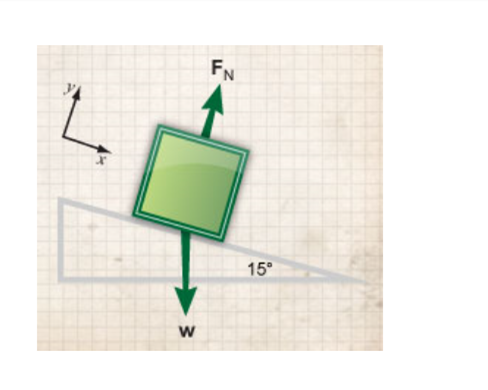
Duane has a mass of 73 kg and slides down an icy hill on a sled. The hill has a slope of 15° and there is no friction. The free-body diagram is shown below. a. Write the expression for the net force in the x-direction. b. Write the expression for the net force in the y-direction. c. What is the acceleration in the y-direction? d. What is the normal force acting on him?
 moreso:
Do you have the free body diagram?
 Vocaloid:
first you have to resolve these forces into horiz/vertical components, keeping in mind the tilted axis|dw:1517440633207:dw|
Vocaloid:
|dw:1517440639293:dw|
Vocaloid:
the component of gravity down the slide is wsin(15) so overall we have: net force in x-direction = Fg - Ff = wsin(15) - Ff net force in the y-direction = Fn - Fg = Fn - wcos(15) since a and b are just asking to set up the expression leave it like that
Vocaloid:
for c) set the y-direction expression equal to ma and solve for acceleration d) set the x-direction expression equal to 0 since the box stays on the x-axis, then solve for normal force
zarkam21:
BAck!
zarkam21:
Okay a is Fg - Ff = wsin(15) - Ff
Vocaloid:
good might wanna stick a ΣFy just to be claer so ΣFy = Fg - Ff = wsin(15) - Ff
Vocaloid:
Fx sorry
Vocaloid:
other one would be ΣFy = Fn - Fg = Fn - wcos(15)
zarkam21:
ΣFx = Fg - Ff = wsin(15) - Ff
zarkam21:
for a right
Vocaloid:
ye
zarkam21:
sorry just double checking
zarkam21:
okay now for c
zarkam21:
m*a right
zarkam21:
f=m*a
Vocaloid:
yeah I would actually recommend starting d) first since you need the normal force first
Vocaloid:
I wish we could edit our posts but you need to set the expression for y-direction force (not x) equal to 0 and solve for Fn
Vocaloid:
so Fn - wcos(15) = 0 where w is the weight (mg) solve for normal force Fn
zarkam21:
Fn - 715.4)cos(15) = 0
Vocaloid:
good, Fn = ?
zarkam21:
691.02
Vocaloid:
good, so N let's go back to a and b b/c I just re-read the problem and there's no friction so we need to get rid of the Ff term
Vocaloid:
net force in x-direction = Fg = wsin(15) net force in the y-direction = same as before
zarkam21:
a. Write the expression for the net force in the x-direction. (2 points) Fg = wsin(15) b. Write the expression for the net force in the y-direction. (2 points) ΣFy = Fn - Fg = Fn - wcos(15) c. What is the acceleration in the y-direction? (1 point) d. What is the normal force acting on him? (2 points) Fn - 715.4)cos(15) = 0 Fn=691.02N
Vocaloid:
good to find the acceleration in the y-direction just set ΣFy = ma and solve for a we determined w and Fn (normal force) earlier
zarkam21:
Σ(691.02)y = (73)a
Vocaloid:
691.01 is the normal force not the net force the net force in the y direction is Fn - wcos(15) Fn - (mg)cos(15) = ma
zarkam21:
691.01n - (715.4)cos(15)
Vocaloid:
hm. I'm getting weird numbers for this :S let me review my work
zarkam21:
Sure, take your time
Vocaloid:
ugh of course, since the axis is tilted the box doesn't move up or down with respect to the tilted axis so acceleration is just 0 m/s/s
zarkam21:
Got it so c is 0 m/s/s
Vocaloid:
yeah (tilted axes always mess me up since I typically use a horizontal/vertical axis)
zarkam21:
OK thanks !!
zarkam21:
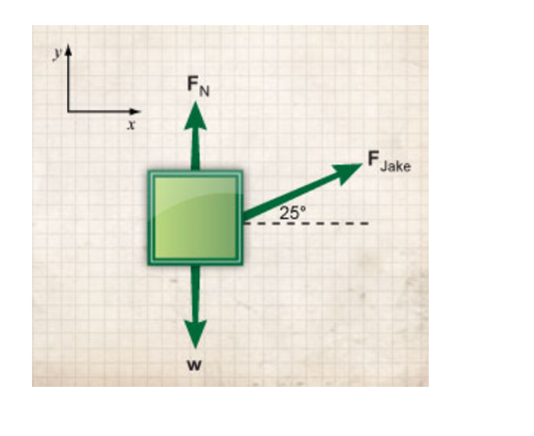
Jake pulls a couch of mass 38 kg across his apartment. He pulls on the couch at an angle of 25° with a force of 300 N. The free-body diagram is shown below. a. What is the x-component of his applied force? b. What is the y-component of his applied force? c. Assuming the couch does not leave the ground, what is the normal force acting on the couch?
 Vocaloid:
x component = Fcos(theta) y component = Fsin(theta) (this is generally true for an object sitting on a flat surface, for tilted slopes we might have to think differently)
zarkam21:
x component = 300cos(25)=271.9 y component = 300sin(25) =126.79
Vocaloid:
good, units are N as usual for c) the net force in the y direction is 0 (box is not moving up or down) so Fn + Fsin(theta) - mg = 0 solve for Fn
zarkam21:
Fn + 300sin(25) - 38(9.8) = 0
Vocaloid:
good, solve for fn
zarkam21:
245.61
zarkam21:
N
Vocaloid:
yeah good
zarkam21:
Mazie stands on her kitchen floor. The coefficient of kinetic friction between her socks and the floor is 0.35, and the coefficient of static friction is 0.42. She has a mass of 58 kg. a. What is the maximum force of static friction between her socks and the floor? b. If you push Mazie with a force of 200 N, will she start to slide? Explain your answer. c. Mazie slides across the floor at a speed of 1.3 m/s. What is the force of kinetic friction acting on her?
zarkam21:
58*0.42
Vocaloid:
mu = coefficient of friction (not mass * u) static friction = normal force * mu normal force = mg in this case
zarkam21:
wait so for a i would multiply right
Vocaloid:
normal force = mg static friction = μ*mg = ?
zarkam21:
so mg=58*9.8
Vocaloid:
yes, keep going
zarkam21:
578.2
Vocaloid:
good, keep going
zarkam21:
static friction = μ*578.2 = ?
Vocaloid:
good, keep going
zarkam21:
for u i would substitute one of the forces?
Vocaloid:
μ is the coefficient of static friction
zarkam21:
0.42*578.2 = 242.844
Vocaloid:
good, 242.844 N for b) since static friction = 242.844 is more than the applied force 200N she does ~not~ slide
Vocaloid:
for c) calculate μN except this time use the coefficient of kinetic friction for μ
zarkam21:
0.35*242.844
Vocaloid:
good, then just evaluate that to get the ans
zarkam21:
85
Vocaloid:
good, 85 N since this is a force
zarkam21:
You slide a hockey puck across the ice in a hockey rink. The puck gradually slows down as it moves. How does Newton's first law explain the motion of the puck?
Vocaloid:
newton's first law - object doesn't change motion unless a force acts upon it - so there must be a force (friction) slowing it down
zarkam21:
could you check my answer
zarkam21:
In the case of a puck sliding across the ice: it slows down because of the friction force between ice and puck. This friction force is the external force spoken about in the 1st Law, above and is the reason the puck eventually stops moving.
Vocaloid:
awesome
Join our real-time social learning platform and learn together with your friends!
 VERNEISH:
Two objects are moving along separate linear paths where each path is described by position, d, and time, t.
VERNEISH:
Two objects are moving along separate linear paths where each path is described by position, d, and time, t.

 Maci:
what are the best stock apps for people who want to start investing?
Maci:
what are the best stock apps for people who want to start investing?
 Twaylor:
genuienly how do i get better self control i keep watcing youtube and theres this
Twaylor:
genuienly how do i get better self control i keep watcing youtube and theres this
 IzzyCookie:
|dw:1792074056138:dw| Uhm, I don't know where to ask this, but I'm in college welding at my community college, and I need help learning vertical welding for
IzzyCookie:
|dw:1792074056138:dw| Uhm, I don't know where to ask this, but I'm in college welding at my community college, and I need help learning vertical welding for

 thehearken:
not sure if this is considered spam, im sorry if it is, but does anyone have tips
thehearken:
not sure if this is considered spam, im sorry if it is, but does anyone have tips