
 zarkam21:
Help please
 Vocaloid:
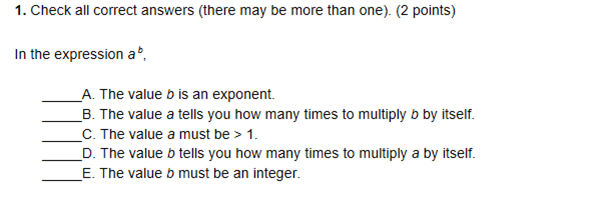
it says nothing about whether a or b have to be positive/negative/integers/whatever you only know that b is an exponent and that means b is the number that says how many times to multiply a by itself so A+D
 Vocaloid:
|dw:1517462564775:dw|
Vocaloid:
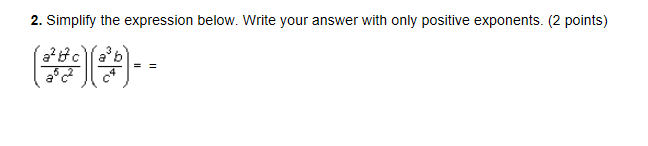
just start off with the a terms use rule 1 + 2 to simplify (a^2 * a^3)/(a^5)
Vocaloid:
gonna go to sleep tag me again when you're awake
zarkam21:
@Vocaloid I'm back
Vocaloid:
\(\color{#0cbb34}{\text{Originally Posted by}}\) @Vocaloid just start off with the a terms use rule 1 + 2 to simplify (a^2 * a^3)/(a^5) \(\color{#0cbb34}{\text{End of Quote}}\) have you made any progress on this?
zarkam21:
well this simplified would be a^5
Vocaloid:
the numerator becomes a^5 so (a^5)/(a^5) = ?
zarkam21:
1
Vocaloid:
good, now we move on to the b terms b * b^2 = ?
zarkam21:
b^3
Vocaloid:
good, now we move on to the c terms c/(c^2 * c^4) = ?
zarkam21:
1/c^5
Vocaloid:
good so putting everything together --> b^3/c^5 --> your answer
zarkam21:
thank you
zarkam21:
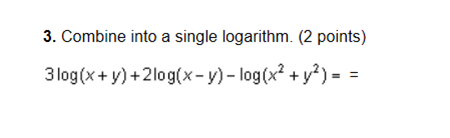
\[\log (\frac{ (x+y)^3(x-y)^2 }{ x^2+y^2 })\]
zarkam21:
is this the right answer for this
 Vocaloid:
yup good
 Vocaloid:
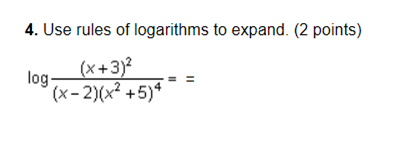
it's basically just the reverse of what you just did, separate the components of the log then drop the exponent down as coefficients
Vocaloid:
2log(x+3)... then continue with the rest of the log
 Vocaloid:
the website is trying to expand the logarithm all the way even though it's probably not needed 2log(x+3) - log(x-2) - 4log(x^2+5) is what they are looking for
zarkam21:
rewrite as an exponential equation \[\ln (x+y)=5\]
Vocaloid:
raise both sides to the power of e
zarkam21:
e^5=x+y
Vocaloid:
good but you might want to re-write that as y = e^5 - x so it looks like an equation of y in terms of x
zarkam21:
rewrite as an logarithmic equation 2^4=(a-b)
Vocaloid:
|dw:1517497396050:dw|
Vocaloid:
y = (a - b), b is the base 2 and x is the exponent 4 re-write in the log form
zarkam21:
log2(a-b)=4
Vocaloid:
good
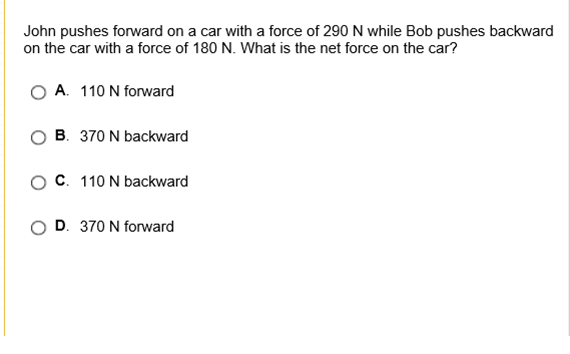 zarkam21:
I'm sorry not this one
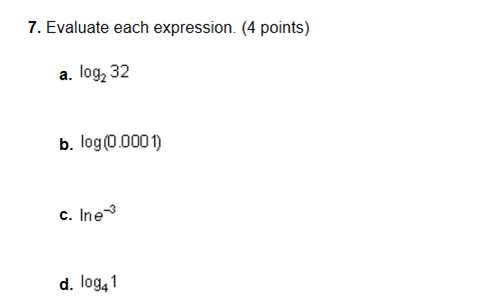 zarkam21:
a. 5 b. -4 c. -3 d. 0
Vocaloid:
well done
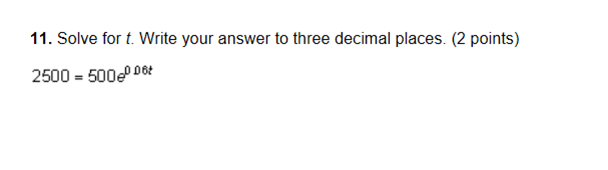 zarkam21:
I dont know how to solve this for t
Vocaloid:
divide both sides by 500 first then take the natural log of each side then dividing by 0.06 will isolate t
zarkam21:
4.709
Vocaloid:
check your calculations again let's just take it one step at a time, divide both sides by 500 and lmk what you get
zarkam21:
5=e^0.06t
Vocaloid:
good, now take the natural log of each side
zarkam21:
wait is it 26....?
Vocaloid:
good but it wants 3 decimal places so your answer would be...?
zarkam21:
26.824
Vocaloid:
good, that's it
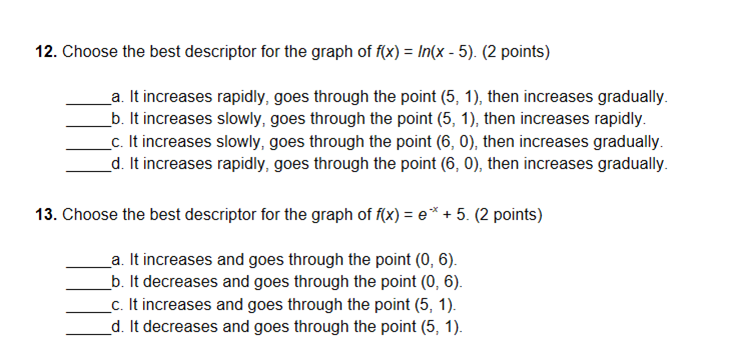 Vocaloid:
since ln(0) is undefined which two choices can you eliminate right off the bat?
zarkam21:
um c
Vocaloid:
what value of x will make ln(x-5) = ln(0)?
zarkam21:
oh a and b
Vocaloid:
good, a and b are out the actual behavior of ln(x-5) show that it increases quickly before crossing (6,0) so D is the best choice
Vocaloid:
for 13 if we plug in x = 0 we get 6, making A and B possible candidates since the exponent is -x it will keep decreasing as x ---> infinity so B
zarkam21:
=)
 Vocaloid:
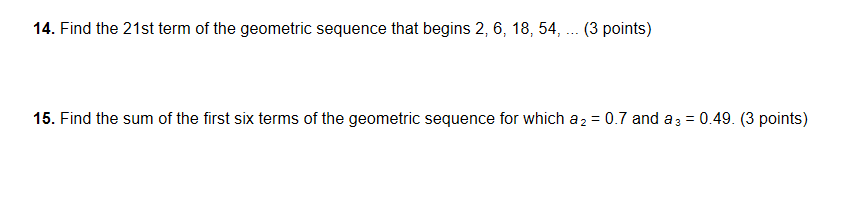
14 - what is the common ratio?
zarkam21:
x3
Vocaloid:
good (just 3) so r = 3 a1 = first term = 2 use nth term = a1 * r ^ (n-1) to find the nth term
zarkam21:
2 * 3 ^ (n-1)
Vocaloid:
good try to remember what n stands for
zarkam21:
21
Vocaloid:
good, n = 12 so evaluate 2 * 3 ^ (n-1)
zarkam21:
69735
Vocaloid:
you left off some digits, it's a very big #
zarkam21:
6973568802
Vocaloid:
good
Vocaloid:
for 15 figure out the common ratio by dividing a3/a2
zarkam21:
0.7
Vocaloid:
good, now we need to figure out what a1 is if a1 * r = a2 then what is a1?
zarkam21:
a1 * r = 0.7
zarkam21:
would r be 6?
Vocaloid:
we calculated r earlier
zarkam21:
0.7
zarkam21:
a1 * 0.7= 0.7 a1=1
Vocaloid:
awesome now you have everything you need|dw:1517499714775:dw| evaluate sum
zarkam21:
so sn=1(1-0.7^n/1-0.7)
Vocaloid:
yes, keep going
 Vocaloid:
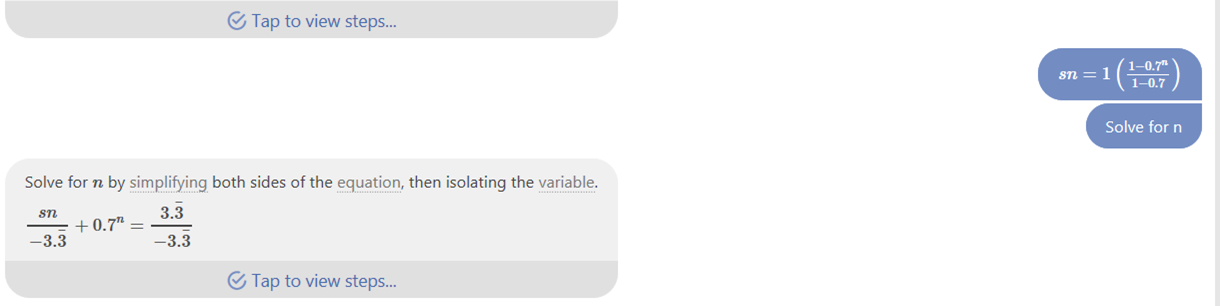
remember what n stands for also don't enter sn into the formula, it will treat sn as s*n
Vocaloid:
just enter this part 1(1-0.7^n/1-0.7) and replace n w/ the appropriate value
zarkam21:
n is 0.7?
Vocaloid:
n is the number of terms r is 0.7.
zarkam21:
6?
Vocaloid:
good, now evaluate the expression
zarkam21:
0.74
Vocaloid:
check your calculations again, the answer is much bigger than that
Vocaloid:
(1-0.7^6)/(1-0.7) = ?
zarkam21:
2.94
Vocaloid:
good but let's try to leave as many digits as possible so 2.94117
zarkam21:
okay rewrite using radicals\[(a^\frac{ 3 }{ 4 })^5\]
zarkam21:
i got\[(4 \sqrt{a^3})^5\]
Vocaloid:
yeah, that's right (just make sure the 4 is sitting on the radical sign not out in front) also I"m not sure if they'd want you to multiply that 5 through the exponent but let's go with your answer
zarkam21:
rewrite using radical exponents\[\sqrt[5]{x^2}\]
Vocaloid:
basically it's the reverse of the earlier problem, the exponent becomes the numerator of the fraction-exponent and the radical becomes the denominator
zarkam21:
\[x^\frac{ 2 }{ 5 }\]
Vocaloid:
good
zarkam21:
If you deposit $1,000 into an account that pays 4% interest compounded continuously, how long will it take the account to grow to $2,000?
Vocaloid:
A = Pe^rt solve for t
zarkam21:
A = Pe^rt we are given A, P and r: 2000 = 1000e^0.04t divide both sides by 1000: 2 = e^0.04t take Napierian log of both sides: ln2 = 0.04t divide both sides by 0.04: t = ln2/0.04 ~ 17.33 years or 17years 4 months
zarkam21:
is this right
Vocaloid:
yeah that's good
 Vocaloid:
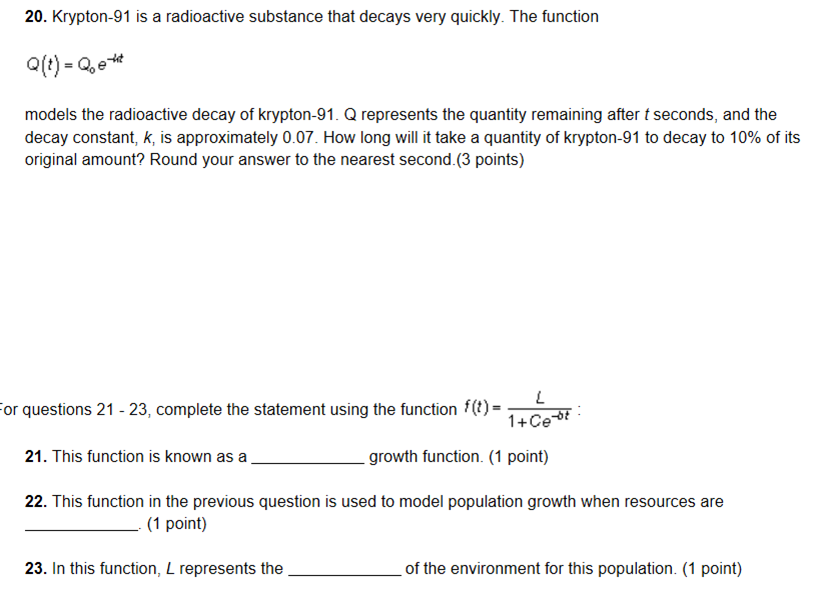
we want to know when Q(t) = 0.10Q_0 so plug in 0.10Q_0 for Q(t) and solve for t, you're given everything else and Q_0 should cancel out on both sides
zarkam21:
0.1
Vocaloid:
check your calculations again, it should be much bigger than that 0.10Q_0 = Q_0 * e^(-0.07t) solve for t
zarkam21:
0.10= * e^(-0.07t)
zarkam21:
um what would e be?
Vocaloid:
e is euler's number and always has this value |dw:1517501608878:dw|
Vocaloid:
the software you are using should have e automatically programmed into it, look for an italicized e
zarkam21:
32.89
Vocaloid:
this gives me 38 seconds (since they want it rounded up to the nearest second)
zarkam21:
yeah its probably my mistake in calculations
Vocaloid:
for 21 they're probably looking for "exponential" 22 - "limited" 23 - probably 'carrying capacity"
zarkam21:
Thank you so much
Join our real-time social learning platform and learn together with your friends!
 VERNEISH:
Two objects are moving along separate linear paths where each path is described by position, d, and time, t.
VERNEISH:
Two objects are moving along separate linear paths where each path is described by position, d, and time, t.

 Maci:
what are the best stock apps for people who want to start investing?
Maci:
what are the best stock apps for people who want to start investing?
 Twaylor:
genuienly how do i get better self control i keep watcing youtube and theres this
Twaylor:
genuienly how do i get better self control i keep watcing youtube and theres this
 IzzyCookie:
|dw:1792074056138:dw| Uhm, I don't know where to ask this, but I'm in college welding at my community college, and I need help learning vertical welding for
IzzyCookie:
|dw:1792074056138:dw| Uhm, I don't know where to ask this, but I'm in college welding at my community college, and I need help learning vertical welding for

 thehearken:
not sure if this is considered spam, im sorry if it is, but does anyone have tips
thehearken:
not sure if this is considered spam, im sorry if it is, but does anyone have tips