
 zarkam21:
Help please
 Vocaloid:
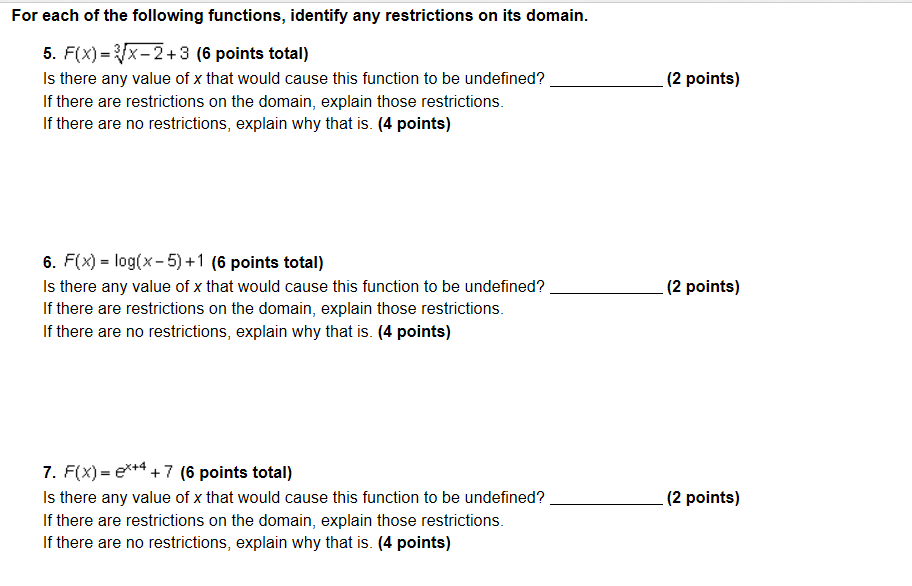
any restrictions on x? keep in mind this is a cube root not a square root function
zarkam21:
Um 0
Vocaloid:
the cube root can be taken for any x-value, positive or negative (cube root of 0 is still defined) so no restrictions on x
Vocaloid:
for 6: what value of x makes the log undefined?
zarkam21:
5
Vocaloid:
good, since x = 5 makes the inside of the log 0 it's undefined there for 7: any restrictions on x?
zarkam21:
um 7?
Vocaloid:
does putting x = 7 make the function undefined?
zarkam21:
no
zarkam21:
would it be maybe a negative number
zarkam21:
idk I'm having trouble with this one
Vocaloid:
good e^x doesn't have any restrictions on its domain (x can be positive or negative) so e^(x+4) + 7 doesn't have any restrictions either
Vocaloid:
that's it for 5,6,7
zarkam21:
so no restrictions ofr 7
Vocaloid:
yup that's correct
Vocaloid:
also change #6 to x cannot be 5 ~~~or less~~~ since logs need to be positive
zarkam21:
oh so i would not put anything for the restriction and just write x cannot be 5 or less since logs need to be positive
zarkam21:
or do i put 5 as the restriction and then add this explanation
Vocaloid:
x cannot be 5 or less
zarkam21:
Got it !
Vocaloid:
"x < 5" "x must be greater than 5 because the input/argument for a log must be positive"
zarkam21:
okay and for this
 zarkam21:
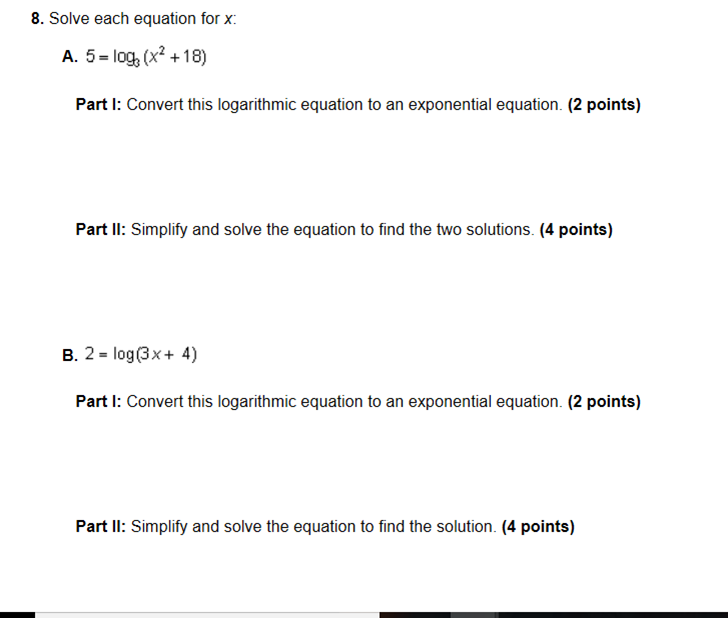
8A Part I 3^5=x^2+18 Part II x=15,-15
Vocaloid:
yup good
zarkam21:
B Part I 10^2=3x+4 Part II x=32
Vocaloid:
good
zarkam21:
I'm having a hard time with C PArt I
Vocaloid:
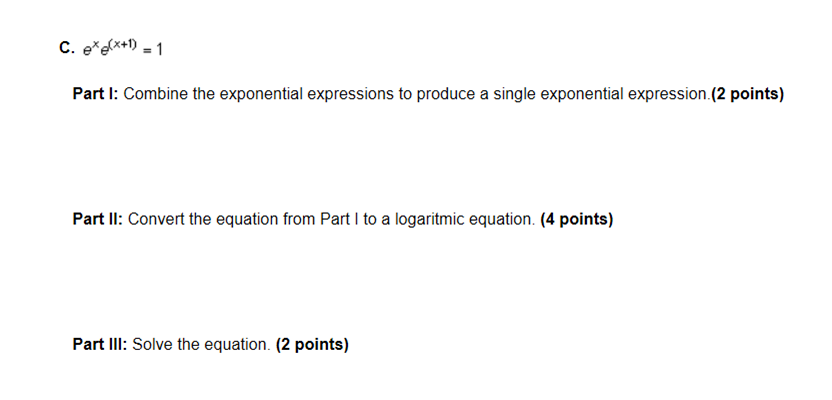
first use the exponent rules to combine the e's into one e expression
zarkam21:
e^x^2+1?
Vocaloid:
the rule is to add the exponents not multiply them
zarkam21:
2x?
Vocaloid:
what is x + x + 1?
zarkam21:
3x
Vocaloid:
combine like terms
zarkam21:
oh shoot I'm sorry
zarkam21:
2x+1
zarkam21:
2x+1
Vocaloid:
good so e^(2x+1) = 1 is your soln' for part I to convert this to a log for part II take the natural log of both sides
zarkam21:
I dont even know what i was doing there :/
zarkam21:
x=-0.5
Vocaloid:
good that's part III but for part II they only want the log expression so 2x + 1 = ln(1) is your soln' for part II
zarkam21:
loge(1)=2x+1
zarkam21:
oh okay
Vocaloid:
yeah that works too, loge is the same as ln
 zarkam21:
i would just solve for n right
zarkam21:
and substitute 5 for n
Vocaloid:
hold up a sec
Vocaloid:
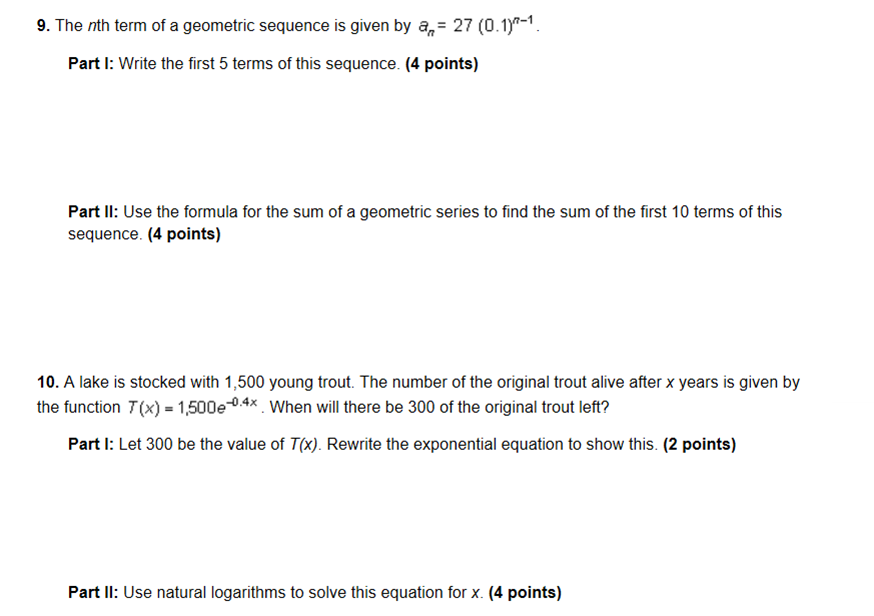
judging by the equation, the first term is 27, and the common ratio is 0.1 so start with 27, multiply by 0.1 to get 2.7, then just keep multiplying by 0.1 until you have a list of the first five terms
zarkam21:
27,2.7,0.27,0.027,0.0027
Vocaloid:
good, now we just use the geometric sum formula to find the sum of the first ten terms|dw:1517503960910:dw|
zarkam21:
29.9
Vocaloid:
good
zarkam21:
okay
Vocaloid:
for 10 part I it's just asking you to re-write the original equation with 300 instead of T(x)
zarkam21:
300=1500e^-0.4x
Vocaloid:
yeah just like that for part II it just wants you to solve for x divide both sides by 1500 and then take the natural log of both sides, then divide by -0.4
zarkam21:
loge(300)=-0.4x
Vocaloid:
300/1500 = ?
zarkam21:
0.2
Vocaloid:
good so ln(0.2) = -0.04x solve for x
zarkam21:
40.24
Vocaloid:
good so about 40 years 3 months ish
 Vocaloid:
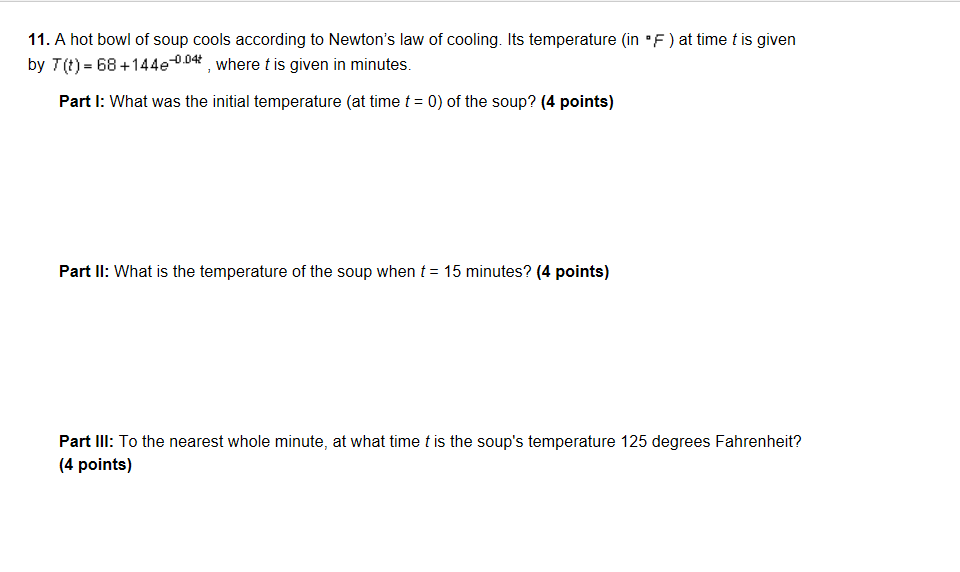
for parts I/II you just need to plug in t = 0 and t = 15 into the equation, respectively
zarkam21:
212
zarkam21:
and
zarkam21:
330.39
Vocaloid:
awesome for part III just set T(t) = 125 and solve for t
zarkam21:
-23.17
Vocaloid:
good (you probably forgot the negative sign on 0.04) t = 23 (needs to be positive since this is time)
Vocaloid:
anyway I should probably go I have some stuff to take care of
Join our real-time social learning platform and learn together with your friends!
 VERNEISH:
Two objects are moving along separate linear paths where each path is described by position, d, and time, t.
VERNEISH:
Two objects are moving along separate linear paths where each path is described by position, d, and time, t.

 Maci:
what are the best stock apps for people who want to start investing?
Maci:
what are the best stock apps for people who want to start investing?
 Twaylor:
genuienly how do i get better self control i keep watcing youtube and theres this
Twaylor:
genuienly how do i get better self control i keep watcing youtube and theres this
 IzzyCookie:
|dw:1792074056138:dw| Uhm, I don't know where to ask this, but I'm in college welding at my community college, and I need help learning vertical welding for
IzzyCookie:
|dw:1792074056138:dw| Uhm, I don't know where to ask this, but I'm in college welding at my community college, and I need help learning vertical welding for

 thehearken:
not sure if this is considered spam, im sorry if it is, but does anyone have tips
thehearken:
not sure if this is considered spam, im sorry if it is, but does anyone have tips