
 xXMarcelieXx:
solve the diff eq
xXMarcelieXx:
\[x^2y'-4xy=x^7 sinx\]
xXMarcelieXx:
@Zepdrix
xXMarcelieXx:
how do we know which type of diff eq to use?
 Zepdrix:
Mmm can you give me that link again? That pdf. The one that talked about the matching "degrees". Cause it looks like that's what we have going on here: x^2 and xy are the same "degree".
Zepdrix:
Oh it's in my messages box :D nevermind. one sec
xXMarcelieXx:
i was thinking we could use the first order diff eq where we have an integration factor
Zepdrix:
One sec im a little rusty XD I think integrating factor is the right way to go. Just need to do it on paper real quick hehe.
xXMarcelieXx:
okie ;p
Zepdrix:
Ok ok ok I think I'm remembering :d So ya... this is a first order linear differential equation. Let's divide the x's off the first term and try an integrating factor,\[\large\rm y'-\frac4xy=x^5\sin x\]
Zepdrix:
So our D.E. is in this form:\[\large\rm y'+py=q\] And what we want to do is multiply by some value u,\[\large\rm uy'+(pu)y=q\]such that pu is the derivative of u. That way we have a perfect product rule in reverse,\[\large\rm uy'+u'y=uq\]Which we simplify using our product rule,\[\large\rm (uy)'=uq\]And do some integration. So the derivative of u needs to be equivalent to pu. That's what gives us all this magic. \(\large\rm u'=pu\) Doing some stuff will eventually get you to the realization that a substitution of the form:\[\large\rm u=e^{\int\limits p~dx}\]will suffice. If that's too much detail, I apologize :P We can just use that last part that I mentioned.
Zepdrix:
So ... recognize that the subtraction sign will be a part of our substitution,\[\large\rm y'+\color{orangered}{\left(-\frac4x\right)}y=x^5 \sin x\]
Zepdrix:
\[\huge\rm u=e^{\int\limits \color{orangered}{\left(-\frac4x\right)}~dx}\]
Zepdrix:
Can you figure out the u value for me? :D Simplify it down. Come on Macha! Lemme see you do it!
xXMarcelieXx:
arghh wait its not posting
Zepdrix:
Hmm you're kinda close :)
Zepdrix:
|dw:1517622337547:dw|
xXMarcelieXx:
oh yeh.. ;p
Zepdrix:
You can't apply your e^lnx=x thing until you've gotten the -4 out of the way.
Zepdrix:
Ok so that's our integrating factor. Let's multiply through by x^-4
Zepdrix:
\[\large\rm \frac{1}{x^4}y'-\frac{4}{x^5}y=x \sin x\]Ok with that step? Make sure you're getting the same thing. (Don't forget to multiply the RIGHT SIDE by x^-4 as well.)
xXMarcelieXx:
okie
Zepdrix:
If we have the right integrating factor, then the left side should simplify to (uy)' by product rule in reverse,\[\large\rm \left(\frac{1}{x^4}y\right)'=x \sin x\]
Zepdrix:
You can check your work by applying product rule,\[\large\rm \left(\frac{1}{x^4}y\right)'\quad=\quad \left(\frac{1}{x^4}\right)'y+\left(\frac{1}{x^4}\right)y'\]Which gives us,\[\large\rm \left(\frac{1}{x^4}y\right)'\quad=\quad \left(-\frac{4}{x^5}\right)y+\left(\frac{1}{x^4}\right)y'\]So ya, good times.
Zepdrix:
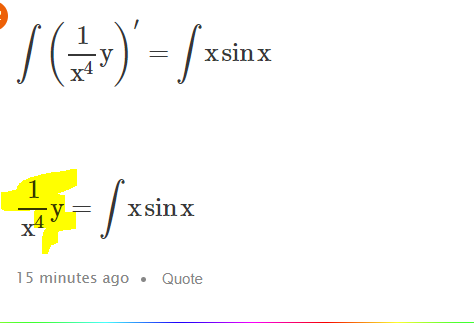
So now integrate,\[\large\rm \int\limits\left(\frac{1}{x^4}y\right)'=\int\limits x \sin x\] \[\large\rm \frac{1}{x^4}y=\int\limits x \sin x\]
Zepdrix:
Right side will require ummm .. integration by parts. Hopefully you remember that from Calc 2, because you'll be using it a lot in this class :D
Zepdrix:
You want to DESTROYYYYY the x, so that will be your u, While the sinx will just cycle around, so that's our dv. Then du = dx and v = -cosx And apply your IBP: int(u dv) = uv - int(v du)
Zepdrix:
I'll write that information down again if it helps: \[\large\rm u=x\]\[\large\rm dv = \sin x~dx\]and \[\large\rm du=dx\]\[\large\rm v=-\cos x\]
Zepdrix:
\[\large\rm \int\limits x \sin x~dx\quad=\quad uv-\int\limits v~du\]\[\large\rm \int\limits x \sin x~dx\quad=\quad -x \cos x-\int\limits -\cos x~dx\]
Zepdrix:
\[\large\rm \int\limits\limits x \sin x~dx\quad=\quad -x \cos x+\sin x\]
Zepdrix:
So then,\[\large\rm \frac{1}{x^4}y=\int\limits\limits x \sin x\]gives us,\[\large\rm \frac{1}{x^4}y=-x~\cos x+\sin x + C\]And multiplying through by x^4 will give us our general solution,\[\large\rm y=-x^5~\cos x+x^4\sin x + x^4C\]
xXMarcelieXx:
is this the final answer xD
Zepdrix:
Yes.
xXMarcelieXx:
question how did this happen again? was it bc the integral canceled with the y'?
 Zepdrix:
The prime (derivative) was being applied to the whole thing, not just the y. So careful with that :O it's not just a y'. But yes, integration is 'anti-differentiation'. So you're taking the anti-derivative of a derivative :) They are inverses of one another and essentially "cancel out"
xXMarcelieXx:
oh okie
 Zepdrix:
I've never seen the movie, so the reference is a little lost on me lol I've always enjoyed Big Vikings comedic style since they took over YoWorld tho x'D
xXMarcelieXx:
yeh lmaooo the tie though hahaha
Join our real-time social learning platform and learn together with your friends!
 VERNEISH:
Two objects are moving along separate linear paths where each path is described by position, d, and time, t.
VERNEISH:
Two objects are moving along separate linear paths where each path is described by position, d, and time, t.

 Maci:
what are the best stock apps for people who want to start investing?
Maci:
what are the best stock apps for people who want to start investing?
 Twaylor:
genuienly how do i get better self control i keep watcing youtube and theres this
Twaylor:
genuienly how do i get better self control i keep watcing youtube and theres this
 IzzyCookie:
|dw:1792074056138:dw| Uhm, I don't know where to ask this, but I'm in college welding at my community college, and I need help learning vertical welding for
IzzyCookie:
|dw:1792074056138:dw| Uhm, I don't know where to ask this, but I'm in college welding at my community college, and I need help learning vertical welding for

 thehearken:
not sure if this is considered spam, im sorry if it is, but does anyone have tips
thehearken:
not sure if this is considered spam, im sorry if it is, but does anyone have tips