
 xXMarcelieXx:
i got stuck here with my logs
xXMarcelieXx:
\[-2\ln(v-1)+3\ln(v-2)=-\ln|(x)|+c\]
xXMarcelieXx:
then i made some sub with v= y/x which i got this \[3\ln(\frac{ y }{ x }-2)-2\ln(\frac{ y }{ x }-1)=-\ln|x|+c\]
xXMarcelieXx:
@Zepdrix
 bm717:
Still hasn't noticed smh
xXMarcelieXx:
lol he will come eventually x'D so no worries
bm717:
Hopefully Can't help you bc too hard for my brain
 Zepdrix:
Oh you're trying to solve for y, yes?
Zepdrix:
\[\large\rm 3\ln\left[\frac{y}{x}-2\right]-2\ln\left[\frac{y}{x}-1\right]=-\ln|x|+c\]Apply your coefficient/exponent rule for logs, whatever it's called,\[\large\rm \ln\left[\left(\frac{y}{x}-2\right)^3\right]-\ln\left[\left(\frac{y}{x}-1\right)^2\right]=-\ln|x|+c\]
Zepdrix:
Then apply your subtraction/division rule for logs,\[\large\rm \ln\left[\frac{\left(\frac{y}{x}-2\right)^3}{\left(\frac{y}{x}-1\right)^2}\right]=-\ln|x|+c\]
Zepdrix:
Then exponentiate,\[\large\rm \frac{\left(\frac{y}{x}-2\right)^3}{\left(\frac{y}{x}-1\right)^2}=e^{-\ln|x|+c}\]
xXMarcelieXx:
how come the right side didnt cancel with the e
Zepdrix:
It will, but we have to split up the exponent first.\[\large\rm \frac{\left(\frac{y}{x}-2\right)^3}{\left(\frac{y}{x}-1\right)^2}=e^{-\ln|x|}\cdot e^c\]And also deal with the negative in front,\[\large\rm \frac{\left(\frac{y}{x}-2\right)^3}{\left(\frac{y}{x}-1\right)^2}=e^{\ln|x^{-1}|}\cdot e^c\]Now they can "cancel out",\[\large\rm \frac{\left(\frac{y}{x}-2\right)^3}{\left(\frac{y}{x}-1\right)^2}=\frac{1}{x}\cdot e^c\]
Zepdrix:
We'll simply that last part by calling it something else,\[\large\rm \frac{\left(\frac{y}{x}-2\right)^3}{\left(\frac{y}{x}-1\right)^2}=\frac{1}{x}\cdot C\]Where C is non-zero, I suppose. Blah whatever, let's just try to get to some answer :D lol
Zepdrix:
Multiplying by our denominator,\[\large\rm \left(\frac{y}{x}-2\right)^3=\frac{1}{x}\cdot C\cdot \left(\frac{y}{x}-1\right)^2\]
Zepdrix:
To be honest, it's probably easier to do all of these previous steps leaving v as v.
Zepdrix:
\[\large\rm \left(v-2\right)^3=\frac{1}{x}\cdot C\cdot \left(v-1\right)^2\]
xXMarcelieXx:
oh yeah thats right e.e
Zepdrix:
And then ummm.. hmm <.< Do we have to expand and do all that ugly business? Hmmm
xXMarcelieXx:
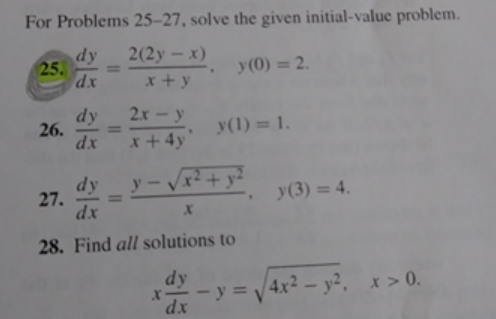
hmmmm it also says y(0) = 2 :3 .. do you wanna see the original problem
Zepdrix:
Yes pls
 Zepdrix:
Mmmm I'm getting a little stuck ... It doesn't seem like you can make the substitution v=y/x because v is not defined at x=0. So y(0)=2 doesn't work for our substitution. Hmm
xXMarcelieXx:
right hmmm
Zepdrix:
Oh... I guess this one is non-linear. https://www.wolframalpha.com/input/?i=y%27(x)%3D(2*(2y(x)-x)%2F(x%2By(x))),+y(0)%3D2 So we're not going to be able to get a solution y(x). We'll have to leave it as something ugly, I think :U Hmm
xXMarcelieXx:
yeh D:
Zepdrix:
Weird my link broke :|
xXMarcelieXx:
D:
 sillybilly123:
at a glance, that looks very do-able. so, i copied and pasted, and it blows up Wolfram. now, isn't that interesting?!?! personally, i'd give it another go.
Zepdrix:
Were you able to get an answer Macha? It's pretty straight forward from this point,\[\large\rm \left(\frac{y}{x}-2\right)^3=\frac{1}{x}\cdot C\cdot \left(\frac{y}{x}-1\right)^2\] Just a few simple Algebra steps :)
xXMarcelieXx:
yeah i got that x'D so then D:
Zepdrix:
Ok this next step might be a lil confusing. Just try to think. It would be nice if we could get the x's out of the denominators. See how we have a bunch of y/x stuff? Ya let's try to clean that up. So think.... what is the largest power of x in the denominators?
xXMarcelieXx:
hmmm we would have to factor it right
Zepdrix:
No, don't do that.
Zepdrix:
Just try to think ahead, what is the largest power of x in the denominators?
xXMarcelieXx:
1?
Zepdrix:
|dw:1517792926401:dw|It's 3.
Zepdrix:
So we'll multiply both sides by x^3 to clean things up.
xXMarcelieXx:
woah how did that happen x'D
Zepdrix:
You have to THINK AHEAD. If you were to expand everything out, then (y/x)^3 would be the largest term, yes? So x^3 is the biggest degree of x in a denominator.
xXMarcelieXx:
oh yeah thats right
Zepdrix:
\[\large\rm \color{orangered}{x^3}\cdot\left(\frac{y}{x}-2\right)^3=\color{orangered}{x^3}\cdot\frac{1}{x}\cdot C\cdot \left(\frac{y}{x}-1\right)^2\]
Zepdrix:
Simplify the x's on the right,\[\large\rm \color{orangered}{x^3}\cdot\left(\frac{y}{x}-2\right)^3=x^2\cdot C\cdot \left(\frac{y}{x}-1\right)^2\]
Zepdrix:
So ... another tricky Algebra step... You want to bring this x into the cube.
Zepdrix:
|dw:1517793261543:dw|
Zepdrix:
You lose that 3rd power when you bring the x into the cube. I hope the a,b,c picture helps to illustrate why.
Zepdrix:
|dw:1517793332309:dw|
Zepdrix:
Same type of thing will happen on the right side, you're bring a squared x into a square.
Zepdrix:
\[\large\rm x^3\left[\left(\frac{y}{x}-2\right)\right]^3=Cx^2 \left[\left(\frac{y}{x}-1\right)\right]^2\] \[\large\rm \left[x\left(\frac{y}{x}-2\right)\right]^3=C\left[x\left(\frac{y}{x}-1\right)\right]^2\]And then distribute the x to each term in the round brackets,\[\large\rm \left[y-2x\right]^3=C\left[y-x\right]^2\]
xXMarcelieXx:
oh okay that makes sense. so then
Zepdrix:
When they provide us with the information y(0)=2, it means that the point (0,2) satisfies this differential equation. So we can plug in the point (0,2) to solve for C.
Zepdrix:
\[\large\rm \left[2-2\cdot0\right]^3=C\left[2-0\right]^2\]
Zepdrix:
\[\large\rm [2]^3=C[2]^2\]\[\large\rm 2=C\]
Zepdrix:
Go BACK to your general solution, \[\large\rm \left[y-2x\right]^3=C\left[y-x\right]^2\]and plug this new found C value in,\[\large\rm \left[y-2x\right]^3=2\left[y-x\right]^2\] Boom there it is. You've found the solution to this differential equation which corresponds with the specific data they provided.
xXMarcelieXx:
yay ;p
xXMarcelieXx:
zeppers how would you write this ? (320.7 million) (72.36)
xXMarcelieXx:
@Zepdrix
Zepdrix:
I don't understand what you're asking. Do you need to multiply, and then convert to scientific notation?
xXMarcelieXx:
well i have to multiply it
Zepdrix:
(320.7 million) x (72.36) = (320.7 x 72.36) million = 23205.852 million Which could be written in billions like this == 23.205852 billion
xXMarcelieXx:
would the 320.7 million be written as 320 700 000?
Zepdrix:
Yes :)
xXMarcelieXx:
would the 72.36 be considered as a million too?
Zepdrix:
No, I don't think so.
xXMarcelieXx:
aahh okay so how did you get a billion? i got this 2.3205852E10
Zepdrix:
E is a weird calculator notation. It means your number is being multiplied by 10 to this E(xponent) power. For example: 2.44E5 is really \(\large\rm 2.44\times10^5\) 2.773E3 is really \(\large\rm 2.773\times10^3\) So your number, 2.3205852E10 is really \(\large\rm 2.3205852\times10^{10}\)
Zepdrix:
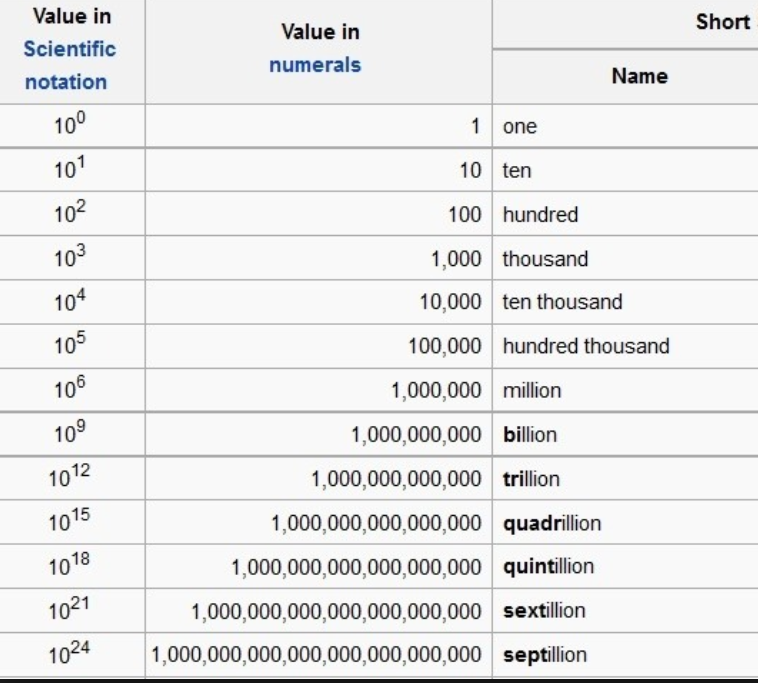
Try to get comfortable with your powers of 10. 10 to the 6 power is a million. 7.4E6 is really \(\large\rm 7.4\times10^6\) which is 7.4 million. 10 to the power 9 is a billion. 2.3205852E9 is really \(\large\rm 2.3205852\times10^9\) which is 2.3205852 billion. If we multiply that value by 10 (because we have E10 not E9) we just move the decimal place one to the right.
 Zepdrix:
Yes :)
xXMarcelieXx:
ah okay so then im assuming that 10 ^9 , 10 ^10 , 10^11 is known as a billion
Zepdrix:
Yes. 10^9 is billions 10^10 is ten billions 10^11 is hundred billions
Join our real-time social learning platform and learn together with your friends!
 DoltonCarlee:
what are y'all's options on S A T essays because honestly their not that bad
DoltonCarlee:
what are y'all's options on S A T essays because honestly their not that bad

 thereneelg:
Can someone give me a summary of article 231, The war guilt clause?? I need to explain what it is, but I can't find any shortened version of what it is and
thereneelg:
Can someone give me a summary of article 231, The war guilt clause?? I need to explain what it is, but I can't find any shortened version of what it is and
 luisaam2:
What should you do when the person you want to talk to the most is the one making
luisaam2:
What should you do when the person you want to talk to the most is the one making
 Breathless:
https://medal.tv/games/roblox/clips/nAYivIl6oXB6q9QAI?invite=cr-MSxCSk4sMTY4OTA4N
Breathless:
https://medal.tv/games/roblox/clips/nAYivIl6oXB6q9QAI?invite=cr-MSxCSk4sMTY4OTA4N
 Twaylor:
I'm not that good at law can someone fact check this without bias? June 29, 2026, the Supreme Court decided Chatrie v.
Twaylor:
I'm not that good at law can someone fact check this without bias? June 29, 2026, the Supreme Court decided Chatrie v.
 Demon25:
For a hoco proposal with a cheerleader and football player, what else should be a
Demon25:
For a hoco proposal with a cheerleader and football player, what else should be a
