
 NotJay:
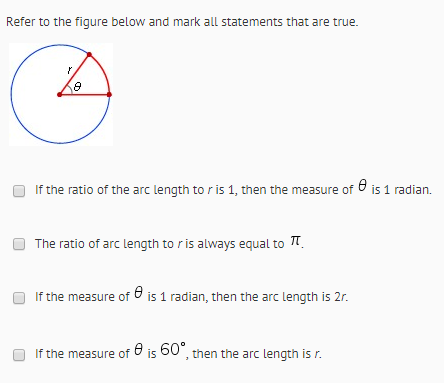
Refer to the figure below and mark all statements that are true.
 NotJay:
@dude @haleyelizabeth2017
 ThisGirlPretty:
@Nnesha
ThisGirlPretty:
@563blackghost
 563blackghost:
sorry i went afk for a while >.< i know it just trying to write out an explanation >.<
NotJay:
?
563blackghost:
s = arc length The equation is s = \({\theta}\)r where it becomes \({\theta}\)=s/r. If \({\theta}\) = 1 radians then s/r = 1. So A is an answer.
563blackghost:
I think C is too but I dont know >.<
 Zepdrix:
Hmm ya A looks good. C. If the measure of theta=1, then... \(\large\rm s=r\cdot\theta\qquad\to\qquad s=r\) then the arc length is r, ya? So clearly C is false.
Zepdrix:
I skipped a step in the middle, r*theta gets replaced by r*1 which is simply r.
Zepdrix:
D. If theta is 60 degrees, then... \[\large\rm s=r\cdot \theta\qquad\to\qquad s=r\cdot \frac{60\cdot \pi}{180}\]I guess we would need to convert to radians, ya? Are you familiar with that process? :o \[\large\rm s=\frac{\pi}{3}\cdot r\] So then the arclength is equal to pi/3*r not just r Do D is false as well. What do you think? Too confusing? :O
NotJay:
*head slowly breaking* So B is also false, right?
NotJay:
@Zepdrix
Join our real-time social learning platform and learn together with your friends!
 VERNEISH:
Two objects are moving along separate linear paths where each path is described by position, d, and time, t.
VERNEISH:
Two objects are moving along separate linear paths where each path is described by position, d, and time, t.

 Maci:
what are the best stock apps for people who want to start investing?
Maci:
what are the best stock apps for people who want to start investing?
 Twaylor:
genuienly how do i get better self control i keep watcing youtube and theres this
Twaylor:
genuienly how do i get better self control i keep watcing youtube and theres this
 IzzyCookie:
|dw:1792074056138:dw| Uhm, I don't know where to ask this, but I'm in college welding at my community college, and I need help learning vertical welding for
IzzyCookie:
|dw:1792074056138:dw| Uhm, I don't know where to ask this, but I'm in college welding at my community college, and I need help learning vertical welding for

 thehearken:
not sure if this is considered spam, im sorry if it is, but does anyone have tips
thehearken:
not sure if this is considered spam, im sorry if it is, but does anyone have tips