
 zarkam21:
Help
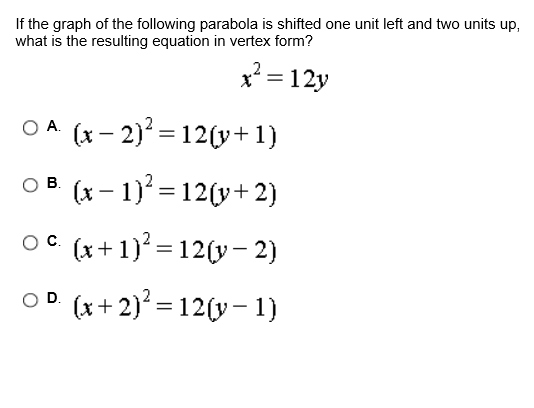 zarkam21:
B
zarkam21:
@Vocaloid
zarkam21:
because left would be the x-axis and going up would be the y axis
 Vocaloid:
for parabolas written in this form, it's the opposite of what we normally expect 12y = x^2 y = (1/12)x^2 12(y+1) = x^2 becomes 12y + 12 = x^2 which becomes 12y = x^2 - 12 which becomes y = (12)(x^2 - 1) a downward shift, the opposite of what we expected from adding 1 to y so in order to shift 2 up, we need to subtract 2 from y and to shift right we need to subtract 1 from x so C not B
 zarkam21:
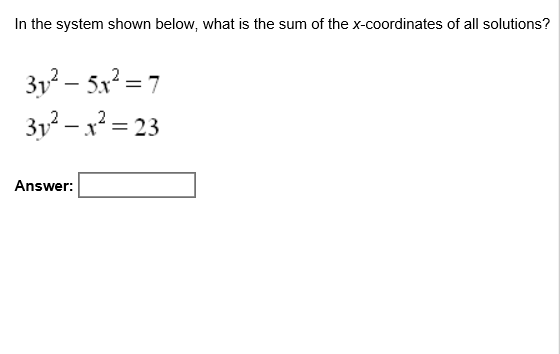
I would just work with the 5 and -x right?
Vocaloid:
whenever you take the square root of something you get +A, - A, or 0, making the sum 0
 Vocaloid:
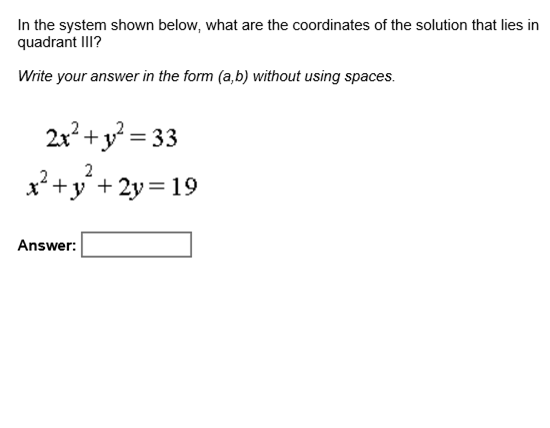
first you have to double the second equation and eliminate the x^2 terms, then half the second equation to eliminate the y^2 terms, then you'll be left with y to solve for
zarkam21:
(-4,-3)
Vocaloid:
yeah nvm that's right
zarkam21:
Thanks
zarkam21:
0?
 Vocaloid:
good
Vocaloid:
can we actually go back to this problem for a sec, I plugged in your answer and it didn't end up working :S
Vocaloid:
|dw:1517935602661:dw|
Vocaloid:
2x^2 + y^2 = 33 2x^2 + 2y^2 + 4y = 38 y^2 + 4y = 5 after we factor this we get y = 1 and y = -5, then we need to plug this back into the equation to get the possible x values
Vocaloid:
plugging in y = -5 gives x = -2, making the quadrant III solution (-2,-5)
zarkam21:
Okay thanks
zarkam21:
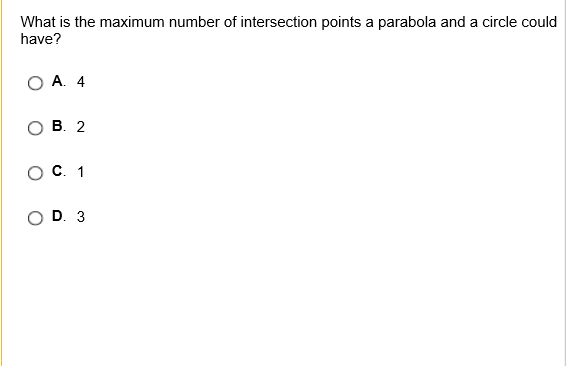
4?
 Vocaloid:
good
 zarkam21:
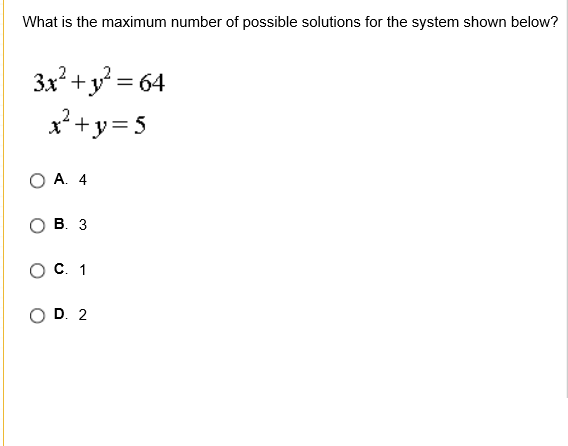
B
Vocaloid:
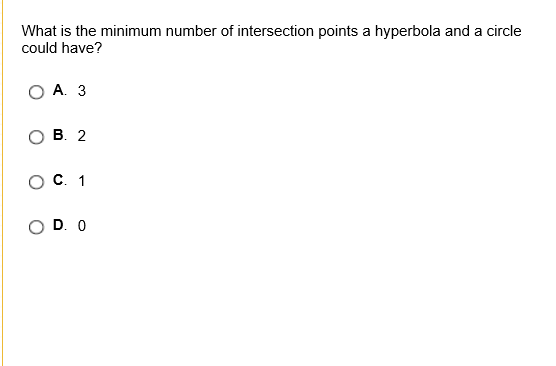
it's a parabola and a circle, so w/o doing any calculations the max is theoretically 4 not 3
Vocaloid:
parabola + an ellipse technically
zarkam21:
and 3 for this one right
 Vocaloid:
yes
 Vocaloid:
good
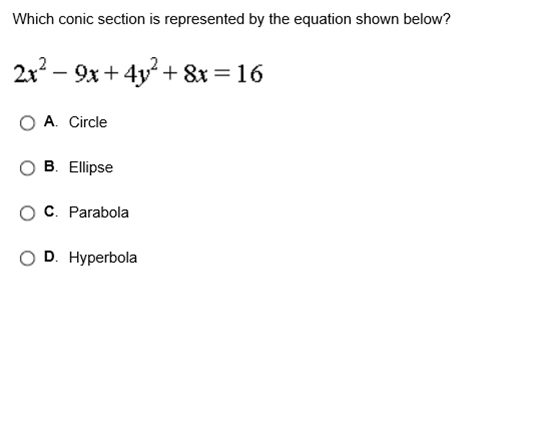 zarkam21:
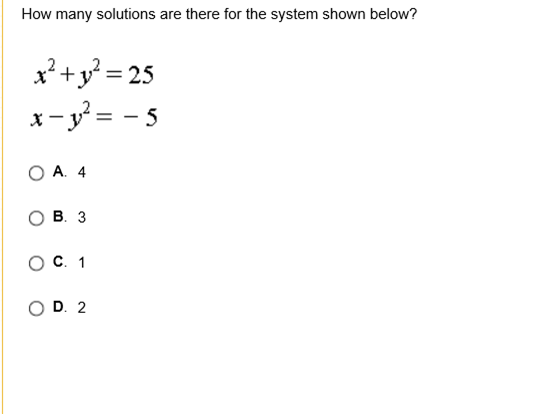
B
Vocaloid:
good
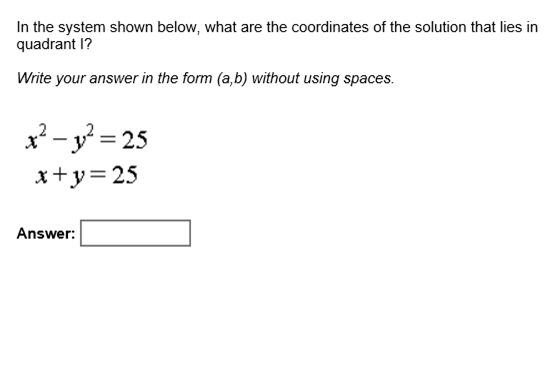 Vocaloid:
solve the first equation for y y = 25 - x then plug this in for y into the first equation to solve for x
zarkam21:
(13,12)
Vocaloid:
good
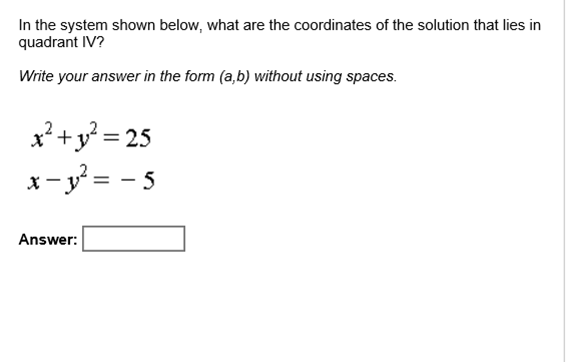 zarkam21:
(4,3)
Vocaloid:
that's quadrant I
zarkam21:
sorry (4,-3)
Vocaloid:
good
zarkam21:
3
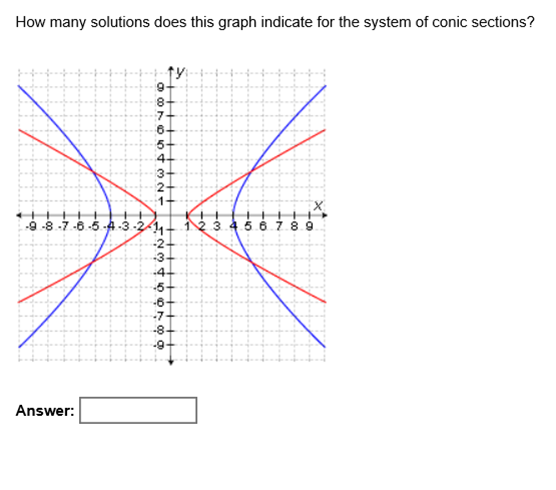 Vocaloid:
check again, how many times do the red lines/blue lines cross each other?
zarkam21:
4
Vocaloid:
good, so 4 solns not 3
zarkam21:
0?FR?
zarkam21:
0?
 Vocaloid:
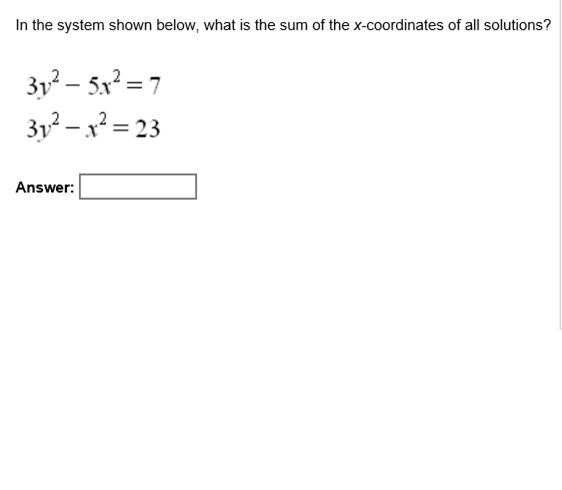
the first time I did this I used software and got 2,2, -2,-2 as the x-coordinates making the sum 0 we could also do it by hand if you want to confirm
zarkam21:
Yeah i did it an got 0 as well
zarkam21:
Lol wrong picture
Vocaloid:
subtracting the two eqn's gives us 4x^2 = 16 x = +/- 2 making 0 the sum :S
zarkam21:
yes so it is 0
Vocaloid:
yeah, 0
zarkam21:
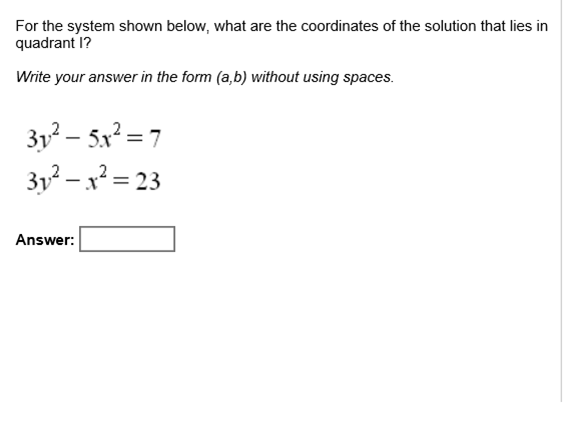
(-2,3)?
 Vocaloid:
quadrant I so both coordinates have to be positive
zarkam21:
(2,3))
Vocaloid:
good
 zarkam21:
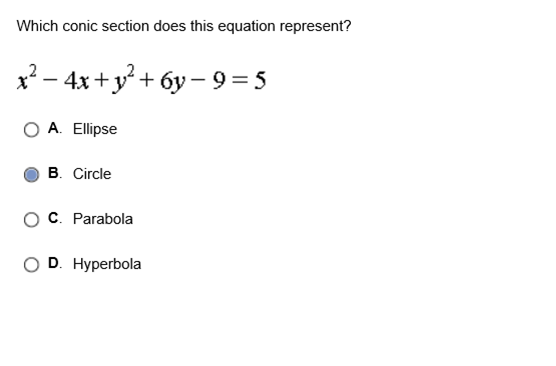
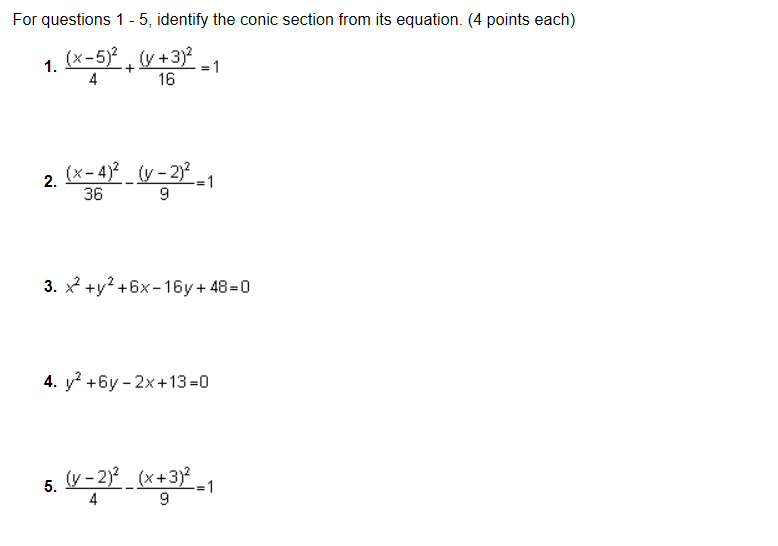
1. ellipse
Vocaloid:
good
zarkam21:
2. hyperbola 3.
Vocaloid:
you'd have to complete the square for #3 to figure out what shape it is
zarkam21:
3.circle
zarkam21:
oh it wouldn't be circle?
Vocaloid:
yeah it's a circle
zarkam21:
4. parabola 5. hyperbola
Vocaloid:
awesome, that's it
 zarkam21:
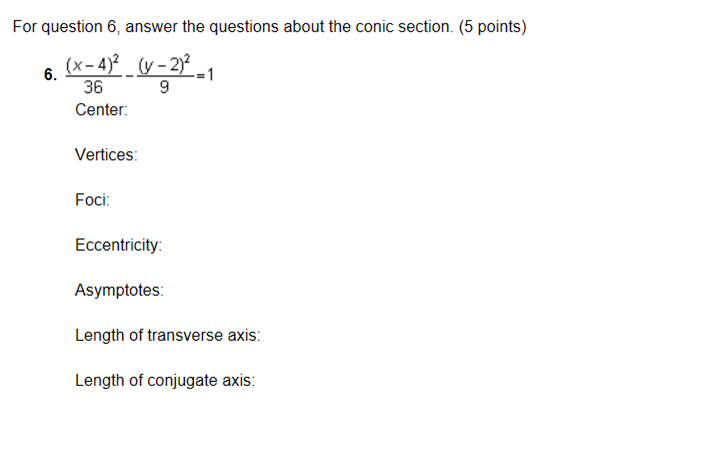
\[center: (4,2) \]
zarkam21:
vertices (10,2)(-2,2)
zarkam21:
\[Foci: (4+\sqrt[3]{5},2)\]
zarkam21:
\[Foci: (4\sqrt[-3]{5},2)\]
zarkam21:
\[Eccentricity: \frac{ \sqrt{5} }{ 2 }\]
zarkam21:
\[assymptotes: y=\frac{ x }{ 2 }, y=-\frac{ x }{ 2 }+4\]
Vocaloid:
yeah so far so good (normally I would prefer to do the calculations by hand but it's pretty tedious tbh)
zarkam21:
Yeah no its fine i did 3 out 6 by hand
zarkam21:
I'm sure they are all correct
Vocaloid:
yeah I just checked and it looks fine
zarkam21:
length of transverse axis
zarkam21:
how do i find the length for the transverse axis and conjugate axis
Vocaloid:
the bigger denominator (36) is the a^2 value the smaller denominator (9) is the b^2 value transverse axis = 2a conjugate = 2b so transverse = 12 and conjugate = 6
zarkam21:
perfect thanks
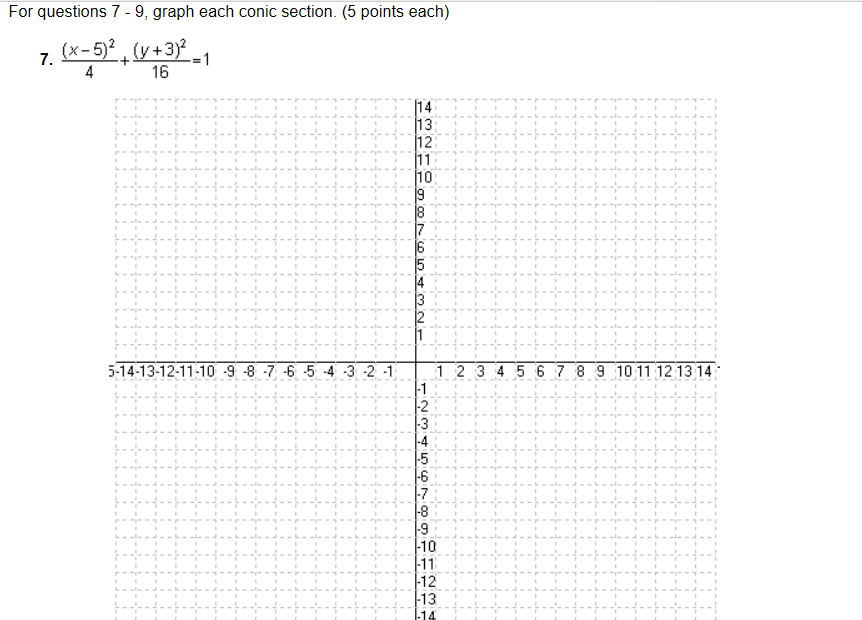
 zarkam21:
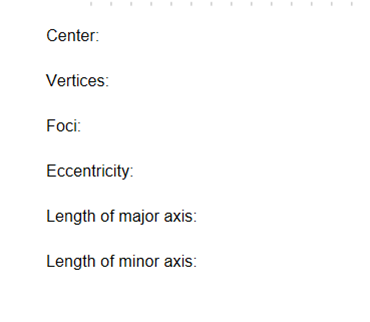
okay so i graphed it already, and got the center, vertices, and foci
zarkam21:
Need help with the eccentricity , major axis , and minor axis
Vocaloid:
major axis is double the square root of the bigger number so 2sqrt(16) = 2*4 = 8 minor axis is double the square root of the smaller denominator so 2sqrt(4) = 2*2 = 4 the minor axis is 4, which is under x so the minor axis is along the x-axis major axis is along the y-axis
zarkam21:
okay so major : 8 minor: 4
Vocaloid:
eccentricity = c/a a is the half length of the major axis (so a = 4) b is half the length of the minor axis (so b = 2) c^2 = a^2 - b^2 find eccentricity
zarkam21:
2^2
Vocaloid:
4^2 - 2^2 = ? remember exponents come first in pemdas
zarkam21:
16-4
zarkam21:
12
Vocaloid:
good, so c^2 = 12 and c = sqrt(12) or 2sqrt(3) so c/a = eccentricity = 2sqrt(3) / 4, or sqrt(3)/2
zarkam21:
\[\frac{ \sqrt{3} }{ 2 }\]
Vocaloid:
yeah, that
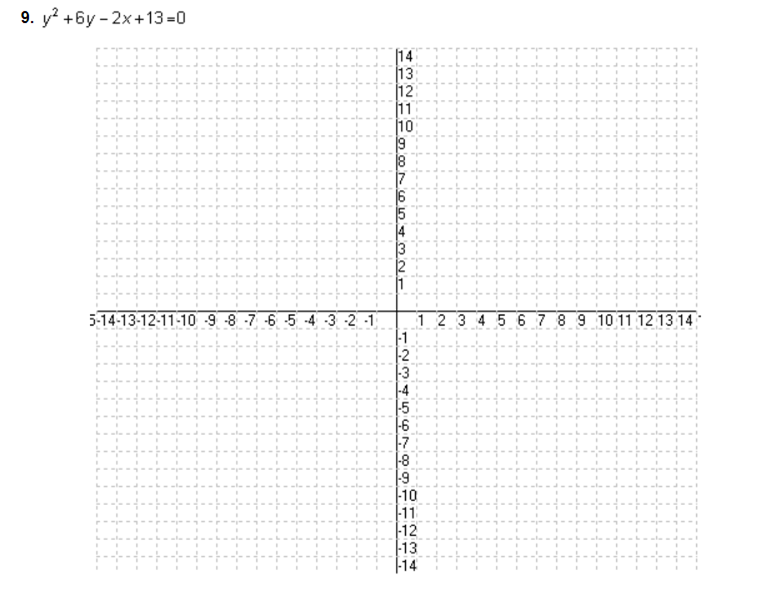
 zarkam21:
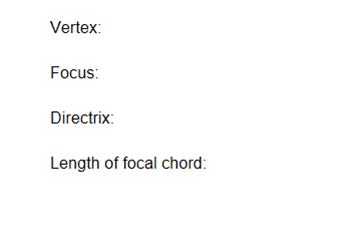
for this i got everything except for focal chord
Vocaloid:
brb going to teach myself what the hell a focal chord is
zarkam21:
Lmao sure thing
Vocaloid:
alright what did you get for your p-value? b/c the focal chord is just 4p
zarkam21:
honestly i just figured out vertex, etc by online calculator
Vocaloid:
that's fine, we can just do a quick complete the square y^2 + 6y- 2x + 13 = 0 adding 9 to each side: y^2 + 6y + 9 - 2x + 13 = 9 (y+3)^2 = 2x - 4 = 2(x-2) then if y^2 = 4px then 4px = 2(x-2) making 4p = 2 and p = 1/2 making the focal chord 4p = 2 = your answer for focal chord
zarkam21:
Thank you so much
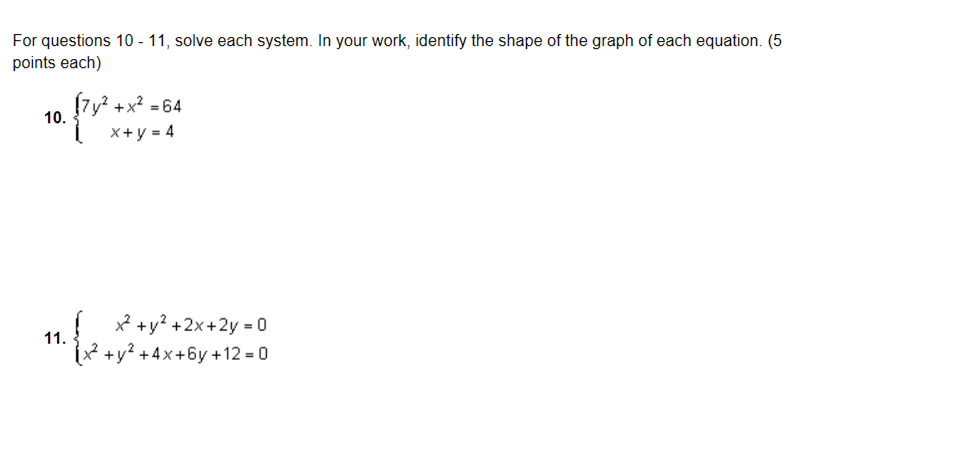 zarkam21:
I already got #10 , for some reason I'm not getting a correct answer for #11
Vocaloid:
gonna get back to this asap
zarkam21:
Sure take your time
Vocaloid:
alright, you can subtract equation 2 - equation 1 to get 2x + 4y + 12 = 0 dividing by 2: x + 2y + 6 = 0 so x = -2y - 6 then we can just plug this into the first equation to get y
Vocaloid:
x^2 + y^2 + 2x + 2y = 0 ( -2y - 6)^2 + y^2 + 2( -2y - 6) + 2y = 0 shoving this into a calculator gives us y = -12/5, y = -2 then we just plug back into equation 1 (one at a time) to find the matching x-values
Vocaloid:
it's a lot of algebra but I end up getting (-2,-2) and (-6/5, - 12/5) and they're both circles (since the question asks)
zarkam21:
Thank you so muchh
Join our real-time social learning platform and learn together with your friends!
 VERNEISH:
Two objects are moving along separate linear paths where each path is described by position, d, and time, t.
VERNEISH:
Two objects are moving along separate linear paths where each path is described by position, d, and time, t.

 Maci:
what are the best stock apps for people who want to start investing?
Maci:
what are the best stock apps for people who want to start investing?
 Twaylor:
genuienly how do i get better self control i keep watcing youtube and theres this
Twaylor:
genuienly how do i get better self control i keep watcing youtube and theres this
 IzzyCookie:
|dw:1792074056138:dw| Uhm, I don't know where to ask this, but I'm in college welding at my community college, and I need help learning vertical welding for
IzzyCookie:
|dw:1792074056138:dw| Uhm, I don't know where to ask this, but I'm in college welding at my community college, and I need help learning vertical welding for

 thehearken:
not sure if this is considered spam, im sorry if it is, but does anyone have tips
thehearken:
not sure if this is considered spam, im sorry if it is, but does anyone have tips