
 zarkam21:
Help
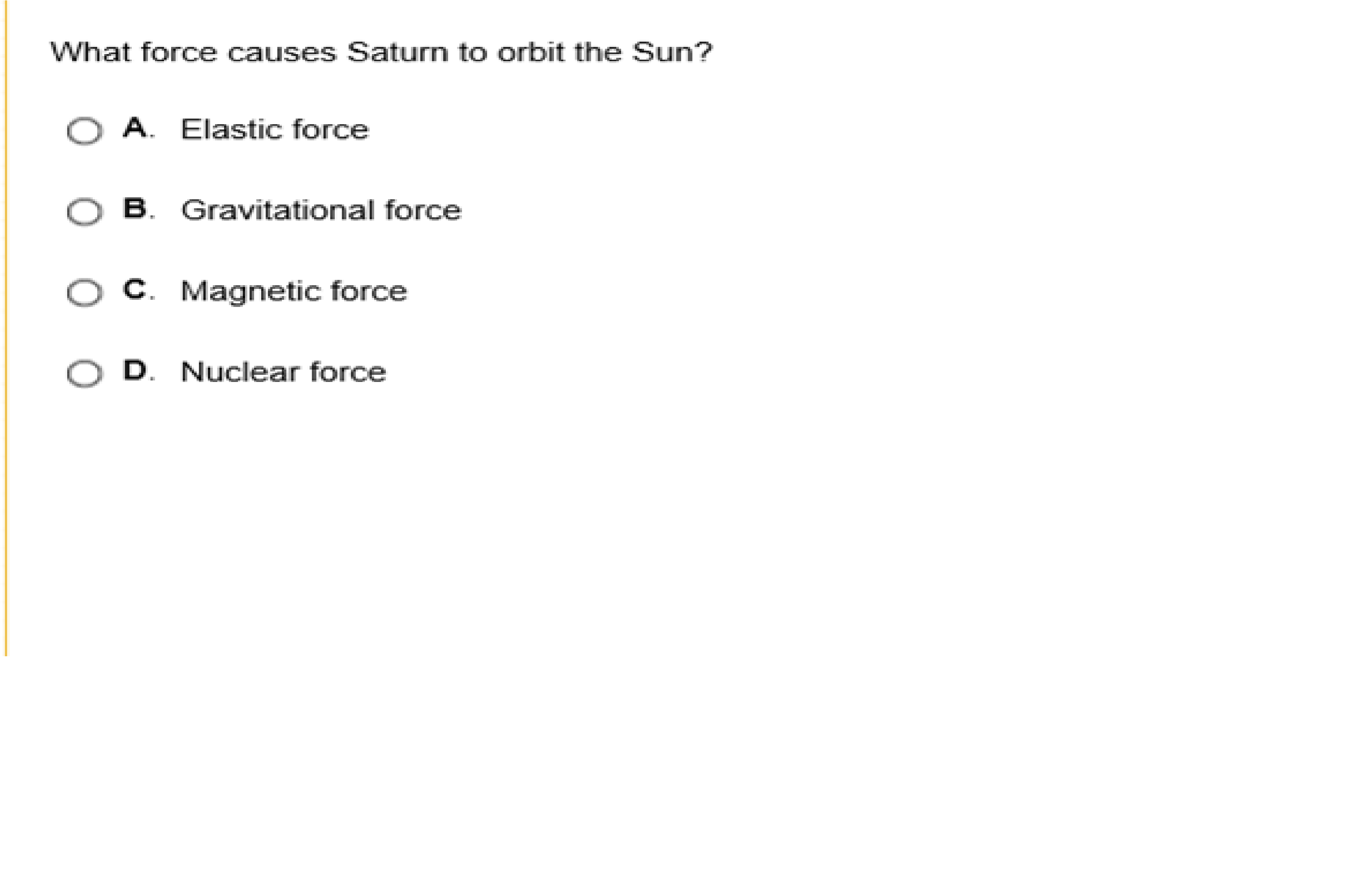 zarkam21:
B
zarkam21:
@Vocaloid
 Vocaloid:
good!
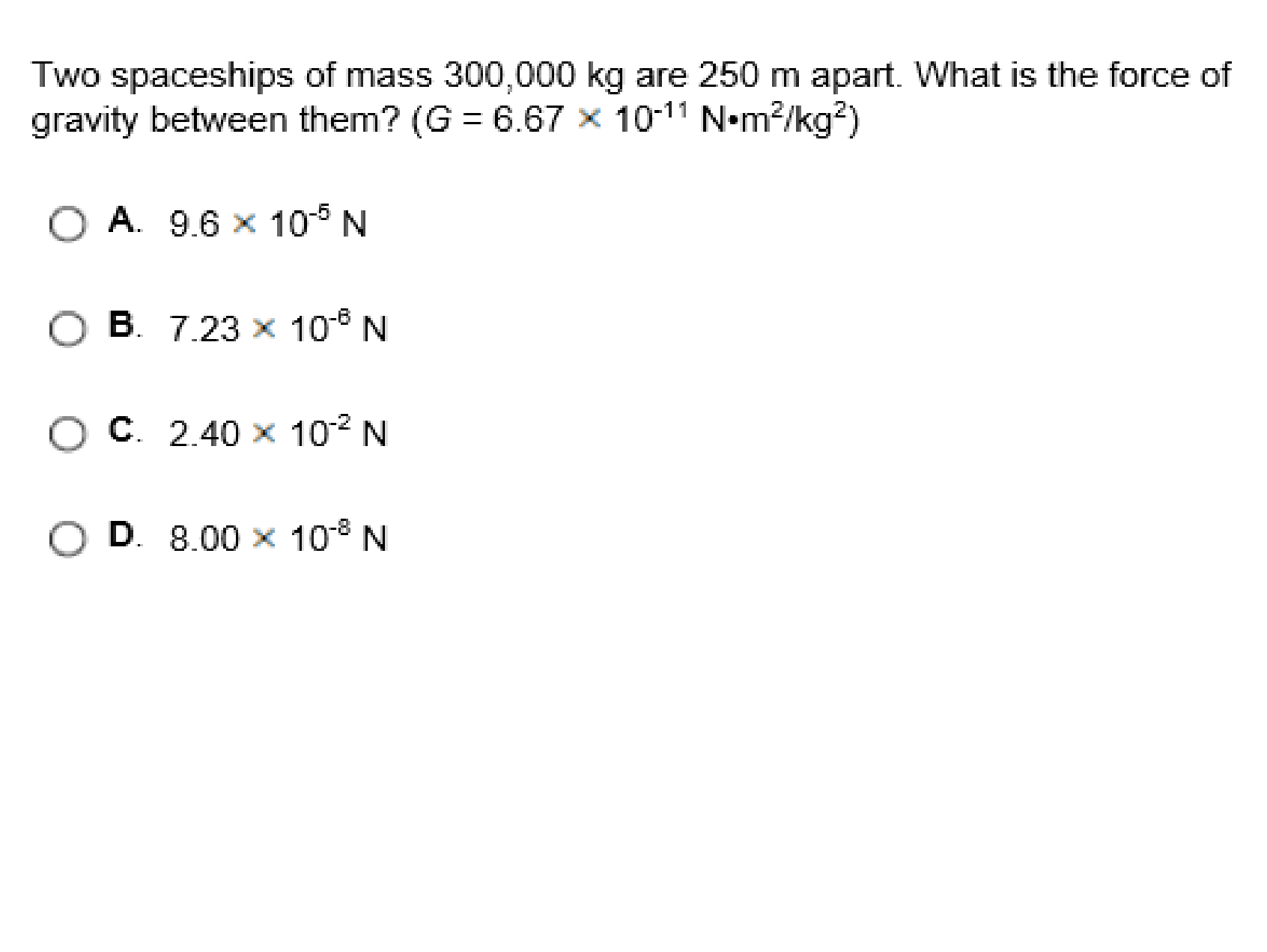 Vocaloid:
|dw:1518065378791:dw| you're given big G, the two masses, and d, find the force
zarkam21:
C
zarkam21:
actually A
Vocaloid:
yeah, I got A as well, gj
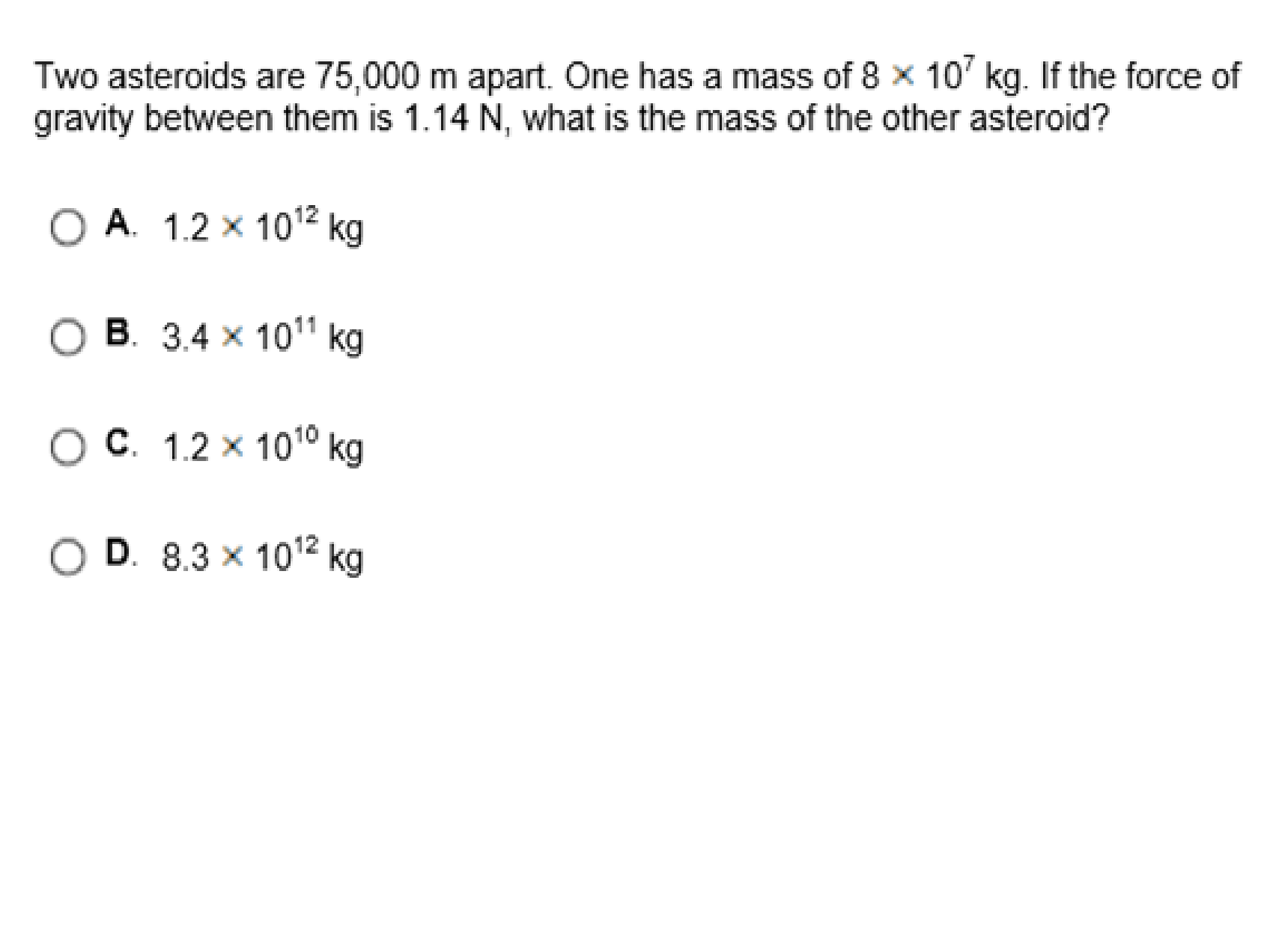 zarkam21:
A
Vocaloid:
yeah that's correct ^^ forgottoaddthevalueofbigG
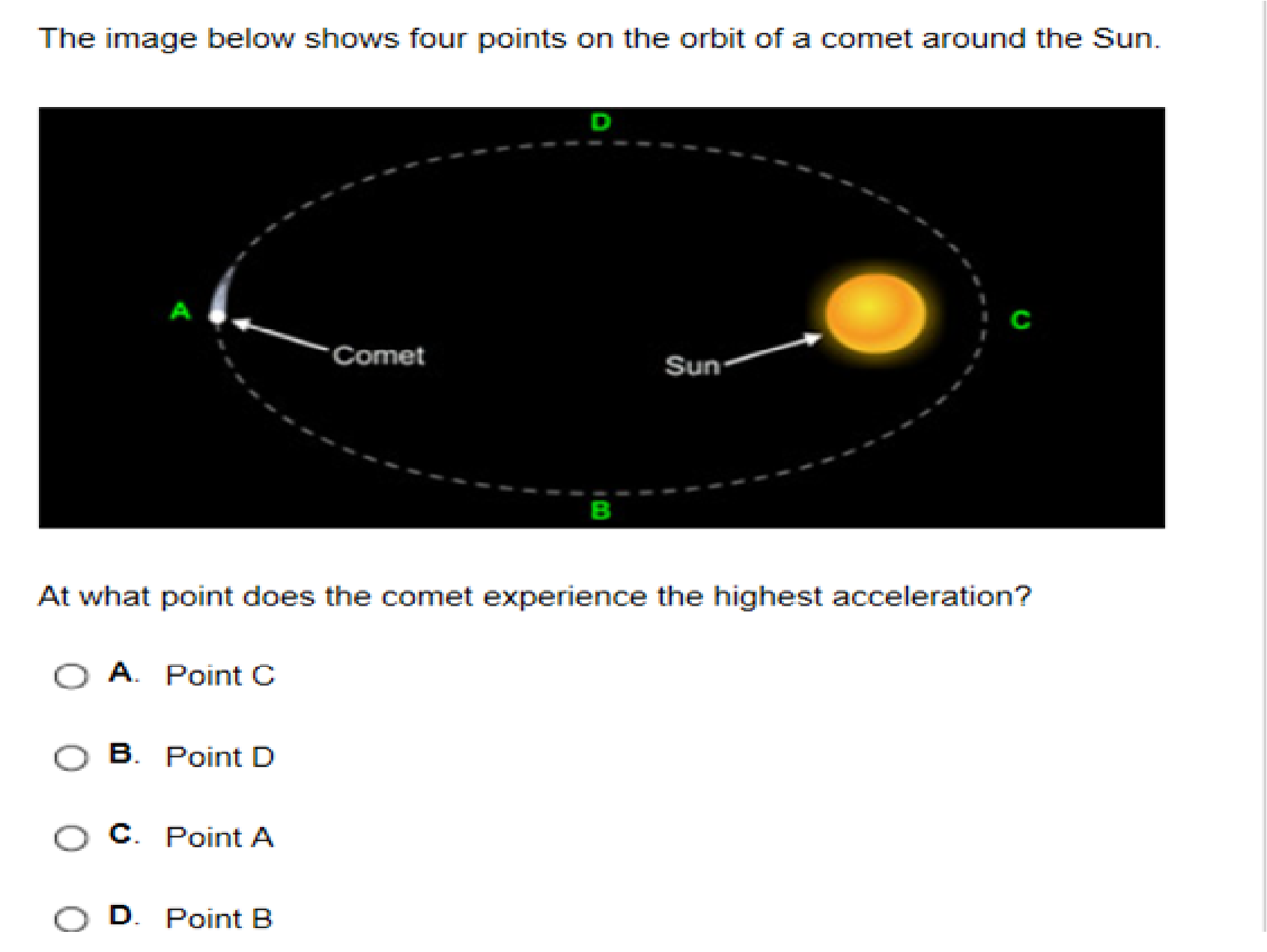 zarkam21:
POint d
Vocaloid:
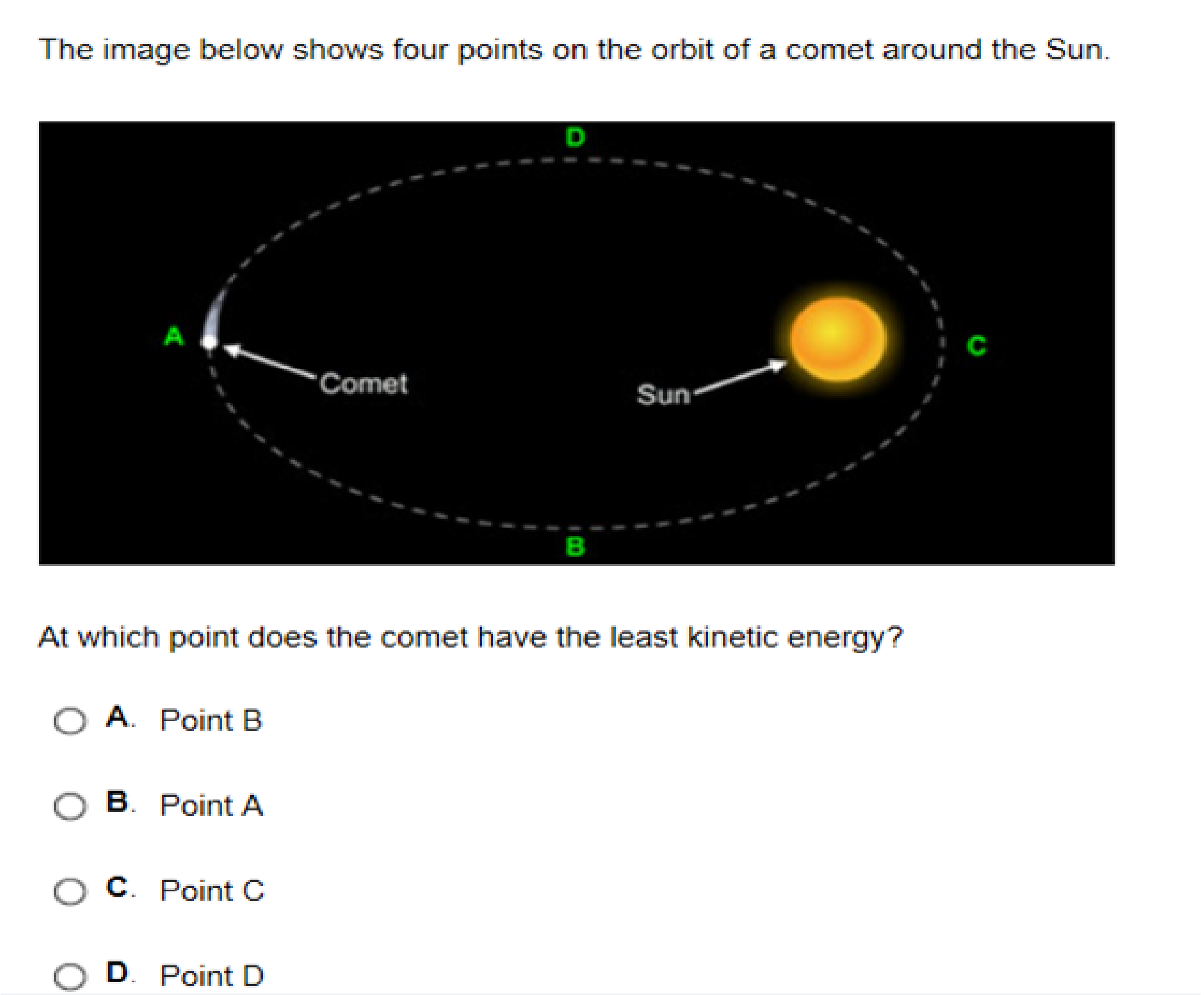
|dw:1518068100664:dw| ok, so the velocity is the highest at the perigree so the point that's closest to the central body (the sun in this case)
Vocaloid:
so which point would it be?
 ronndjaia:
The gravity of the Sun keeps the planets in their orbits. They stay in their orbits because there is no other force in the Solar System which can stop them.
zarkam21:
Point c
zarkam21:
Sorry I fell asleep
Vocaloid:
well done ^^
 zarkam21:
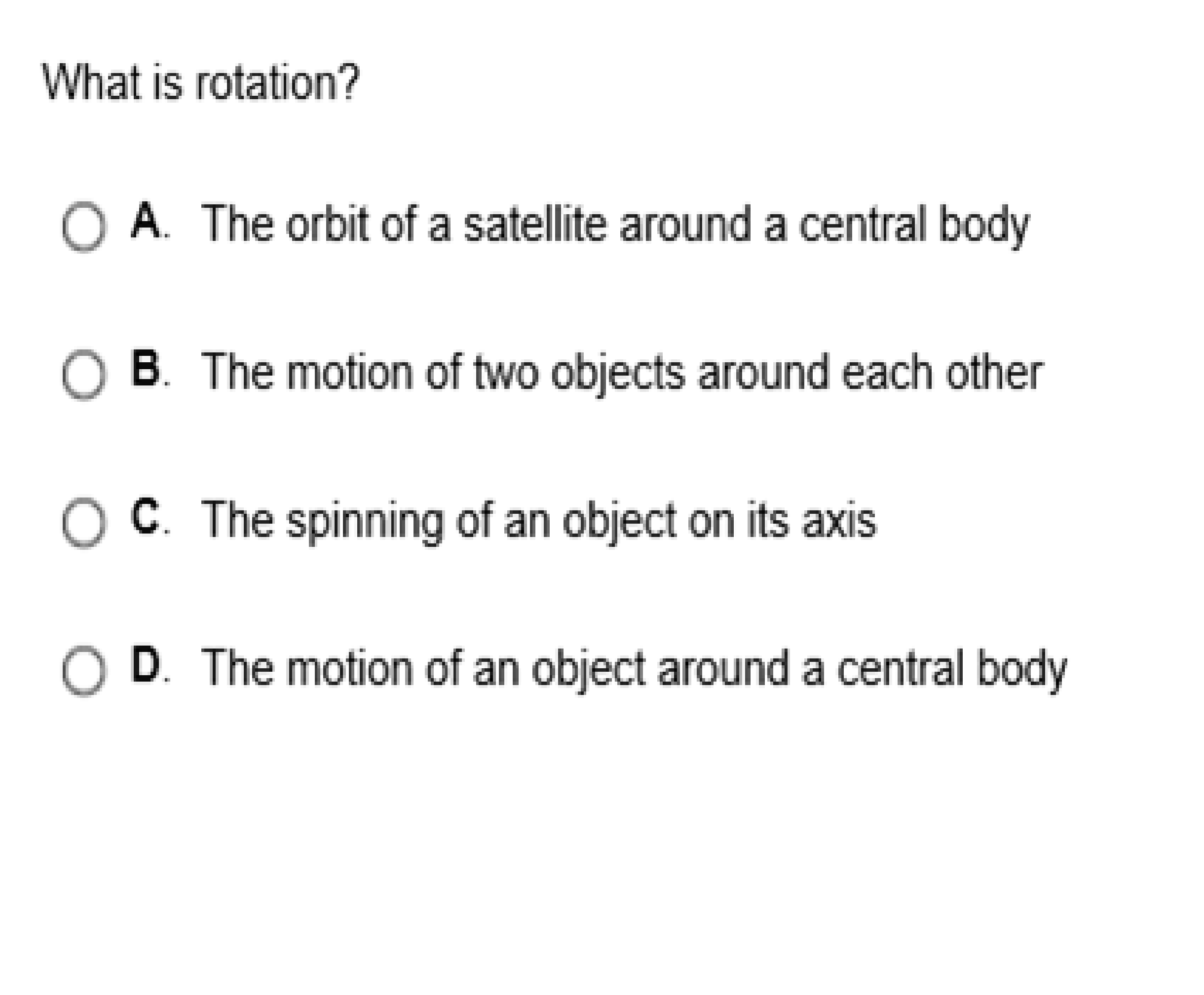
A
Vocaloid:
|dw:1518100732366:dw| you might be mixing these two terms up
zarkam21:
Yeah I def was, so it should be C then?
Vocaloid:
good ^_^ C
 Vocaloid:
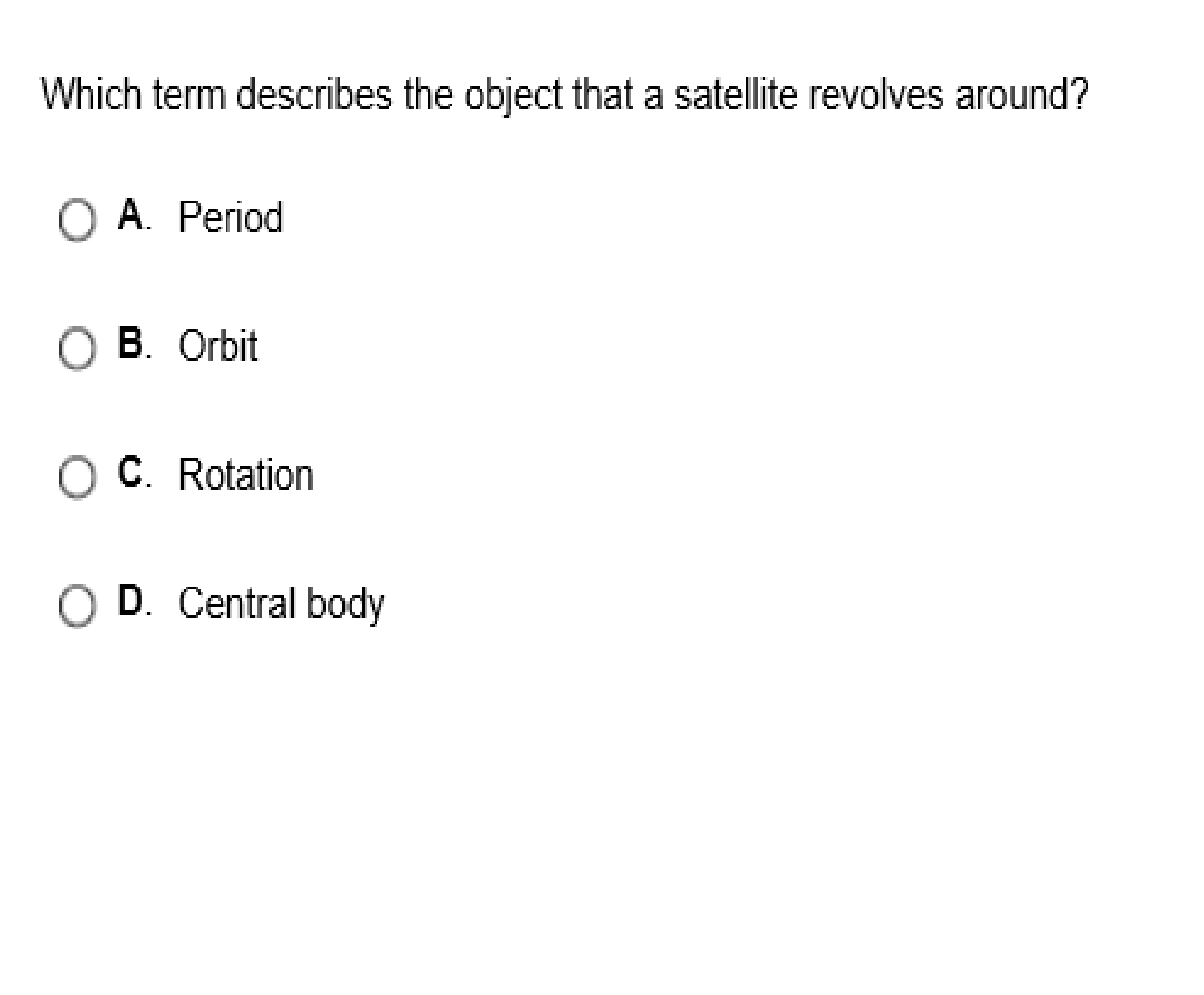
any guesses? there's only one that's an actual physical object, the rest are concepts
zarkam21:
D
Vocaloid:
good ^^
 zarkam21:
Point A because that is the farthest from the sun?
zarkam21:
\(\color{#0cbb34}{\text{Originally Posted by}}\) @Vocaloid Created with RaphaëlReply Using Drawing ok, so the velocity is the highest at the perigree so the point that's closest to the central body (the sun in this case) \(\color{#0cbb34}{\text{End of Quote}}\)
Vocaloid:
good, point A
 Vocaloid:
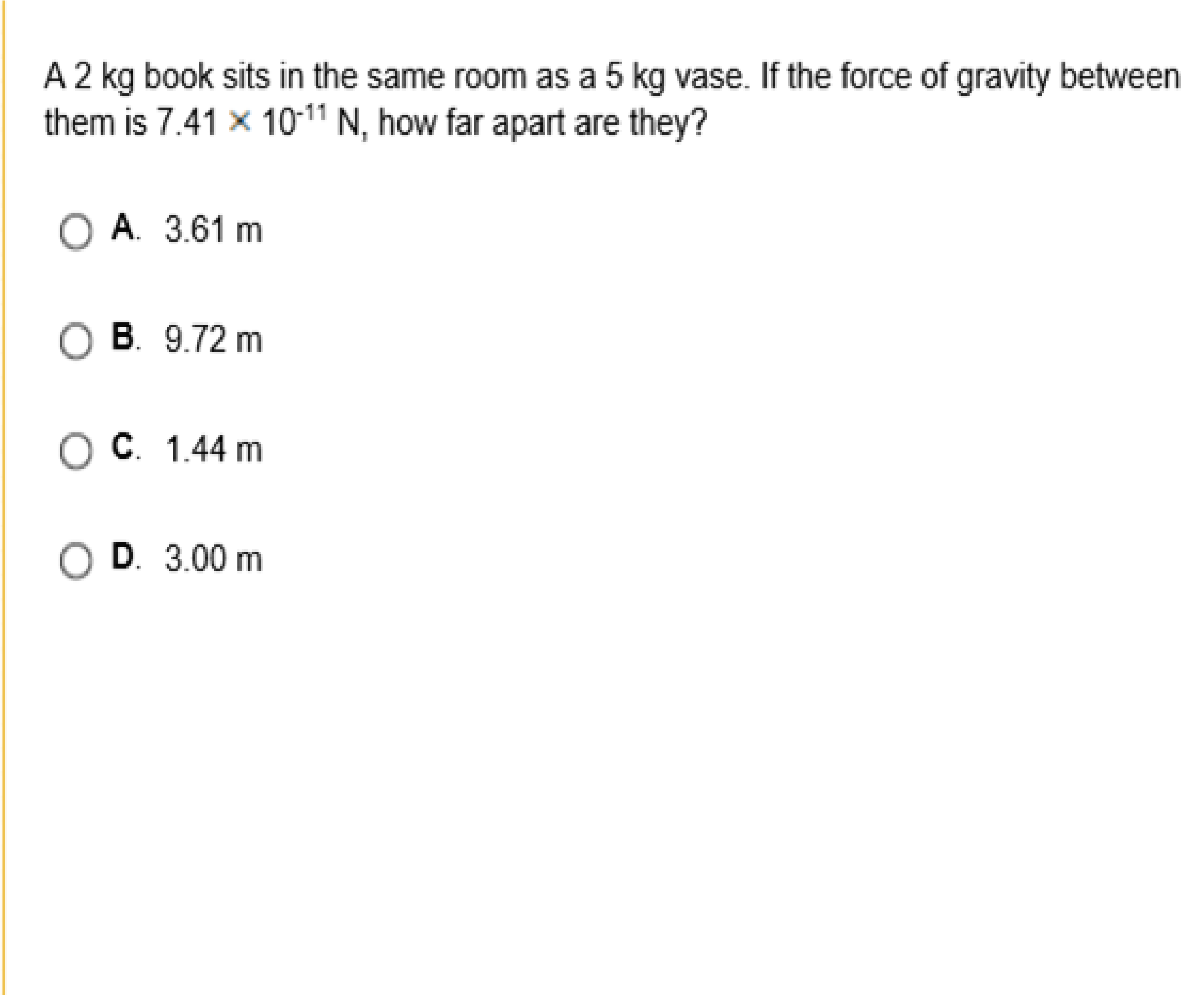
F = m1 * m2 * G /r^2, solve for r
zarkam21:
F=2 * 5 * 7.41
Vocaloid:
G = (6.67×10^−11)
zarkam21:
F=2 * 5 * (6.67×10^−11)
Vocaloid:
good but don't forget the r^2 in the denominator
zarkam21:
F=2 * 5 * (6.67×10^−11)/r^2
Vocaloid:
yeah, that's it. you're also given the force (7.41e-11) so plug this in and solve for r
zarkam21:
7.41e-11=2 * 5 * (6.67×10^−11)/r^2
Vocaloid:
good, now solve for r
Vocaloid:
remember that 7.41e-11 means 7.41*10^-11
zarkam21:
D
Vocaloid:
good, that's what i got too
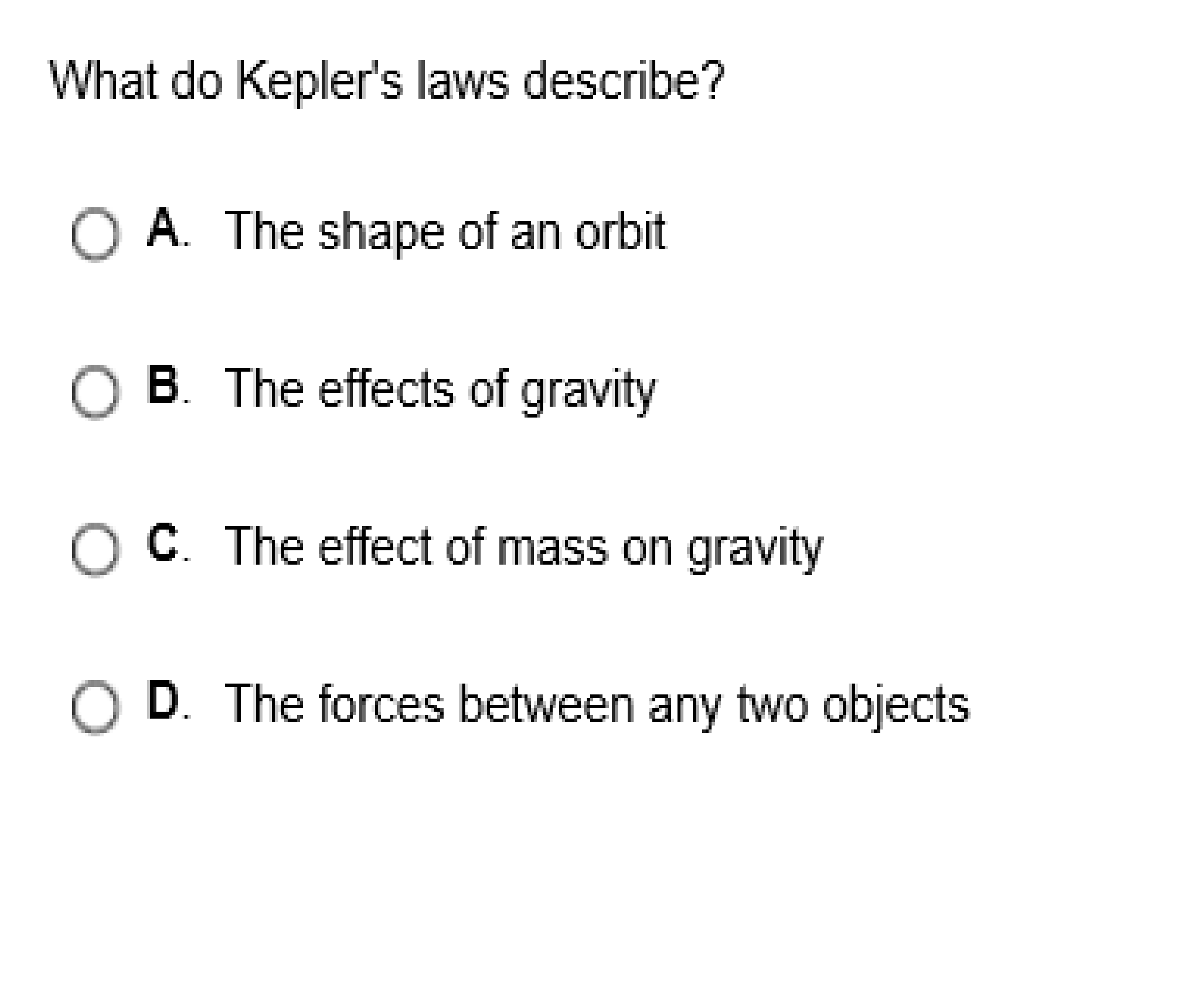 zarkam21:
A
Vocaloid:
awesome
zarkam21:
What is the momentum of a tiger that has a mass of 81 kg and runs with a velocity of 5.4 m/s to the east?
Vocaloid:
momentum = p = mv
zarkam21:
so just 81*5.4=437.4
zarkam21:
so just 81*5.4=437.4
Vocaloid:
good, but since momentum is a vector it's 437.4 kg * m/s east [remember these units for momentum]
Vocaloid:
(if you ever forget it's just the units of velocity and the units of mass multiplied, so kg * m/s)
zarkam21:
A horse has a momentum of 1200 kg·m/s. If the horse has a mass of 313 kg, what is the speed of the horse?
Vocaloid:
p = mv, this time solve for v
zarkam21:
1200=313(v) v=3.83 m/s
Vocaloid:
good, since it's speed not velocity, no direction needed here
zarkam21:
A car has a speed of 23 m/s and a momentum of 31,050 kg·m/s. What is the mass of the car p=mv 31,050=23(m) m=1350kg
Vocaloid:
good
zarkam21:
A boat uses its motor to increase its speed from 5 m/s to 7 m/s. If the boat has a mass of 250 kg, what was the impulse applied by the motor?
Vocaloid:
impulse = change in momentum = m*deltav
zarkam21:
250*5 250*7
Vocaloid:
good, then just subtract 250*7 - 250*5
zarkam21:
250*5=1250 250*7=1750 1750-1250=500
Vocaloid:
good units of impulse are the same as momentum, kg * m/s
zarkam21:
Dave is moving 3 m/s when he crashes his bike into a wall, which stops him in 0.6 seconds. If Dave and his bike have a mass of 90 kg, what was the force applied by the wall
zarkam21:
Would this be the same formula ?
Vocaloid:
almost, we just have to use the full form|dw:1518102624538:dw|
Vocaloid:
(last row) F * delta t = m * delta v you're given everything except F, so solve for F
zarkam21:
F (0.6) = 90 * 3 F=450
zarkam21:
F=450N
Vocaloid:
yup, well done
zarkam21:
Dale (m = 75 kg) skis across a horizontal surface at a velocity of 5 m/s to the west. He drags his ski poles, which gives him an impulse of 300 kg·m/s to the east. What is his new velocity?
Vocaloid:
For this one I would suggest writing delta v as (vf - vi) since we want the new velocity so impulse = m(vf - vi) solve for vf
zarkam21:
impulse = m(vf - vi) 300=75(vf-5) vf=9
Vocaloid:
hm
Vocaloid:
hold on I think we need to re-do the calculation, I just realized the impulse is in the opposite direction as the initial velocity
zarkam21:
Yeah I just did the math too and it doesn't work out
Vocaloid:
I think it needs to be -300 = 75(vf-vi)
zarkam21:
does that work out ? I'm getting something different
Vocaloid:
I end up w/ 1 m/s west
Vocaloid:
-300 = 74(vf-5), vf = 1 and since it's still positive we're going west
zarkam21:
the mass is 75 isn't it ?
Vocaloid:
** yeah I meant to say 75
zarkam21:
Matt (m = 80 kg) and Trey (m = 90 kg) slide across an ice skating rink and collide with each other. Before the collision, Matt was moving 3 m/s to the east and Trey was moving 2 m/s to the west. After the collision, Matt is moving 1.5 m/s to the west. a. What was the total momentum of the system before the collision? b. What is the total momentum of the system after the collision? c. What is Trey's speed after the collision?
zarkam21:
well for a it would be p=mv
zarkam21:
would i just calculate the momentum for both and add them?
Vocaloid:
good, so you would sum the momenta for both Matt and Terry [keep in mind they're going in opposite directions so the final momenta will be smaller than either of the original momentum]
zarkam21:
Matt: p=mv p=80*3 p=240 kg * m/s Trey: p=mv p=90*2 p=180 kg * m/s 240+180=420 kg * m/s
zarkam21:
This for a
Vocaloid:
you're very close, however, we must take direction into account Matt is going east, let's define east as the positive x and west as negative x 240-180=60 kg * m/s east
zarkam21:
Oh so just subtract because its opposite
zarkam21:
ANd i added where i was wrong
Vocaloid:
good for b) it's the same as a) 60 kg * m/s east b/c momentum is conserved
Vocaloid:
for c) use the final momentum to calculate Trey's velocity 60 = (80)(-1.5) + (90)v solve for v
zarkam21:
v=-2
zarkam21:
2
zarkam21:
SOrry
Vocaloid:
good so Trey's going 2 m/s east
Vocaloid:
can we open a new question this one is starting to lag a bit
zarkam21:
SUre
Join our real-time social learning platform and learn together with your friends!
 VERNEISH:
Two objects are moving along separate linear paths where each path is described by position, d, and time, t.
VERNEISH:
Two objects are moving along separate linear paths where each path is described by position, d, and time, t.

 Maci:
what are the best stock apps for people who want to start investing?
Maci:
what are the best stock apps for people who want to start investing?
 Twaylor:
genuienly how do i get better self control i keep watcing youtube and theres this
Twaylor:
genuienly how do i get better self control i keep watcing youtube and theres this
 IzzyCookie:
|dw:1792074056138:dw| Uhm, I don't know where to ask this, but I'm in college welding at my community college, and I need help learning vertical welding for
IzzyCookie:
|dw:1792074056138:dw| Uhm, I don't know where to ask this, but I'm in college welding at my community college, and I need help learning vertical welding for

 thehearken:
not sure if this is considered spam, im sorry if it is, but does anyone have tips
thehearken:
not sure if this is considered spam, im sorry if it is, but does anyone have tips