
 zarkam21:
Bob throws a sticky piece of gum at a stationary cardboard box. The gum has a mass of 0.003 kg, and the box has a mass of 0.05 kg. The gum hits the box with a speed of 9 m/s, and they stick together and slide forward. a. What is the total momentum of the system before the collision? b. What is the total momentum of the system after the collision? c. What is the velocity of the gum/box combination after the collision?
zarkam21:
Same concept
zarkam21:
So a
zarkam21:
p=9*0.003 p=0.027kg * m/s
zarkam21:
p=9*0.003 p=0.027kg * m/s
 Vocaloid:
yup and for b) it's the same answer since momentum is conserved
Vocaloid:
for c) use the final momentum to solve for velocity keep in mind: the mass you must use is the mass of the gum + box b/c they're stuck together
zarkam21:
0.027=0.053(v)
zarkam21:
v=0.51 m/s
Vocaloid:
awesome, that' s it
zarkam21:
A projectile launcher has a mass of 3 kg. It fires a projectile of mass 0.08 kg horizontally at a speed of 300 m/s. a. What is the total momentum of the system before the projectile is fired? b. What is the total momentum of the system after the projectile is fired? c. What is the recoil velocity of the launcher?
zarkam21:
a. p=mv p=3*300=900kg* m/s b. p=mv p=0.08*300=24 kg * m/s
Vocaloid:
I can see where you're going but you have to be very careful with how the question is phrased - before the projectile is fired, nothing is moving - so what's the total momentum?
zarkam21:
Oh 0
Vocaloid:
good as a general rule, the total momentum of a system before and after should be the same no matter what is happening so a and b are both 0 kg*m/s
zarkam21:
Got it
Vocaloid:
for c) since the total momentum is 0, the final momentum of the projectile and the final momentum of the launcher are equal, but opposite (so one of them is negative) first calculate the momentum of the projectile (let's just use your calculations from earlier): p=mv p=0.08*300=24 kg * m/s for the projectile
Vocaloid:
the launcher has the opposite momentum -24 kg m/s so -24 = 3v v = ?
zarkam21:
-8
Vocaloid:
good, so the launcher is -8 m/s [this is negative since it's in the opposite direction of the bullet]
Vocaloid:
and that's it ~
zarkam21:
Cool ! )
zarkam21:
Use Hooke's law to solve the following problems. a. A spring with k = 11 N/m is stretched 0.25 m. What force does the spring apply? b. What is the spring constant of a rubber band that exerts a force of 35 N when it is stretched 0.1 m? c. An elastic band has a spring constant of 55 N/m. It will break when the force reaches 2000 N. How far do you need to stretch the band for it to break? d. A 2 kg mass hangs motionless from a spring with spring constant 8 N/m. How far will the spring stretch if the mass is motionless?
Vocaloid:
a) F = -kx F = ?
zarkam21:
F = -kx F=-11(0.25) F = -2.75
zarkam21:
N
Vocaloid:
good (it's negative since it's acting in the opposite direction of the stretch) for b) same thing, this time solving for k [just take the positive value of k since spring constants are always positive]
zarkam21:
wait so its -2.75N
Vocaloid:
for a yes
zarkam21:
okay
zarkam21:
F=kx 35=0.1(k) K=350 m/s
zarkam21:
N/m actually as the unit
Vocaloid:
awesome, 350 N/m = your answer for b) for c) same formula, this time you're solving for x
Vocaloid:
F = kx 2000 = 55x x= ?
zarkam21:
x=36.36
Vocaloid:
awesome, so 36.36 m = answer for c for d) d. A 2 kg mass hangs motionless from a spring with spring constant 8 N/m. How far will the spring stretch if the mass is motionless? F is equal to gravity (spring is hanging down vertically) so F = kx mg = kx solve for x
Vocaloid:
still there? having a little trouble? :S
zarkam21:
Sorry I was afk
zarkam21:
F = kx mg = kx 2*9.8=8(x) 19.6=8(x) x=2.45 m/s
Vocaloid:
good ^^ however, x is a distance so just m not m/s
zarkam21:
A spring with spring constant 40 N/m is compressed 0.1 m past its natural length. A mass of 0.5 kg is attached to the spring. a. What is the elastic potential energy stored in the spring? b. The spring is released. What is the speed of the mass as it reaches the natural length of the spring?
Vocaloid:
a) potential energy = U = (1/2)kx^2 = ?
zarkam21:
U = (1/2)kx^2 = ? (1/2)(40)(0.1)
zarkam21:
2
Vocaloid:
missed the exponent (1/2)(40)(0.1)^2 = ?
zarkam21:
0.2
Vocaloid:
awesome, so a) = 0.2J b) initial potential energy = final potential energy so 0.2 = (1/2)mv^2 solve for v
zarkam21:
0.2 = (1/2)mv^2 solve for v 0.2 = (1/2)0.5v^2 v=0.89
Vocaloid:
good, so 0.89 m/s and that's it ~
zarkam21:
A pendulum has a mass of 3 kg and is lifted to a height of 0.3 m. What is the maximum speed of the pendulum?
Vocaloid:
potential energy = U = mgh all of the initial PE is converted to KE so mgh = (1/2)mv^2 solve for v
zarkam21:
mgh = (1/2)mv^2 3*9.8*0.3=(1/2)3v^2 v=2.42 N/m
Vocaloid:
good but v is velocity so m/s
zarkam21:
Use the universal law of gravitation to solve the following problems. a. Two cars of mass 3000 kg are 2 m apart. What is the force of gravity between them? b. The force of gravity between a planet and its moon is 371 N. If the planet has a mass of 4 × 10²² kg and the moon has a mass of 5 × 10⁵ kg, what is the distance between their centers? c. The force of gravity between Tim and John is 1.85 × 10⁻⁹ N. If they are 18 m apart and Tim has a mass of 120 kg, what is John's mass?
Vocaloid:
|dw:1518109058344:dw|
Vocaloid:
G = (6.67 * 10^-11) for a) solve for F
zarkam21:
F=(6.67 * 10^-11)(3000/2^2)
zarkam21:
LIke that
Vocaloid:
almost, there are two masses so it needs to be 3000*3000
zarkam21:
F=(6.67 * 10^-11)(9000000/2^2)
Vocaloid:
yup then just chuck that into mathway or whatever you're using
zarkam21:
1.650825 x 10^8
Vocaloid:
hm. that's actually not what I got (that's too big for two trucks anyway)
Vocaloid:
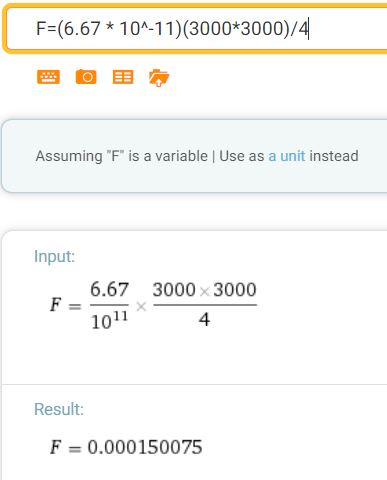
can I see what the input looks like on your screen?
 Vocaloid:
that's really weird can you try entering (6.67 * 10^-11)(3000*3000) * (1/4) = ?
zarkam21:
Got the same thing
zarkam21:
0.00015 for f though right?
Vocaloid:
yeah (I think the problem might be mathway not interpreting the exponent correctly)
Vocaloid:
force is N as usual anyway for b) b. The force of gravity between a planet and its moon is 371 N. If the planet has a mass of 4 × 10^22 kg and the moon has a mass of 5 × 10^5 kg, what is the distance between their centers? same equation, this time we're finding r
Vocaloid:
still there?
zarkam21:
Yess sorry sorry I was doing something
zarkam21:
371=
zarkam21:
would i combine the 2 masses
Vocaloid:
nah it's just m1 * m2
zarkam21:
4 × 10^22* 5 x 10^5
Vocaloid:
371= (6.67*10^-11)*( 4 * 10^22 *5 * 10^5)/r^2 solve for r
zarkam21:
r=6
Vocaloid:
don't forget the exponent 6 * 10^7 m = your ans
Vocaloid:
c. The force of gravity between Tim and John is 1.85 × 10⁻⁹ N. If they are 18 m apart and Tim has a mass of 120 kg, what is John's mass same formula, this time you are solving for one of the masses
zarkam21:
371= (120*18)
Vocaloid:
we don't have both masses here, just 1 mass so 120*m 18 is the distance (r)
zarkam21:
371=120*m/18
zarkam21:
like that
Vocaloid:
almost there 18 needs to be squared, and then G needs to be added to the formula
Vocaloid:
(also the force isn't 371 anymore)
zarkam21:
1.85 × 10–9 =120*m/18^2
Vocaloid:
good, now solve for m.
 Vocaloid:
Hm :S the software is interpreting m as meters try this 1.85 × 10^–9=(6.67 * 10^-11)(120x)/18^2
Vocaloid:
wolframalpha can be really stupid if you use a variable other than x :S
zarkam21:
74.89
Vocaloid:
good so 74.89 kg = ans
Join our real-time social learning platform and learn together with your friends!
 VERNEISH:
Two objects are moving along separate linear paths where each path is described by position, d, and time, t.
VERNEISH:
Two objects are moving along separate linear paths where each path is described by position, d, and time, t.

 Maci:
what are the best stock apps for people who want to start investing?
Maci:
what are the best stock apps for people who want to start investing?
 Twaylor:
genuienly how do i get better self control i keep watcing youtube and theres this
Twaylor:
genuienly how do i get better self control i keep watcing youtube and theres this
 IzzyCookie:
|dw:1792074056138:dw| Uhm, I don't know where to ask this, but I'm in college welding at my community college, and I need help learning vertical welding for
IzzyCookie:
|dw:1792074056138:dw| Uhm, I don't know where to ask this, but I'm in college welding at my community college, and I need help learning vertical welding for

 thehearken:
not sure if this is considered spam, im sorry if it is, but does anyone have tips
thehearken:
not sure if this is considered spam, im sorry if it is, but does anyone have tips