
 Vocaloid:
Quick Quantum Mechanics q - why is the potential governing particle motion time independent when the wavefunction is time dependent?
 sillybilly123:
|dw:1518615085694:dw|
sillybilly123:
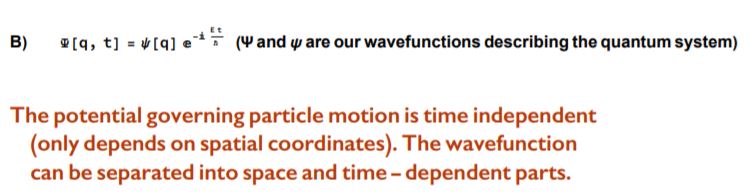
Voca i know that you already will know most of this but i'll scattergun anyways ! I'm guessing that where you started here was with an attempt to "solve" the SE using **separation of variables** So in **separation of variables** we say that: \(\Psi(q,t) = \psi(q) \cdot \psi(t)\) ie we suppose the 2-var wavefunction is actually a product of single-variable functions in q and t alone plough through that and you end up with something that goes : \(\text{ a DE in q only } = \text{ a DE in t only} = \text { const (which is E in this case)} \) With the SE, that only works however if you also assume that \(V = V(q)\). ie if V remains time dependent also, you haven't separated. The devil is in the details and I am sure you have the algebra to hand in one of your books. If not, shout and I can Latex something out In practical terms this \(V = V(q)\) is not a bad start. Eg the classical harmonic oscillator is: \(T + V = \frac{1}{2} m \dot x^2 + \frac{1}{2} k x^2 = \text {const}\) \(V = V(x)\), in fact the whole thing is cast in terms of position and momentum so you can throw the now-separated SE at it and start getting some results . [You can also use it to go at the infinite square well the proper way, ie by solving the SE, rather than forgetting everything and treating the wave function almost like a classical wave function] Hope that is helpful, if not do shout :)
Join our real-time social learning platform and learn together with your friends!
 DoltonCarlee:
what are y'all's options on S A T essays because honestly their not that bad
DoltonCarlee:
what are y'all's options on S A T essays because honestly their not that bad

 thereneelg:
Can someone give me a summary of article 231, The war guilt clause?? I need to explain what it is, but I can't find any shortened version of what it is and
thereneelg:
Can someone give me a summary of article 231, The war guilt clause?? I need to explain what it is, but I can't find any shortened version of what it is and
 luisaam2:
What should you do when the person you want to talk to the most is the one making
luisaam2:
What should you do when the person you want to talk to the most is the one making
 Breathless:
https://medal.tv/games/roblox/clips/nAYivIl6oXB6q9QAI?invite=cr-MSxCSk4sMTY4OTA4N
Breathless:
https://medal.tv/games/roblox/clips/nAYivIl6oXB6q9QAI?invite=cr-MSxCSk4sMTY4OTA4N
 Twaylor:
I'm not that good at law can someone fact check this without bias? June 29, 2026, the Supreme Court decided Chatrie v.
Twaylor:
I'm not that good at law can someone fact check this without bias? June 29, 2026, the Supreme Court decided Chatrie v.
 Demon25:
For a hoco proposal with a cheerleader and football player, what else should be a
Demon25:
For a hoco proposal with a cheerleader and football player, what else should be a
