
 zarkam21:
Blake stands in a canoe in the middle of a lake. The canoe is stationary. Blake holds an anchor with mass 15 kg, then throws it west with a speed of 8 m/s. Blake and the canoe have a combined mass of 135 kg. a. The system is defined as Blake, the canoe, and the anchor. What is the total momentum of the system before he throws the anchor? b. What is the total momentum of the system after he throws the anchor? c. What is the velocity of the canoe after he throws the anchor?
zarkam21:
A. p=mv p=135*8 p=1080 kg m/s
zarkam21:
Actually this would be B
 Vocaloid:
a) before he throws the anchor nothing is moving so momentum = ?
zarkam21:
A would be 0
Vocaloid:
good since momentum is conserved, momentum before = momentum after, so B is 0 as well
zarkam21:
i would do vf-vi
zarkam21:
for c right
Vocaloid:
for c) set the total momentum equal to 0 and solve for the velocity of the canoe (mass of blake + mass of canoe)(velocity of blake + canoe) = (mass of anchor)(velocity of anchor) solve for the blake + canoe system velocity
zarkam21:
(mass of blake + mass of canoe)(velocity of blake + canoe) (135)(8)
Vocaloid:
8 is the speed of the anchor not the canoe
zarkam21:
135*8=8
Vocaloid:
(135)(velocity of canoe + blake) = 15*8
zarkam21:
oh okay so i would eliminate that
zarkam21:
8/9
Vocaloid:
good, we would probably want to write this as a decimal instead 0.88889 m/s east (since the anchor was thrown west, the canoe goes in the opposite direction east)
zarkam21:
Lincoln goes bungee jumping. He has a mass of 102 kg. a. The bungee cord will stretch 8 m when 500 N of force is applied to it. What is the spring constant of the bungee cord? b. After his jump, Lincoln hangs from the cord motionless. How stretched is the bungee cord past its natural length? c. The maximum force the bungee cord can handle without breaking is 20,000 N. How far would you have to stretch it to get it to break?
zarkam21:
F=-kx
zarkam21:
500=(-k)(8)
zarkam21:
k=-125/2
Vocaloid:
good (for force constant we will use the positive value so 125/2 or 62.5 N/m
Vocaloid:
for b) you will set F = mg and solve for x, using the k value already obtained
zarkam21:
102*9.8=62.5(x) x=16
Vocaloid:
good 16 m
Vocaloid:
then for c) just substitute F = 20,000N and solve for x
zarkam21:
20000=62.5(x)
zarkam21:
x=320m
Vocaloid:
good
zarkam21:
Dwight uses a spring (k = 40 N/m) on a horizontal surface to make a launcher for model cars. The spring is attached to a holder that has a mass of 0.5 kg. If he compresses the spring and releases it, the launcher will move back and forth in periodic motion. a. If he compresses the spring by 0.2 m, what is the acceleration of the launcher as the spring reaches its natural length? b. What is the maximum kinetic energy of the launcher? c. What is the maximum speed of the launcher?
zarkam21:
A is 0
Vocaloid:
good good for b) max KE is same as initial potential energy, so U = (1/2)kx^2 where x = 0.2 (initial displacement)
zarkam21:
U = (1/2)k(0.2)^2
zarkam21:
I solve for U right
Vocaloid:
yes (you are also given k)
zarkam21:
U = (1/2)(40)(0.2)^2 U=0.8
Vocaloid:
good (0.8J) then, since it's asking for KE not U, we say KE = 0.8J for c) set KE equal to (1/2)mv^2 and solve for v
zarkam21:
0.8=(1/2)(0.5)v^2 =1.79
Vocaloid:
good, 1.79 m/s
zarkam21:
When Heather swings on a swing set, she moves in periodic motion like a pendulum. She has a mass of 62 kg. If Heather has a maximum height of 1.2 m, what is her maximum velocity?
Vocaloid:
max U = mgh = (1/2)mv^2 solve for v
zarkam21:
(62)(9.8)(1.2)=(1/2)(62)v^2 4.85
zarkam21:
m/s
Vocaloid:
good
zarkam21:
Mars has a mass of 6.4 × 10²³ kg. It has a moon named Phobos with a mass of 1.07 × 10¹⁶ kg. a. If their centers are 9400 km apart, what is the force of gravity acting on Phobos? b. A scientific satellite of mass 1300 kg orbits Mars 200 km above its surface. If Mars has a radius of 3396 km, what is the force of gravity acting on the scientific satellite? c. The satellite is in a circular orbit around Mars. How does the gravitational potential energy of the satellite change as it orbits Mars? d. How does the acceleration of the satellite change as it orbits Mars?
zarkam21:
fg=mg
Vocaloid:
a) F = Gm1m2/r^2 where G is the gravitational constant 6.674×10⁻¹¹
zarkam21:
F = (6.674×10⁻¹¹)m1m2/r^2
zarkam21:
F = (6.674×10⁻¹¹)(6.4 × 10²³ )( 1.07 × 10¹⁶ )/r^2
Vocaloid:
good, r is the distance between the two planets (9400 km) convert this to meters first
zarkam21:
F = (6.674×10⁻¹¹)(6.4 × 10²³ )( 1.07 × 10¹⁶ )/9400000^2
Vocaloid:
good, then just chuck that into a calculator
zarkam21:
F = 4.48998×10^-6
Vocaloid:
there needs to be an exponent sign between 10 and the exponents
Vocaloid:
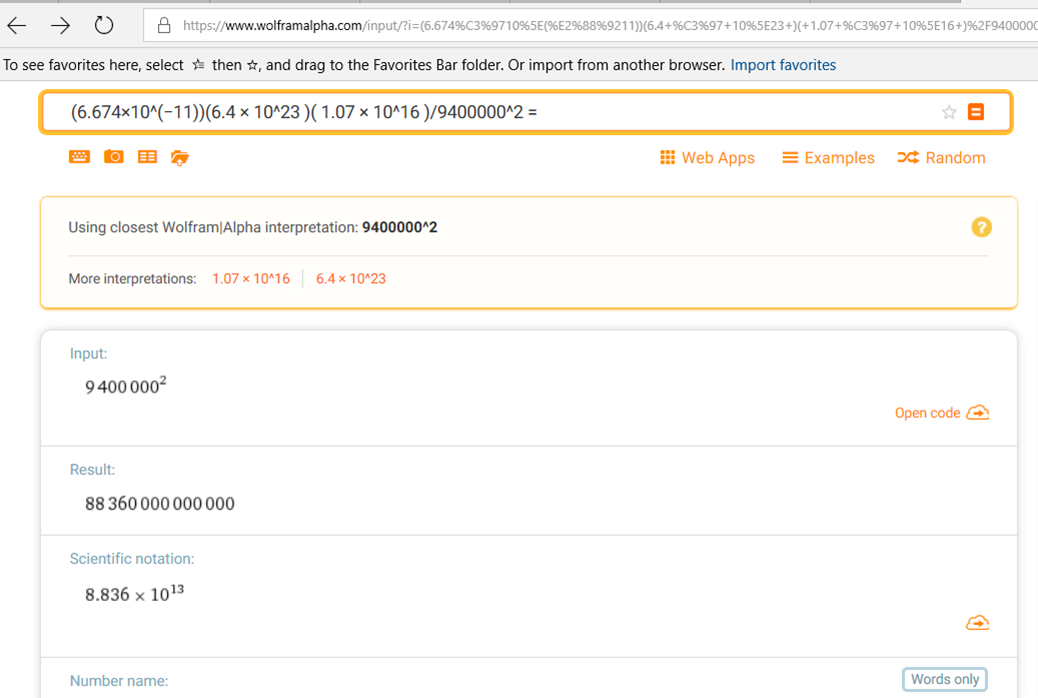
(6.674×10^(−11))(6.4 × 10^23 )( 1.07 × 10^16 )/9400000^2 = ?
zarkam21:
8.836 × 10^13
Vocaloid:
I got something a little different, 5.172 e 15 N http://www.wolframalpha.com/input/?i=(6.674%C3%9710%5E(%E2%88%9211))(6.4+%C3%97+10%5E23+)(+1.07+%C3%97+10%5E16+)%2F9400000%5E2
Vocaloid:
for b) the total distance between the satellite and the planet is (3396 + 200) km, use this value for r, then calculate F using the two masses given, and r
 Vocaloid:
that's weird, it's interpreting your input as 9400000^2 only
Vocaloid:
do you have a scientific calculator you could use instead
zarkam21:
F=3596(1300)
zarkam21:
Yeah i used another calculator and it got what you got
Vocaloid:
3596 is the distance not the mass
zarkam21:
Wait is the formula f=ma
zarkam21:
What formula are we using
zarkam21:
I think that is what is confusing me
Vocaloid:
we are seeking the gravitational force between two objects F = Gm1m2/r^2
zarkam21:
F = G(6.4 × 10²³ )(1.07 × 10¹⁶)/3596^2
Vocaloid:
big G = 6.674×10^(−11) as usual
Vocaloid:
mass of satellite is 1300 kg
zarkam21:
F = ((6.4 × 10²³ ))(1.07 × 10¹⁶)/3596^2
Vocaloid:
the two masses are the mass of mars and the mass of the satellite ((6.4 × 10^23 )) and 1300
Vocaloid:
also you need to convert 3596km to m
zarkam21:
F = (6.4 × 10²³ )(1300)/3596000^2
Vocaloid:
good, then just evaluate this (make sure to include the exponent sign betweeen 10 and 23)
Vocaloid:
*** hold on you forgot G
Vocaloid:
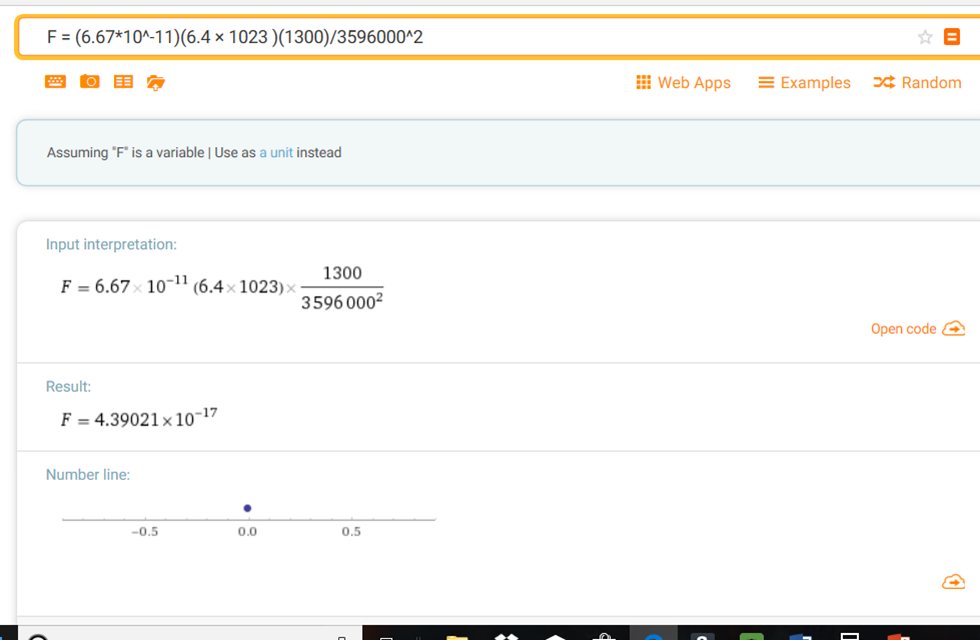
F = (6.67*10^-11)(6.4 × 10²³ )(1300)/3596000^2
 Vocaloid:
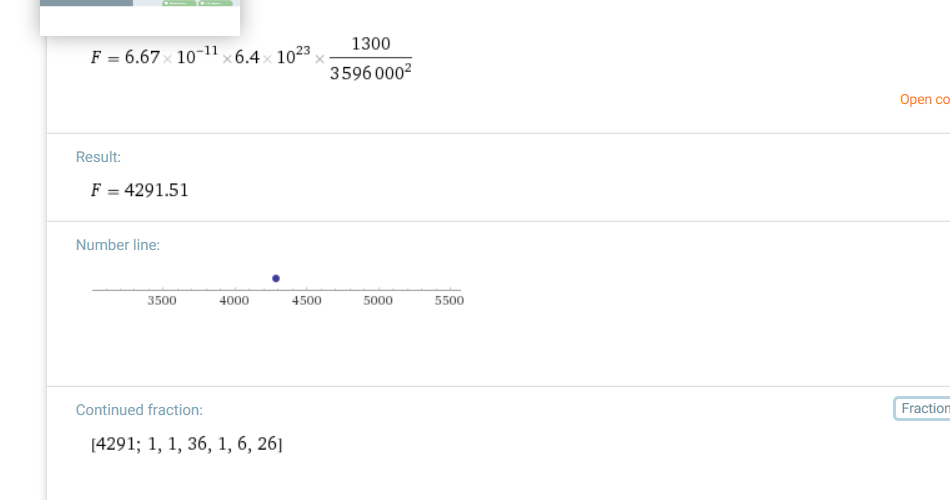
there needs to be an exponent between 10 and 23, it's interpreting it as 1023 not 10^23
 Vocaloid:
yup good
zarkam21:
so the answer would be F = 4291.51
Vocaloid:
yes
Vocaloid:
c. The satellite is in a circular orbit around Mars. How does the gravitational potential energy of the satellite change as it orbits Mars? as the distance between mars and the satellite increases potential energy decreases d. I'm not 100% sure on this but I believe acceleration decreases too
zarkam21:
THank you so much !
Vocaloid:
yeah I have to get going now, take care
zarkam21:
You as well
Join our real-time social learning platform and learn together with your friends!
 Demon25:
For a hoco proposal with a cheerleader and football player, what else should be a
Demon25:
For a hoco proposal with a cheerleader and football player, what else should be a

 Breathless:
TOC: "MGF any confirmation on the commander? we require confirmation as soon as[radio static].
Breathless:
TOC: "MGF any confirmation on the commander? we require confirmation as soon as[radio static].
 EdwinJsHispanic:
I wrote something that I don't know if I want it as a poem or song, Please let me know on yours thoughts about it, I'm still doing this! "Broken promises an
EdwinJsHispanic:
I wrote something that I don't know if I want it as a poem or song, Please let me know on yours thoughts about it, I'm still doing this! "Broken promises an
 thehearken:
hi um I don't know if this is the right section for this, but can someone go over my poem and tell me if its good enough to give my English professor for a
thehearken:
hi um I don't know if this is the right section for this, but can someone go over my poem and tell me if its good enough to give my English professor for a
 heartlessprophet:
Aye what's 19z%u00f74p=9u03c0 my teacher thinking of impossible questions for us
heartlessprophet:
Aye what's 19z%u00f74p=9u03c0 my teacher thinking of impossible questions for us
 kippppp:
does anyone have any good tips for writing stories? i'm trying to write a dnd campaign but i'm not that great of a writer yet.
kippppp:
does anyone have any good tips for writing stories? i'm trying to write a dnd campaign but i'm not that great of a writer yet.
 GRIZZLEY19:
Y'all let me know what y'all think about this beat I made I took me like a hour maybe rate it 0/10 https://drive.
GRIZZLEY19:
Y'all let me know what y'all think about this beat I made I took me like a hour maybe rate it 0/10 https://drive.
 Ultrilliam:
Welcome to the 10th Anniversary Update! (Part 2) Sorry this one passed the date a
Ultrilliam:
Welcome to the 10th Anniversary Update! (Part 2) Sorry this one passed the date a
 Twaylor:
was walking downtown and my adhd brain wanted to make some (rock?) lyrics: There'
Twaylor:
was walking downtown and my adhd brain wanted to make some (rock?) lyrics: There'