
 zarkam21:
Help please
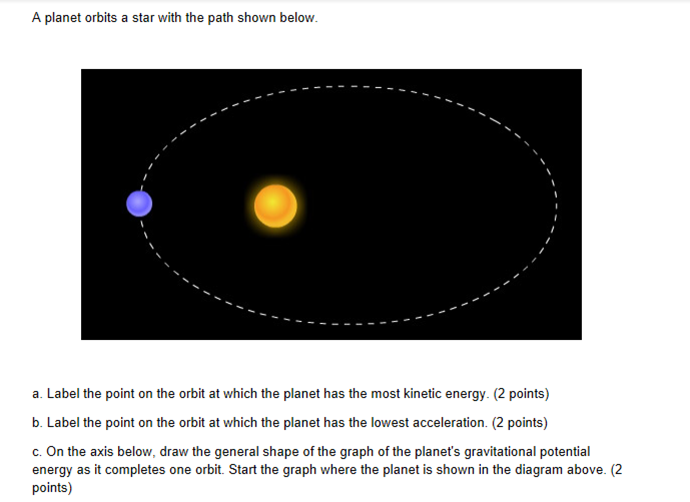 zarkam21:
@Vocaloid
zarkam21:
it would be right by the sun right
 Vocaloid:
for a) yes, for b) it would be the opposite (farthest away from the sun) still figuring out c
Vocaloid:
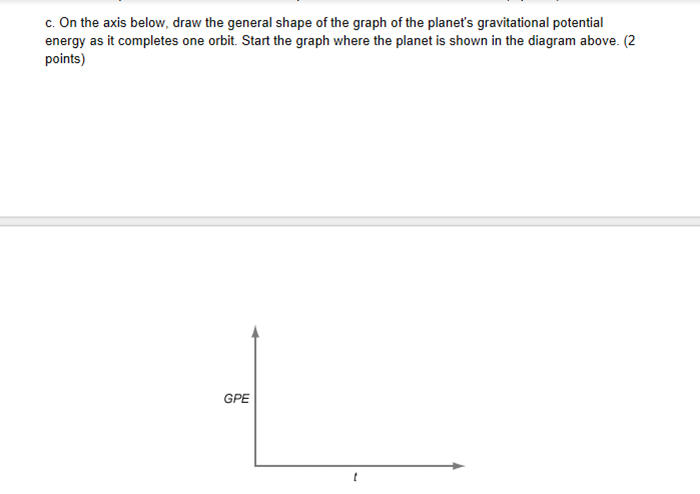
(this part has always confused me about orbits, but the potential energy is highest where the satellite is closest to the central body, then decreases as it moves farther away, then increases again, so your graph should be a parabola/U-shape I believe)
 Vocaloid:
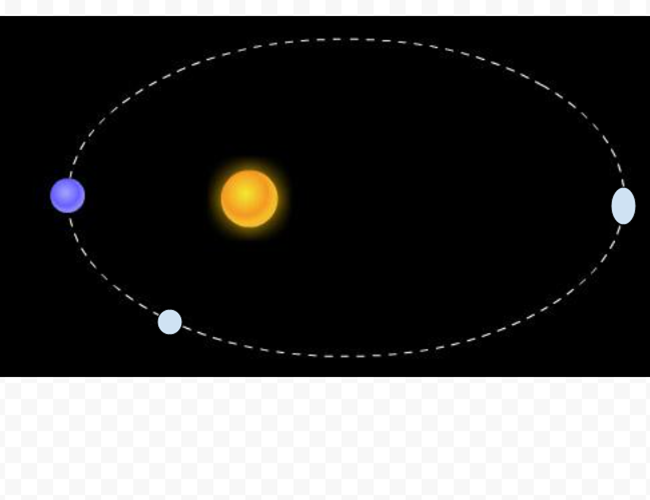
I'm not quite sure what I'm looking at here
zarkam21:
OH the two dots
zarkam21:
i labeled them just wanted to make sure the direction is right
zarkam21:
like where i placed them
Vocaloid:
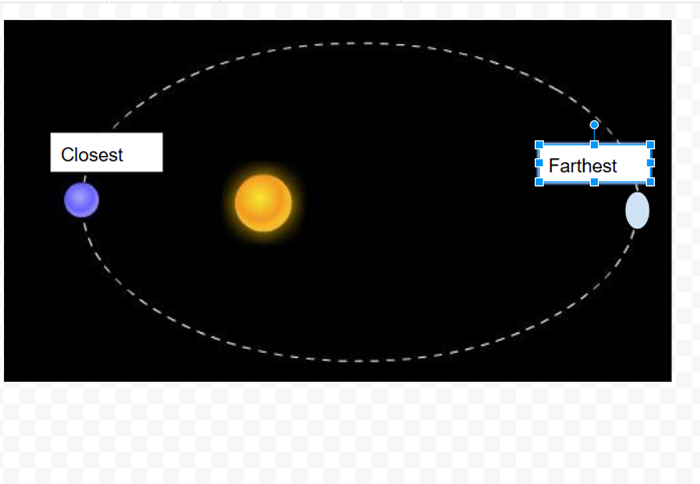
if you're labelling the closest/farthest points away on the orbit it should be at the two ends like this|dw:1519094659186:dw|
Vocaloid:
[your system is the Earth + sun but the principle is the same]
zarkam21:
so where the two arrows are that's where?
Vocaloid:
|dw:1519094687560:dw|
Vocaloid:
where the moon is not the arrows
 Vocaloid:
yeah something like that
zarkam21:
OKay now for b
zarkam21:
I mean c
Vocaloid:
for b it's the farthest point from the central body (so the point on the far right)
 Vocaloid:
make sure you're labelling them as "highest KE" and "lowest acceleration" since that's what they're asking for a + b
Vocaloid:
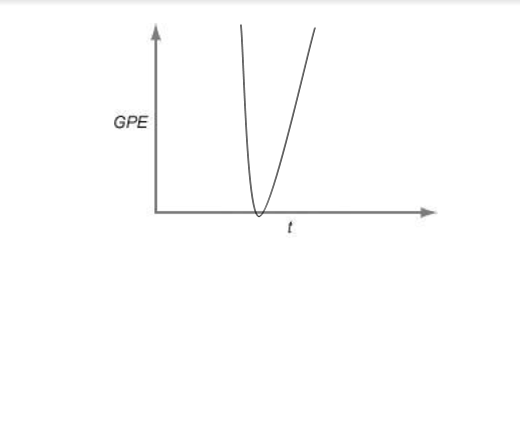
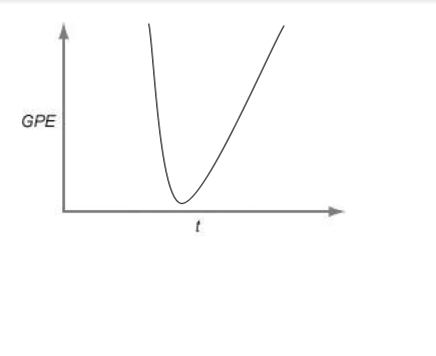
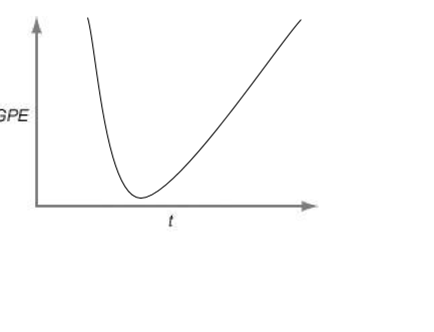
c should be an upward facing parabola
 Vocaloid:
sort of like that but a little broader, plus gpe is never negative or 0 so it shouldn't touch the x-axis
Vocaloid:
|dw:1519095152568:dw|
Vocaloid:
[just make it a bit more symmetrical than that]
 Vocaloid:
better but it could be more symmetrical
 Vocaloid:
eh, could be a bit more even on both sides but let's move on
zarkam21:
Okay sure
Vocaloid:
actually @sillybilly123 would the potential energy during an orbit just be a parabola or is it more complex than that
Vocaloid:
we can move on in the meantime
zarkam21:
okay sure that is it for this question right
Vocaloid:
yeah pretty much
 sillybilly123:
given \(T + U = \text{const.}\), ie we can call it a closed frictionless system, the energy equation should be: \(\dfrac{1}{2} m v^2 - \dfrac{\mu m}{r} = \text{const.} \) where r is distance between star (at ellipse focus) and planet, \(\mu = GM\) and v is planet speed relative to star \(T \propto \frac{1}{r}\), most T means smallest r, ie when they are closest. ( "closest" isn't necessarily right at the perigee but is pretty close from what i can calculate) the gravitational force is always inward toward star, and \(F = m a = - \nabla U = \dfrac{\mu m}{r^2}\) ie \(a \propto \frac{1}{r}\), so that too should be greatest for small r, ie when closest. hence the slingshot effect graphing: the energy has to be negative, and one could guess it looks something like this just by smoothing out between 3 points: |dw:1519124596519:dw| behind that question is a load of great original math from superstars like Kepler, Newton...
sillybilly123:
so "lowest" acceleration when furthest away....must learn to read and graphs look pretty similar except for axis which is that slightly nebulous -ve energy point :(
Join our real-time social learning platform and learn together with your friends!
 KBaby:
Verse 1 We left our names in the dust of the driveway Watched the old town shrink
KBaby:
Lyrics Generator Use AI to write the lyrics for a song. Suggested Genres: Pop Hip
KBaby:
Verse 1 We left our names in the dust of the driveway Watched the old town shrink
KBaby:
Lyrics Generator Use AI to write the lyrics for a song. Suggested Genres: Pop Hip

 aitexturegenerator:
How are you all handling AI-generated textures for 3D models and game assets without losing the hand-made feel? I've been doing a small stylized environment
aitexturegenerator:
How are you all handling AI-generated textures for 3D models and game assets without losing the hand-made feel? I've been doing a small stylized environment

 Demon25:
Woke up feeling like that girl and that dude well he still aint crap pluse the du
Demon25:
Woke up feeling like that girl and that dude well he still aint crap pluse the du
 playtsec:
how do I get rid of stress from teachers... I just feel like running out the classroom and leaving on my own.
playtsec:
how do I get rid of stress from teachers... I just feel like running out the classroom and leaving on my own.
 JohnnyLFowler0812:
What type of gamer would play something and then get off for a while. Why not sta
JohnnyLFowler0812:
Which is better? Metallica Rap Country R&B hiphop Medal Gospel Chill Which 3 opti
JohnnyLFowler0812:
What type of gamer would play something and then get off for a while. Why not sta
JohnnyLFowler0812:
Which is better? Metallica Rap Country R&B hiphop Medal Gospel Chill Which 3 opti