
 zarkam21:
Help please
 zarkam21:
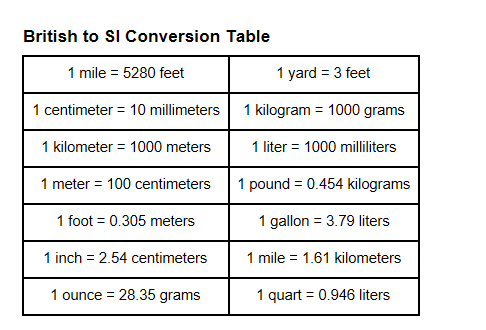
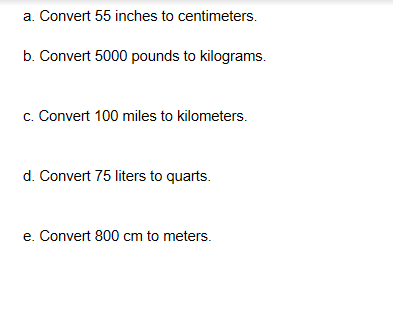
a. Convert 55 inches to centimeters. 55*2.54=137.9 centimeters b. Convert 5000 pounds to kilograms. 5000*0.454=2270 kilograms c. Convert 100 miles to kilometers. 100*1.61=161 kilometers d. Convert 75 liters to quarts.
zarkam21:
@Vocaloid
 Vocaloid:
good on a-c for d) since you are given 1 quart = 0.946 L you need to divide 75L by 0.946 L/q to cancel out units and get q
zarkam21:
a. Convert 55 inches to centimeters. 55*2.54=137.9 centimeters b. Convert 5000 pounds to kilograms. 5000*0.454=2270 kilograms c. Convert 100 miles to kilometers. 100*1.61=161 kilometers d. Convert 75 liters to quarts. 75*0.946=70.95 quarts e. Convert 800 cm to meters. 800*10=8000 meters
Vocaloid:
for d you need to divide by the conversion factor since you are given the factor for 1 quart not 1 L
Vocaloid:
for e - if 100cm = 1 m then you need to divide cm by 100 to get m
zarkam21:
75/0.946=79.3
Vocaloid:
good, 79.3 quarts
zarkam21:
so 800/10?
Vocaloid:
yes
zarkam21:
800/10=80 meters
Vocaloid:
oh no, 800/100 sorry
Vocaloid:
since 1 m = 100 cm
zarkam21:
800/100=8 meters
Vocaloid:
yes
zarkam21:
No need for the apology
zarkam21:
A diver of mass 75 kg jumps upward off a diving board and into the water. The diving board is 2 m above the water. a. When the diver jumps, she has a speed of 2.5 m/s. How much kinetic energy does she have? b. How much gravitational potential energy will she have gained at her highest point? Explain how you found the answer. c. Based on the diver's speed from part (a), how high above the board will she rise? d. How fast will the diver be moving when she hits the water?
Vocaloid:
a) KE = (1/2)mv^2
zarkam21:
KE = (1/2)mv^2 KE=(1/2)(75)(2.5)^2 KE=234.38J
zarkam21:
1470 m/s
Vocaloid:
units of potential energy are joules not m/s
zarkam21:
GPE = mgh GPE=(75)(2)(9.8) GPE=1470J
zarkam21:
Sure
Vocaloid:
I think it's asking for the greatest potential energy after she jumps (largest height) so b) should be equal to the energy from a) since all the energy that goes into jumping is converted into the potential energy increase, so it's also 234.38J
zarkam21:
and c is 2 right?
Vocaloid:
c) is asking for the height with respect to the diving board, so you need to convert the KE from jumping into potential energy according to the equation KE = mgh so 234.38J = mgh solve for h
zarkam21:
234.38J= mgh 234.38=(75)(9.8)h h=0.32
Vocaloid:
good, and since it's a distance units are m
Vocaloid:
for d) we need to set the total potential energy (including the PE from the climb) into KE so mgh = 1/2mv^2, where h is the total height (2 + 0.32)
zarkam21:
mgh = 1/2mv^2, where h is the total height (2 + 0.32) (75)(9.8)(2.32)= 1/2(75)v^2,
Vocaloid:
good, then solve for v
zarkam21:
6.74
zarkam21:
6.74
Vocaloid:
good, since it's velocity units are m/s
zarkam21:
At the beginning of a bobsled race, teammates push their bobsled along the track before jumping into it. a. Before the teammates jump in, they push the bobsled (m = 100 kg) from rest to a speed of 6 m/s. How much kinetic energy does the bobsled gain? b. How much work did the bobsled team do? Explain how you found the answer. c. If the teammates pushed the bobsled a distance of 8 m, how much force did they apply? d. Later, the bobsled is racing down the track at a speed of 20 m/s. With the team in it, the bobsled has a total mass of 325 kg. How much work must be done by friction to slow down the bobsled to 17 m/s?
zarkam21:
KE=(1/2)mv^2/r
zarkam21:
actually no r
Vocaloid:
that's the centripetal force equation, KE is just (1/2)mv^2
zarkam21:
KE=(1/2)mv^2 KE=(1/2)(100)(6)^2 KE=1800J
Vocaloid:
good for b) all of the work they did must have gone into increasing KE (assuming 0 friction) so it's also 1800J of work
Vocaloid:
for c) [I am assuming they are talking about the same work from b?) W = Fd, solve for F
zarkam21:
1800=(f)8
Vocaloid:
good, solve for F
zarkam21:
f=225N
Vocaloid:
good for d) all the work goes into slowing the bobsled down so work = change in KE = ?
zarkam21:
change is 3
zarkam21:
because 20-17
Vocaloid:
getting there since change in velocity is 3 what's the change in KE
zarkam21:
would it be squared?
Vocaloid:
KE = (1/2)mv^2 change in KE = (1/2)m(deltav)^2 where deltav is your change in velocity
zarkam21:
change in KE = (1/2)m(deltav)^2 change in KE = (1/2)(325)(17)^2
Vocaloid:
delta v is the ~change~ in velocity which we determined to be 20 - 17 = 3 m/s
zarkam21:
change in KE = (1/2)m(deltav)^2 change in KE = (1/2)(325)(3)^2
Vocaloid:
good, then just evaluate all that
zarkam21:
1462.5
zarkam21:
J
Vocaloid:
good
 Vocaloid:
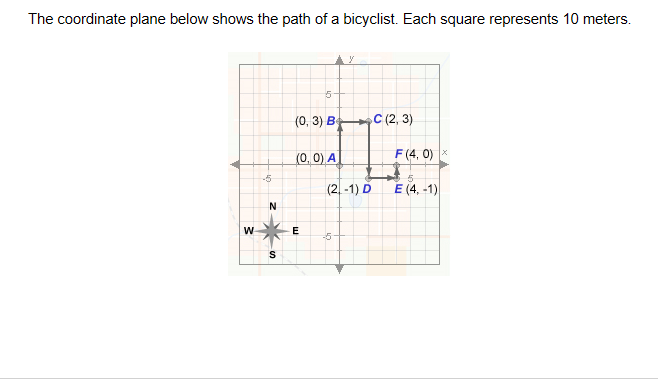
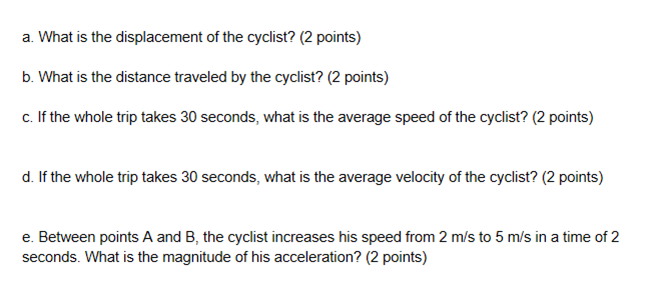
a) displacement is net distance travelled, so you only need to consider the distance between the starting (A) and final (F)
zarkam21:
4
Vocaloid:
must also include a direction since displacement is a vector
Vocaloid:
if the cyclist travels from A to F what direction are they going in? you can use the compass at the bottom left to give you a clue
zarkam21:
East
Vocaloid:
good so displacement = 4 m east
Vocaloid:
for b) distance, you have to add up all the segments travelled
zarkam21:
13
Vocaloid:
good (I just read the thing at the top that says each square is 10 m) so a is actually 40 m east and b) is 130 meters (no direction since displacement isn't a vector)
Vocaloid:
c) average speed = distance/time = ? (make sure you are using distance not displacement)
zarkam21:
130/30=4.3
Vocaloid:
good, units of speed are m/s as usual
Vocaloid:
for d) it's a similar calculation just using displacement instead of distance displacement/time = ?
zarkam21:
10/30=0.3
Vocaloid:
displacement is 40 not 10
zarkam21:
40/30=1.3
Vocaloid:
good, since displacement and velocity are vectors we specify that it is 1.3 m/s east
Vocaloid:
e) acceleration = change in velocity/time = ?
zarkam21:
3/2=1.5
Vocaloid:
good, units are m/s/s as usual
zarkam21:
You stand on a bridge above a river and drop a rock into the water below from a height of 53 m. (Assume no air resistance.) a. What is the acceleration of the rock as it falls? b. How long does it take to hit the water? c. How much more time would it take if instead of dropping the rock straight down, you threw it horizontally with a speed of 5 m/s? Explain. d. You throw another rock at an angle of 30° above the horizontal with a speed of 12 m/s. What are the x- and y-components of the rock's speed? e. How long does it take the rock to reach its maximum height?
Vocaloid:
a) initial PE = final KE so mgh = (1/2)mv^2 solve for v
zarkam21:
m(0)(53) = (1/2)mv^2
Vocaloid:
g is 9.8 not 0
zarkam21:
it says no air resistance that is why i put zero
zarkam21:
m(9.8)(53) = (1/2)mv^2
Vocaloid:
good, solve for v
zarkam21:
32.23
Vocaloid:
good, units are m/s as usual for b) you can use a kinematics equation deltax = (1/2)at^2 where deltax is height and a is the acceleration due to gravity
zarkam21:
deltax = (1/2)at^2 53=(1/2)(9.8)t^2
zarkam21:
t=3.29
Vocaloid:
good for c) throwing the rock horizontally has no effect on the y-components of velocity so the rock will take the same time to fall
Vocaloid:
d) x component is velocity * cos(theta), y component is velocity * sin(theta)
zarkam21:
12*cos(30)=10.39 12*sin(30)=206
Vocaloid:
check that second one again, it looks suspect
zarkam21:
12*cos(30)=10.39 12*sin(30)=6
Vocaloid:
awesome, units are m/s on both as usual
zarkam21:
okay for e
Vocaloid:
kinematics equation 2 - since the velocity of rock is 0 at max height, vf = v0 + at where vf is 0, v0 is the initial y-component of velocity (make sure you are using the resolved y- component, including the angle), a is the acceleration due to gravity (use -9.8 here) and solve for t
zarkam21:
vf = v0 + at 0=6+(-9.8)t
Vocaloid:
good, solve for t
zarkam21:
t=0.61
Vocaloid:
good, units are seconds as usual
zarkam21:
April is moving into a new apartment. She is moving a box of books that has a mass of 30 kg. a. What is the weight of the box? b. What is the normal force acting on the box when it sits on the floor? Explain how you found the answer. c. If she pushes on the box with a force of 100 N and there is no friction, what is the acceleration of the box? d. If the coefficient of static friction between the box and the floor is 0.3, what is the maximum force of static friction acting on the box? e. How hard must she push on the box to get it to slide? f. If she pushes on the box with a force of 100 N, and the coefficient of kinetic friction is 0.25, what is the net force on the box in the x-direction? g. Based on your answer to part (f), what is the acceleration of the box?
zarkam21:
a. 30*9.8=294
Vocaloid:
good, units of weight are N as usual for b) since the box is lying flat, normal force = weight force = answer from a)
Vocaloid:
c) F = ma, solve for a
zarkam21:
3994=30a a=1331.3
Vocaloid:
where are you getting 3994 the force is given as 100N
Vocaloid:
100 = 30*a solve for a
zarkam21:
3.3
zarkam21:
m/s
Vocaloid:
good a = 3.3 m/s/s d) F = μN, N is the normal force from part b), find F
Vocaloid:
μ is the coefficient of static friction
zarkam21:
F=(0.3)294 F=88.2N
Vocaloid:
good
Vocaloid:
e) the force to start sliding is equal to the max static fric force so copy the answer from d)
Vocaloid:
f) net force = applied force - μN, make sure you are using the kinetic friction constant for μ
zarkam21:
0.3*88.2 26.46
Vocaloid:
μ is 0.25 not 0.3 this time, different constant
zarkam21:
0.25*88.2=22.05
Vocaloid:
good, but we are looking for net force not just friction force so applied force = 100N applied force - friction force = ?
zarkam21:
100-22.05=77.95N
Vocaloid:
good for g) set that force equal to ma and solve for a
zarkam21:
f=ma 77.95=30a
zarkam21:
2.6
Vocaloid:
good, 2.6 m/s/s and that's it
zarkam21:
A car of mass 1250 kg drives around a curve with a speed of 22 m/s. a. If the radius of the curve is 35 m, what is the centripetal acceleration of the car? b. The maximum friction that the car's tires can apply is 20,000 N. What is the radius of the smallest circle the car can drive in at a speed of 22 m/s?
Vocaloid:
a = v^2 / r = ?
zarkam21:
22=v^2/35
Vocaloid:
we are solving for a not v here v is already given as 22 m/s
zarkam21:
a=22^2/35 13.86
Vocaloid:
I got something a little diff 13.83 m/s/s
Vocaloid:
anyway for b) set force equal to 20,000, v = 22 and solve for r where F = mv^2/r
zarkam21:
20000=1250(22)^2/r r=121/4 r=30.25
Vocaloid:
awesome, r is a distance so meters are the units
zarkam21:
Alan hits a hockey puck of mass 0.3 kg across a hockey rink with a speed of 23 m/s to the south. a. What is the momentum of the hockey puck? b. If the puck started at rest and the time of impact was 0.1 seconds, what force did Alan apply to the puck when he hit it? c. The puck slides across the rink, losing 2 m/s of speed due to friction. What impulse is applied by friction? d. When Alan's puck is moving at 21 m/s south, it collides with an ice skate of mass 2 kg sitting on the rink. Alan's puck bounces backward at a speed of 4 m/s. What is the momentum of the puck-skate system before the collision? e. What is the speed of the ice skate after the collision? A toy dart gun uses a spring with a spring constant of 35 N/m. To use the dart gun, you compress the spring by pushing in a dart of mass 0.002 kg. a. If you compress the spring by 0.02 m, what force is the spring exerting on the dart? b. With the spring compressed 0.02 m, how much elastic potential energy is stored in the spring? c. If you release the spring, it pushes the dart forward. What is the kinetic energy of the dart when it reaches the natural length of the spring? Explain how you found the answer. d. What is the speed of the dart when it reaches the natural length of the spring?
zarkam21:
p=mv p=0.3*23 p=6.9 kg m/s
Vocaloid:
good, that's a)
zarkam21:
okay and for b it would be 0?
Vocaloid:
for b) set change in momentum equal to impulse and solve for F
Vocaloid:
remember that impulse = F * delta t
zarkam21:
F = mΔv / Δt = 0.3kg * 23m/s / 0.1s = 69 N
Vocaloid:
well done for c) simply calculate the change in momentum, that's your impulse
zarkam21:
mpulse = mΔv = 0.3kg * -2m/s = -0.6 kg·m/s
Vocaloid:
awesome for d) before the collision you only need to consider the momentum of the puck = ?
zarkam21:
p = 0.3kg * 21m/s = 6.3 kg·m/s
zarkam21:
and 6.3 kg·m/s = 0.3kg * -1.2m/s + 2kg * v v = 6.7kg·m/s / 2kg = 3.3 m/s for e
Vocaloid:
the puck bounces back with velocity 4 m/s so just replace that -1.2 with -4
zarkam21:
6.3 kg·m/s = 0.3kg * -4m/s + 2kg * v v = 6.7kg·m/s / 2kg = 3.3 m/s
Vocaloid:
you need to re-do the v calculations since you replaced a value
Vocaloid:
(6.3) = (0.3)(-4) + 2* v solve for v
zarkam21:
(6.3) = (0.3)(-4) + 2* v v=3.75
Vocaloid:
awesome, units are m/s as usual
Vocaloid:
for the gun problem a) F = -kx as usual (not sure about the sign convention here but I would presume a negative delta x since the spring is being compressed?)
zarkam21:
F=-0.02x
zarkam21:
0.02*35
zarkam21:
F=0.7
Vocaloid:
good, units are N as usual
Vocaloid:
b) U = (1/2)kx^2 = ?
zarkam21:
U = (1/2)kx^2 = U=(1/2)(0.02)(35)^2
Vocaloid:
the 35 is k which is not the term that gets squared, it's the 0.02 m that gets squared
zarkam21:
12.25
zarkam21:
U = (1/2)kx^2 = U=(1/2)(35)(0.02)^2
zarkam21:
U=0.007
Vocaloid:
good for c) all the PE from b) gets converted to KE so the answer is also 0.007J
Vocaloid:
for d) set that energy equal to (1/2)mv^2 and solve for v
zarkam21:
0.007=(1/2)(0.002)(35)^2
Vocaloid:
v is not 35, we are solving for v
zarkam21:
0.007=(1/2)(0.002)v^2
zarkam21:
so like this
Vocaloid:
yes
zarkam21:
2.65
Vocaloid:
awesome, units are m/s/s as usual
Vocaloid:
and that's it, gonna go hit the sack
zarkam21:
Same with me thanks so much
Join our real-time social learning platform and learn together with your friends!
 Demon25:
For a hoco proposal with a cheerleader and football player, what else should be a
Demon25:
For a hoco proposal with a cheerleader and football player, what else should be a

 Breathless:
TOC: "MGF any confirmation on the commander? we require confirmation as soon as[radio static].
Breathless:
TOC: "MGF any confirmation on the commander? we require confirmation as soon as[radio static].
 EdwinJsHispanic:
I wrote something that I don't know if I want it as a poem or song, Please let me know on yours thoughts about it, I'm still doing this! "Broken promises an
EdwinJsHispanic:
I wrote something that I don't know if I want it as a poem or song, Please let me know on yours thoughts about it, I'm still doing this! "Broken promises an
 thehearken:
hi um I don't know if this is the right section for this, but can someone go over my poem and tell me if its good enough to give my English professor for a
thehearken:
hi um I don't know if this is the right section for this, but can someone go over my poem and tell me if its good enough to give my English professor for a
 heartlessprophet:
Aye what's 19z%u00f74p=9u03c0 my teacher thinking of impossible questions for us
heartlessprophet:
Aye what's 19z%u00f74p=9u03c0 my teacher thinking of impossible questions for us
 kippppp:
does anyone have any good tips for writing stories? i'm trying to write a dnd campaign but i'm not that great of a writer yet.
kippppp:
does anyone have any good tips for writing stories? i'm trying to write a dnd campaign but i'm not that great of a writer yet.
 GRIZZLEY19:
Y'all let me know what y'all think about this beat I made I took me like a hour maybe rate it 0/10 https://drive.
GRIZZLEY19:
Y'all let me know what y'all think about this beat I made I took me like a hour maybe rate it 0/10 https://drive.
 Ultrilliam:
Welcome to the 10th Anniversary Update! (Part 2) Sorry this one passed the date a
Ultrilliam:
Welcome to the 10th Anniversary Update! (Part 2) Sorry this one passed the date a
 Twaylor:
was walking downtown and my adhd brain wanted to make some (rock?) lyrics: There'
Twaylor:
was walking downtown and my adhd brain wanted to make some (rock?) lyrics: There'