
 zarkam21:
Help?
 Vocaloid:
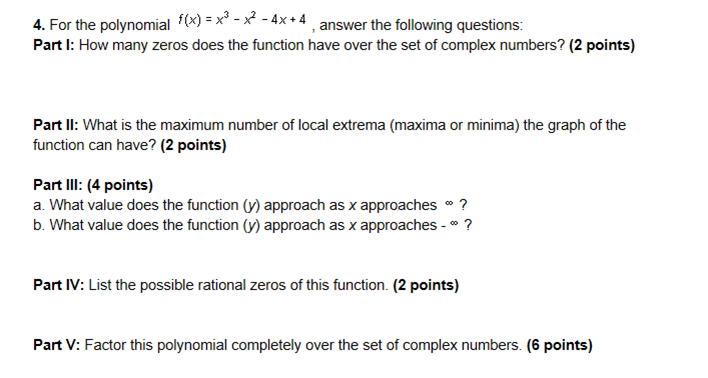
highest exponent is 3, so only 3 possible total roots to figure out how many complex roots, first figure out how many real roots by setting the equation equal to 0, factoring it, and solving for x
zarkam21:
3?
Vocaloid:
good, so 3 roots [just did a quick search and "zeros over the set of complex numbers" doesn't mean complex roots, just total roots, so part A) is 3]
Vocaloid:
part II) number of extrema = degree of the function - 1 = ?
zarkam21:
2
Vocaloid:
good for part III) what happens to the function x gets infinitely large and positive? does it diverge to +infinity or -infinity?
zarkam21:
+?
Vocaloid:
good so a) = +infinity what about b)? does the function approach + or -infinity as x --> -infinity?
zarkam21:
-
zarkam21:
-infinity?
Vocaloid:
good so b) -infinity
Vocaloid:
for part IV) use the rational root theorem start by listing all the factors of the constant term 4, including +/- signs for each factor
zarkam21:
so +1,+2,+3,+4
Vocaloid:
3 is not a factor of 4 so ±1, ±2, ±4 then, the leading coefficient is just 1, so its factors are just ±1 then we list all possibilities of constant factors/leading coefficient factors
Vocaloid:
so ±1/1, ±2/1, ±4/1, then we just simplify this to get ±1, ±2, ±4
Vocaloid:
for part V) x^3 - x^2 - 4x + 4 start by splitting this into two parts (x^3 - x^2) - (4x - 4) then just factor out the from this and lmk what you get (x^3 - x^2)
Vocaloid:
*factor out the gcf
zarkam21:
x^2(x-1)
Vocaloid:
awesome then the other part: (4x - 4) factor out the gcf again
zarkam21:
4(x-1)
Vocaloid:
good then we have x^2(x-1) - 4(x-1) we can re-combine these to get (x^2 - 4)(x-1) {this is the opposite of the distributive property] then, if we look at x^2 - 4 this is a difference of squares so what does x^2 - 4 factor to?
zarkam21:
(x+2)(x-2)
Vocaloid:
awesome so the entire factored form is (x-1)(x+2)(x-2) = your ans
Vocaloid:
and that's it!
Join our real-time social learning platform and learn together with your friends!
 KBaby:
Verse 1 We left our names in the dust of the driveway Watched the old town shrink
KBaby:
Lyrics Generator Use AI to write the lyrics for a song. Suggested Genres: Pop Hip
KBaby:
Verse 1 We left our names in the dust of the driveway Watched the old town shrink
KBaby:
Lyrics Generator Use AI to write the lyrics for a song. Suggested Genres: Pop Hip

 aitexturegenerator:
How are you all handling AI-generated textures for 3D models and game assets without losing the hand-made feel? I've been doing a small stylized environment
aitexturegenerator:
How are you all handling AI-generated textures for 3D models and game assets without losing the hand-made feel? I've been doing a small stylized environment

 Demon25:
Woke up feeling like that girl and that dude well he still aint crap pluse the du
Demon25:
Woke up feeling like that girl and that dude well he still aint crap pluse the du
 playtsec:
how do I get rid of stress from teachers... I just feel like running out the classroom and leaving on my own.
playtsec:
how do I get rid of stress from teachers... I just feel like running out the classroom and leaving on my own.
 JohnnyLFowler0812:
What type of gamer would play something and then get off for a while. Why not sta
JohnnyLFowler0812:
Which is better? Metallica Rap Country R&B hiphop Medal Gospel Chill Which 3 opti
JohnnyLFowler0812:
What type of gamer would play something and then get off for a while. Why not sta
JohnnyLFowler0812:
Which is better? Metallica Rap Country R&B hiphop Medal Gospel Chill Which 3 opti