
 Vocaloid:
Quantum Mechanics Question - How to normalize this wavefunction?
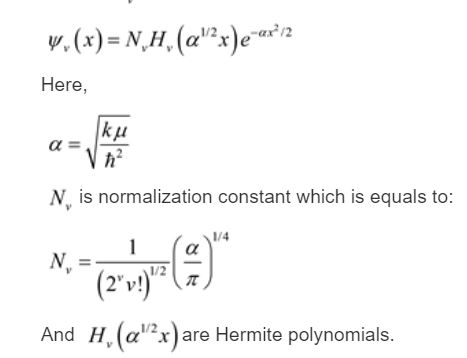 Vocaloid:
(the normalization constant is there; I was just wondering how they derived it)
 kaylak:
I've seen this in ap biology but, I'm not sure how to do it. I wish I was more helpful.
 tigerlover:
A particle with mass mm is moving in one dimension. The wave function of the particle is Ψ(x,t)=Axe−(km√/2ℏ)x2e−ik/m√(3/2)t Ψ(x,t)=Axe−(km/2ℏ)x2e−ik/m(3/2)t for −∞<x<∞−∞<x<∞, where kk and AA are constants. Normalize this wave function. To normalize a wave function, we impose the condition ∫∞−∞|Ψ(x,t)|2dx=1 ∫−∞∞|Ψ(x,t)|2dx=1 and solve for any constants (in this case, AA, and possibly kk). To make my life easier, I set D=km√ℏD=kmℏ, so Ψ(x,t)=Axe−(D/2)x2e−ik/m√(3/2)tΨ(x,t)=Axe−(D/2)x2e−ik/m(3/2)t, and |Ψ(x,t)|2=A2x2e−Dx2|Ψ(x,t)|2=A2x2e−Dx2. Thus, we are tasked with evaluating the integral A2∫∞−∞x2e−Dx2dx A2∫−∞∞x2e−Dx2dx Using an integral table, I found that ∫∞−∞x2e−Dx2dx=14πD3−−−√erf(xD−−√)∣∣∣∞−∞−x2De−Dx2∣∣∣∞−∞ ∫−∞∞x2e−Dx2dx=14πD3erf(xD)|−∞∞−x2De−Dx2|−∞∞ Supposedly, erf(∞)=1erf(∞)=1 and erf(−∞)=−1erf(−∞)=−1, so the first term evaluates to 12πD3−−−√12πD3. For the second term, since DD is a positive quantity, evaluating it at ∞∞ gives 00, but I can't seem to use similar reasoning and intuition for −∞−∞. Crudely substituting −∞−∞ into the expression gives (−∞)(e∞)=(−∞)(∞)(−∞)(e∞)=(−∞)(∞). Is this an indeterminate form? And if so, how should L'Hospital's rule be used to help? I tried it a few different ways and didn't make any progress. PS: It might be silly to want to do the last step of evaluating the integral at its limits, when I already used a table to get to that step, but I'm mostly just curious to see how it can be done analytically / algebraically. I hope this is right but dont listen to me btw. Get confermation from someone else. I'm not to confadent about this answer >.<
 sillybilly123:
This is Qu 10 in Boas' Calculus book, Ch 12 Sect 22, it comes with a few hints and certain "EXTRA"neous results that are necessary. They are "proved" separately in the book \(\int\limits_{-\infty}^{\infty} dx ~ ~ \Psi^* \Psi \) \(= \int\limits_{-\infty}^{\infty} dx ~ ~ N_n H_n e^{- \alpha x^2 /2}~ N_m H_m e^{- \alpha x^2 /2} \) \(= N_n N_m \int\limits_{-\infty}^{\infty} dx ~e^{- \alpha x^2} ~ H_n( \sqrt \alpha x) ~ H_m ( \sqrt \alpha x)\) with \(X = \sqrt \alpha x\) \(= \frac{1}{\sqrt \alpha} N_n N_m \int\limits_{-\infty}^{\infty} dX ~e^{- X^2} ~ H_n(X) ~ H_m(X) \) EXTRA 1: the Rodrigues formula: \(H_n = (-1)^n e^{X^2} \dfrac{d^n}{dX^n} e^{- X^2}\): \(= \frac{1}{\sqrt \alpha} N_n N_m \int\limits_{-\infty}^{\infty} dX ~e^{- X^2} ~ (-1)^n e^{X^2} \dfrac{d^n}{dX^n} e^{- X^2} ~ H_m \) By IBP: \(= \frac{1}{\sqrt \alpha} N_n N_m (-1)^n \left( \left[\dfrac{d^{n-1}}{dX^{n-1}}e^{- X^2} H_m \right]_{- \infty}^{\infty} - \int\limits_{-\infty}^{\infty} dX ~ \dfrac{d^{n-1}}{dX^{n-1}} e^{- X^2} ~\dfrac{d}{dX} H_m \right)\) EXTRA 2: the recursion result: \(H'_n = 2n H_{n-1}\), and a reverse-Rodriguez: \(= \frac{1}{\sqrt \alpha} N_n N_m (-1)^n \left( \left[\dfrac{d^{n-1}}{dX^{n-1}}e^{- X^2} H_m \right]_{- \infty}^{\infty} - \int\limits_{-\infty}^{\infty} dX ~ \dfrac{1}{(-1)^{n-1}} H_{n-1} e^{- X^2} ~2m H_{m-1} \right)\) \(= \frac{1}{\sqrt \alpha} N_n N_m (-1)^n \left( 0 - \dfrac{1}{(-1)^{n-1}} 2m\int\limits_{-\infty}^{\infty} dX ~ e^{- X^2} H_{n-1} H_{m-1} \right)\) \(\implies I_{n,m} = \frac{2m}{\sqrt \alpha} N_n N_m \int\limits_{-\infty}^{\infty} dX ~ e^{- X^2} H_{n-1} H_{m-1} = 2m \dfrac{N_nN_m}{N_{n-1}N_{m-1} }I_{n-1, m-1}\) EXTRA 3: Theeee bombshell, Hermite polynimials are orthogonal when weighted by \(e^{- X^2}\), so we can specify that n = m at any point for an actual wavefunction to exist So \( I_{n,n} = 2n \dfrac{N_n^2}{N_{n-1}^2 }I_{n-1, n-1}\) We can also drop all that normalisation palaver as it's a mess ***and we would get the same result by using actual values of the integrals*** ie really wish i had left those out and normalised later but there is soooo much Latex,...., so we'll ditch them mid stream.... and simplifying \(I_{n,n} = 2n I_{n-1,n-1}\) \(I_{0,0} = \int\limits_{-\infty}^{\infty}~ dx ~ e^{- \alpha x^2} = \sqrt {\dfrac{\pi}{\alpha}}\) as \(H_0 = 1\) \(I_{1,1} = 2(1) \sqrt {\dfrac{\pi}{\alpha}}\) \(I_{2,2} = 2\cdot 2 (1 \cdot 2) \sqrt {\dfrac{\pi}{\alpha}}\) And generally: \(I_{n,n} = 2^n n! \sqrt {\dfrac{\pi}{\alpha}}\) so if we NOW force normalisation \(N_n^2 I_{n,n} = 1 \implies N_n^2 = \dfrac{1}{2^n n! \sqrt {\dfrac{\pi}{\alpha}}}\) which is your result.....
sillybilly123:
That's not really physics or chemistry though :)
Vocaloid:
Thank you so much, it must have taken a long time to do this ;;
sillybilly123:
Yes, Voca, it took ages 😃 but i learned to love the ladder operators more this stuff doesn't even merit a mention in Eisberg/Resnick. hence Boas. and TUVM for the qu 😃
Join our real-time social learning platform and learn together with your friends!
 KBaby:
Verse 1 We left our names in the dust of the driveway Watched the old town shrink
KBaby:
Lyrics Generator Use AI to write the lyrics for a song. Suggested Genres: Pop Hip
KBaby:
Verse 1 We left our names in the dust of the driveway Watched the old town shrink
KBaby:
Lyrics Generator Use AI to write the lyrics for a song. Suggested Genres: Pop Hip
 aitexturegenerator:
How are you all handling AI-generated textures for 3D models and game assets without losing the hand-made feel? I've been doing a small stylized environment
aitexturegenerator:
How are you all handling AI-generated textures for 3D models and game assets without losing the hand-made feel? I've been doing a small stylized environment

 Demon25:
Woke up feeling like that girl and that dude well he still aint crap pluse the du
Demon25:
Woke up feeling like that girl and that dude well he still aint crap pluse the du
 playtsec:
how do I get rid of stress from teachers... I just feel like running out the classroom and leaving on my own.
playtsec:
how do I get rid of stress from teachers... I just feel like running out the classroom and leaving on my own.
 JohnnyLFowler0812:
What type of gamer would play something and then get off for a while. Why not sta
JohnnyLFowler0812:
Which is better? Metallica Rap Country R&B hiphop Medal Gospel Chill Which 3 opti
JohnnyLFowler0812:
What type of gamer would play something and then get off for a while. Why not sta
JohnnyLFowler0812:
Which is better? Metallica Rap Country R&B hiphop Medal Gospel Chill Which 3 opti