
 zarkam21:
Help please
 zarkam21:
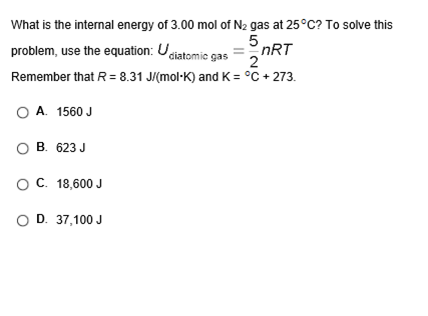
A?
zarkam21:
@Vocaloid
 Vocaloid:
check your calculations again (5/2)nRT = (5/2)(3)(8.31)(25+273) = ?
Vocaloid:
(5/2)(3)(8.31)(25+273) = ? you just need to chuck this into a calculator ^^
zarkam21:
C
Vocaloid:
good!
 zarkam21:
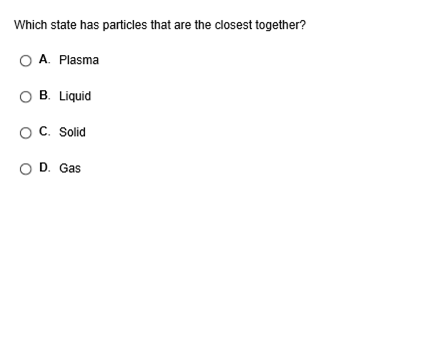
C
Vocaloid:
well done
 zarkam21:
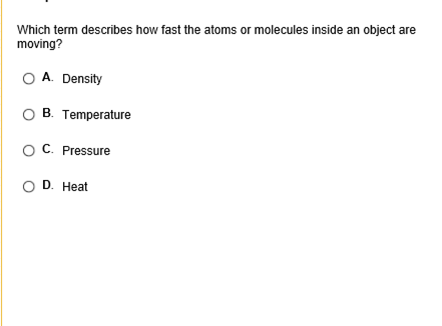
D
Vocaloid:
this is a very common mistake but temperature is the measure of avg. molecular velocity, not heat; heat is a measure of thermal energy
Vocaloid:
so temperature
 Vocaloid:
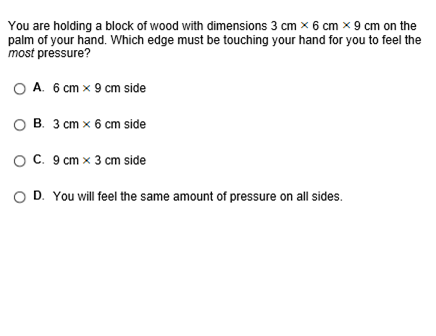
pressure = Force/Area since we're talking about the same block, force of gravity is equal, so we are looking for the smallest surface area of the side
zarkam21:
c
Vocaloid:
9 * 3 = 27 but there's a smaller one than that
zarkam21:
B
Vocaloid:
good, B
 Vocaloid:
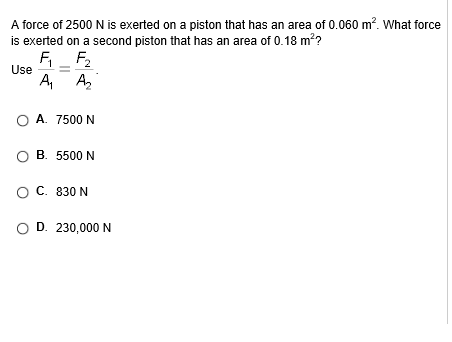
you're given A1, F1, and A2, just need to plug in and solve for F2 F1/A1 = F2/A2 2500/0.06 = F2/0.18 solve for F2
zarkam21:
a
Vocaloid:
good
 zarkam21:
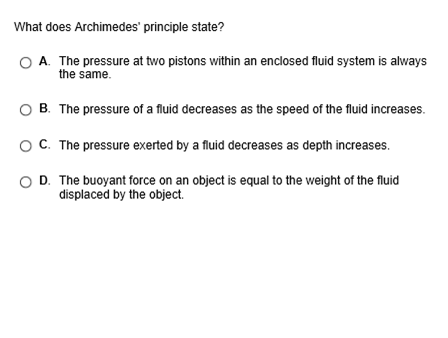
d
Vocaloid:
good
 zarkam21:
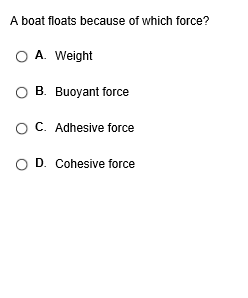
B
Vocaloid:
good
 zarkam21:
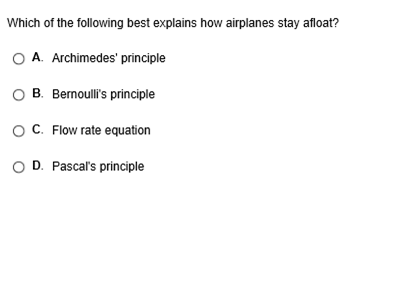
B
Vocaloid:
good
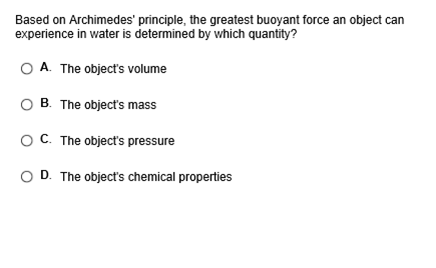 zarkam21:
either a or b
Vocaloid:
well we determined earlier that Archimedes' principle states that buoyant force is proportional to volume (so A not B)
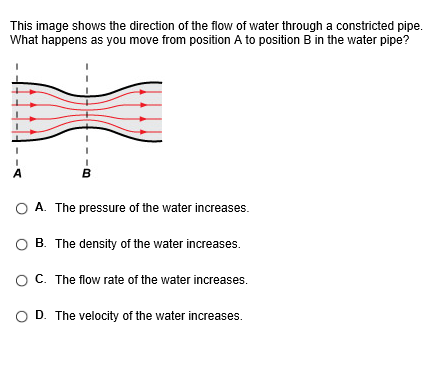 zarkam21:
D
Vocaloid:
yeah good
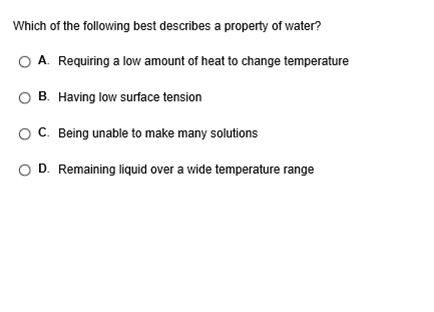 zarkam21:
B
Vocaloid:
water molecules are very attracted to each other causing them to bond together on surfaces, resulting in high surface tension not low as a hint, water has a high heat capacity which would result in which answer choice as the correct conclusion?
zarkam21:
A
Vocaloid:
recall that a high heat capacity means that water must take in a lot of heat to change its temperature, the opposite of what A is stating
zarkam21:
uugh um d
Vocaloid:
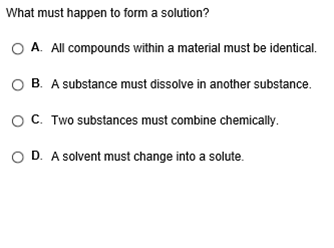
good, D
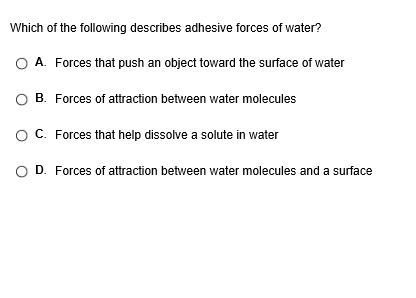 zarkam21:
Ugh stuck between b and d
Vocaloid:
B would be cohesion (being attracted to itself), D would be adhesion (attraction to other surfaces), so D
 zarkam21:
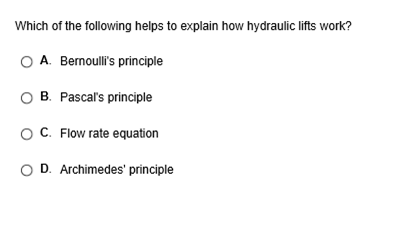
B
Vocaloid:
good
 zarkam21:
B
Vocaloid:
good
 Vocaloid:
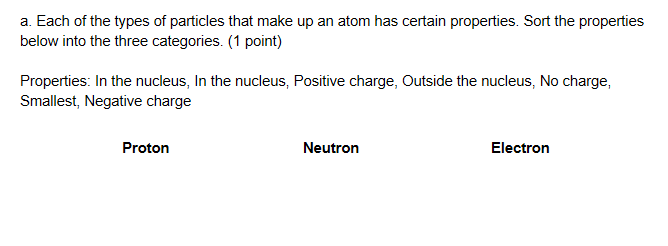
well let's start with in nucleus vs. out, there are two particles that are in and one type that is out, what are they?
 zarkam21:
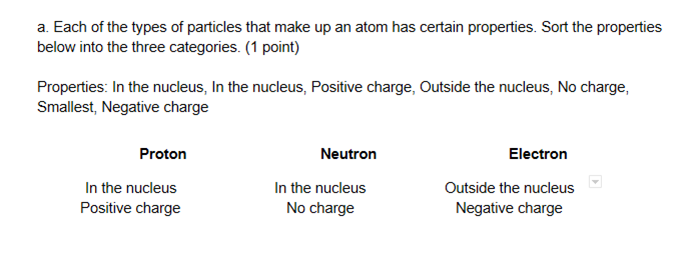
Actually I did it, can you just check it over
Vocaloid:
good but you missed "smallest" which particle is this?
Vocaloid:
oh wait you put it under electron never mind yeah that's right
zarkam21:
No i didnt
zarkam21:
smallest would be electron right?
Vocaloid:
yeah good
zarkam21:
Compare the numbers of protons and electrons in a positive ion with the numbers of protons and electrons in a negative ion.
Vocaloid:
well if it's positive which is greater, # protons or # electrons?
zarkam21:
protons
Vocaloid:
good, so positive ion would be "more protons than electrons" and then for negative ion it would just be the opposite, "more electrons than protons" that's really it
zarkam21:
How many protons, neutrons, and electrons does a neutral atom of nitrogen-15 have
Vocaloid:
well, # of protons is easy --> just look at the ptable and find its atomic number
Vocaloid:
ptable.com atomic number is 7, then the number of electrons is also equal to protons since the atom is neutral, then to find neutrons just subtract mass # (15) - atomic number (7)
zarkam21:
A nitrogen atom has 7 protons, typically 7 neutrons, and 7 electron
Vocaloid:
you're on the right track but we are talking about nitrogen-15 which is not a typical nitrogen atom
Vocaloid:
# of neutrons = mass # - atomic # = 15 - 7 = ?
zarkam21:
8
Vocaloid:
good so 7 protons ; 7 electrons ; 8 neutrons
zarkam21:
Many scientists have contributed to the atomic theory. Match the scientists below with the correct descriptions of their work. Some scientists will be used more than once. (1 point) A. Thomson B. Bohr C. Rutherford D. Dalton _____ Believed that electrons move in specific orbits _____ Discovered electrons _____ Believed that atoms could not be broken into smaller parts _____ Experimented with cathode rays _____ Inferred that atoms have a small, dense, positive nucleus _____ Developed plum-pudding model _____ Shot particles at gold foil
zarkam21:
Well the last two are c and a
Vocaloid:
yeah, that's good, for this one you really just have to look them up ex. electrons in orbits would be Bohr
Vocaloid:
lmk if you're getting stuck or need help
zarkam21:
__B___ Believed that electrons move in specific orbits __A___ Discovered electrons __D___ Believed that atoms could not be broken into smaller parts ___A__ Experimented with cathode rays _____ Inferred that atoms have a small, dense, positive nucleus ___C__ Developed plum-pudding model __A___ Shot particles at gold foil
Vocaloid:
you mixed up the last two, rutherford was the one with the gold foil and thompson was the one who came up w/ the plum pudding model
Vocaloid:
"Inferred that atoms have a small, dense, positive nucleus" hint - this was a result of the gold foil experiment
zarkam21:
C
Vocaloid:
good, so __B___ Believed that electrons move in specific orbits __A___ Discovered electrons __D___ Believed that atoms could not be broken into smaller parts ___A__ Experimented with cathode rays __C__ Inferred that atoms have a small, dense, positive nucleus ___A__ Developed plum-pudding model __C___ Shot particles at gold foil
zarkam21:
Explain the progression of ideas from a variety of scientists that led to the current understanding of atomic theory.
Vocaloid:
this is a very bare-bones and I would recommend fleshing this out but: Dalton, used ideas about the atoms from the Greeks (particularly Aristotle), thought atoms were indivisible, every atom in a particular element is identical in composition JJ Thompson - plum pudding, cathode ray experiments, discovered charge of electron Rutherford - gold foil, model where atom had dense center w/ mostly empty space outside the center Bohr - came up w/ orbit model and the idea of quantized electron energy, positions of electrons could only be on integer energy levels Schrodinger: quantum atom model where electrons are de-localized in electron clouds instead of orbits
Vocaloid:
I would try to put this into coherent sentences, make sure to fill in approximate dates, do any additional clarification/research to help explain certain things in more detail, etc.
Vocaloid:
Each person should probably have its own short 2-5 sentence paragraph
zarkam21:
did that, i added more details and dates.
zarkam21:
hoose one example from the historical development of the atomic theory, and use it to illustrate how models are used in the process of forming conclusions from scientific experiments.
Vocaloid:
well, I think the Rutherford gold experiments are good example - since he wanted to test a hypothesis about the structure of the atom, had very unexpected results (the atom had a dense center that reflected particles), and had to come up with a better model to describe his results, which is an example of how he used a model to form a conclusion about the structure of the atom
Vocaloid:
something like that
zarkam21:
I got the idea let me reword it :)
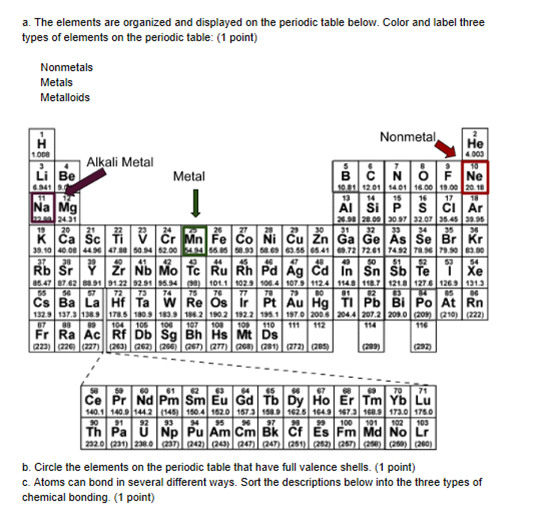 Vocaloid:
I am not sure about the phrasing for a) but it seems like they want you to color three regions not just three elements, the metal, nonmetal, and metalloid regions (just have to look up a periodic table and color the areas)
Vocaloid:
for b) full valence shells => last group, where helium and the noble gases are
zarkam21:
okay and c
Vocaloid:
I can't see below where it says "sort the descriptions below"
zarkam21:
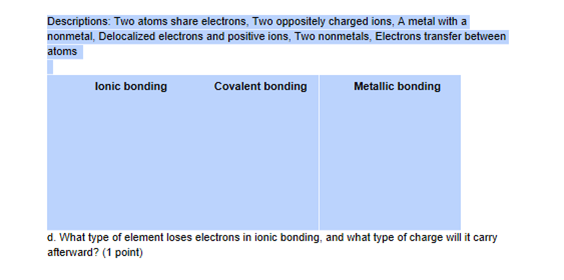
Atoms can bond in several different ways. Sort the descriptions below into the three types of chemical bonding.
Vocaloid:
may I see the descriptions please
 Vocaloid:
do you have any guesses/ any ideas where to start?
Vocaloid:
like, for "two atoms share electrons" do you remember which one this is?
zarkam21:
covalent
Vocaloid:
good, what about 'two oppositely charged ions"?
zarkam21:
ionic
Vocaloid:
good, what about metal + nonmetal?
Vocaloid:
you kinda just have to memorize this, it's ionic
Vocaloid:
any ideas for "delocalized electrons + positive ions"?
zarkam21:
metallic
Vocaloid:
good two nonmetals -->?
zarkam21:
ionic
Vocaloid:
nonmetals form covalent bonds w/ each other (just have to memorize this)
Vocaloid:
electron transfer between atoms -->?
zarkam21:
metallic
Vocaloid:
close but not quite when ions are formed, they gain/lose electrons, right? and when ions bond w/ each other, electrons are transferred from the anion to the cation---> making ionic the better answer
Vocaloid:
that leads us into d) ---> metals lose electrons, and if a neutral metal loses electrons is the new charge positive or negative?
zarkam21:
neg
Vocaloid:
electrons are negative charge so if the negative charges are going away, what's the charge of the remaining atom?
zarkam21:
positove
Vocaloid:
good, that's it for d
zarkam21:
When you hold a rectangular object, how does the area of the side that is resting on your hand affect the pressure and the force that the object exerts
Vocaloid:
P = F/A, force of gravity is constant for an object, so the area determines pressure
zarkam21:
this is the answer right, there wouldn't be any numbers
Vocaloid:
yeah, we aren't given any numbers so we can't do any calculations
zarkam21:
What are four types of energy that might make up the internal energy of a substance?
zarkam21:
internal
zarkam21:
heat chemical
Vocaloid:
I'm not 100% sure what they want as the answer here but I'd say translational kinetic energy, vibrational KE, rotational KE, potential energy from intermolecular forces
zarkam21:
Yeah i wasn't sure either the question is very vague
Vocaloid:
(I don't know whether they want you to consider the macroscopic vs microscopic perspective)
Vocaloid:
anyway I should probably sleep I have an 8am tomorrow goodnight
zarkam21:
See ya
Join our real-time social learning platform and learn together with your friends!
 KBaby:
Verse 1 We left our names in the dust of the driveway Watched the old town shrink
KBaby:
Lyrics Generator Use AI to write the lyrics for a song. Suggested Genres: Pop Hip
KBaby:
Verse 1 We left our names in the dust of the driveway Watched the old town shrink
KBaby:
Lyrics Generator Use AI to write the lyrics for a song. Suggested Genres: Pop Hip

 aitexturegenerator:
How are you all handling AI-generated textures for 3D models and game assets without losing the hand-made feel? I've been doing a small stylized environment
aitexturegenerator:
How are you all handling AI-generated textures for 3D models and game assets without losing the hand-made feel? I've been doing a small stylized environment

 Demon25:
Woke up feeling like that girl and that dude well he still aint crap pluse the du
Demon25:
Woke up feeling like that girl and that dude well he still aint crap pluse the du
 playtsec:
how do I get rid of stress from teachers... I just feel like running out the classroom and leaving on my own.
playtsec:
how do I get rid of stress from teachers... I just feel like running out the classroom and leaving on my own.
 JohnnyLFowler0812:
What type of gamer would play something and then get off for a while. Why not sta
JohnnyLFowler0812:
Which is better? Metallica Rap Country R&B hiphop Medal Gospel Chill Which 3 opti
JohnnyLFowler0812:
What type of gamer would play something and then get off for a while. Why not sta
JohnnyLFowler0812:
Which is better? Metallica Rap Country R&B hiphop Medal Gospel Chill Which 3 opti