
 zarkam21:
How does pressure change as the depth below the surface of a fluid increases
 Vocaloid:
do you think pressure increases or decreases as depth below the surface increases?
zarkam21:
um decreases
Vocaloid:
keep in mind, when an object is at the surface, there's no fluid above it so no fluid pressure, but as the object keeps going further and further down it experiences more and more pressure from the fluid above it so pressure increases as depth below increases
Vocaloid:
that's really all you need to say for this problem, you could also mention p = (rho)*g*h where h is the height of fluid above the object, but the pressure vs depth relationship is the important part
zarkam21:
hat is the mathematical equation for the total pressure below the surface of a fluid that has air above it? Identify each variable.
zarkam21:
x
Vocaloid:
i'm not 100% sure on this but I believe it would be P = (rho)* g * h where rho is the density, g is the gravitational constant, h is the height between the surface of the fluid and the height at which we are measuring
zarkam21:
Yeah i did a quick google search and that is what came up
 Vocaloid:
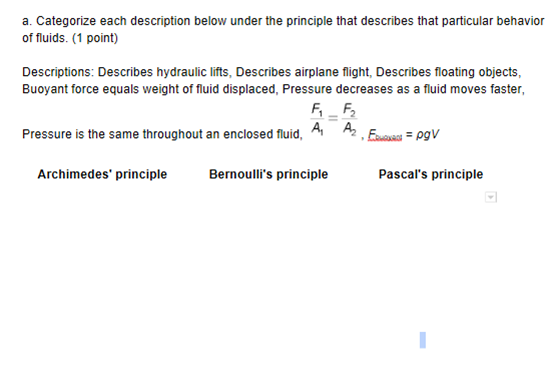
any ideas/guesses so far? this is mostly just memorization/fact based
 Vocaloid:
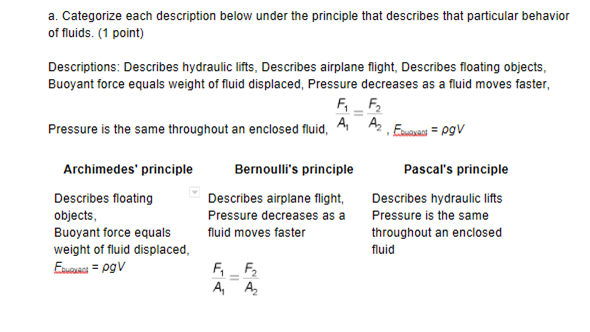
the F/A = F/A would be pascals not bernoulli pressure is same throughout enclosed fluid is pascal
Vocaloid:
everything else is ok
zarkam21:
A force of 3300 N is exerted on a piston that has an area of 0.060 m2. What force is exerted on a second piston that has an area of 0.18 m^2
Vocaloid:
F/A = F/A 3300/0.06 = F/0.18 solve for F
zarkam21:
9900N
Vocaloid:
good
zarkam21:
c. Describe an object that floats in water and an object that sinks in water in terms of their respective densities, as well as in terms of the relationship between each one's weight and buoyant force
zarkam21:
a ship?
Vocaloid:
good, since "whether an object floats" is dependent on density (which is related to weight/mass but not the same thing) a ship will float b/c it's less dense than water, opposite would be true for a sinking object like a rock
Vocaloid:
in terms of weight/buoyant force, if buoyant force > weight, object floats on surface, if buoyant force = weight, object floats but inside the fluid not the surface, if buoyant force < weight object sinks
Vocaloid:
that's pretty much the jist of it
Join our real-time social learning platform and learn together with your friends!
 KBaby:
Verse 1 We left our names in the dust of the driveway Watched the old town shrink
KBaby:
Lyrics Generator Use AI to write the lyrics for a song. Suggested Genres: Pop Hip
KBaby:
Verse 1 We left our names in the dust of the driveway Watched the old town shrink
KBaby:
Lyrics Generator Use AI to write the lyrics for a song. Suggested Genres: Pop Hip

 aitexturegenerator:
How are you all handling AI-generated textures for 3D models and game assets without losing the hand-made feel? I've been doing a small stylized environment
aitexturegenerator:
How are you all handling AI-generated textures for 3D models and game assets without losing the hand-made feel? I've been doing a small stylized environment

 Demon25:
Woke up feeling like that girl and that dude well he still aint crap pluse the du
Demon25:
Woke up feeling like that girl and that dude well he still aint crap pluse the du
 playtsec:
how do I get rid of stress from teachers... I just feel like running out the classroom and leaving on my own.
playtsec:
how do I get rid of stress from teachers... I just feel like running out the classroom and leaving on my own.
 JohnnyLFowler0812:
What type of gamer would play something and then get off for a while. Why not sta
JohnnyLFowler0812:
Which is better? Metallica Rap Country R&B hiphop Medal Gospel Chill Which 3 opti
JohnnyLFowler0812:
What type of gamer would play something and then get off for a while. Why not sta
JohnnyLFowler0812:
Which is better? Metallica Rap Country R&B hiphop Medal Gospel Chill Which 3 opti