
 kaylak:
help
kaylak:
@Vocaloid
 Vocaloid:
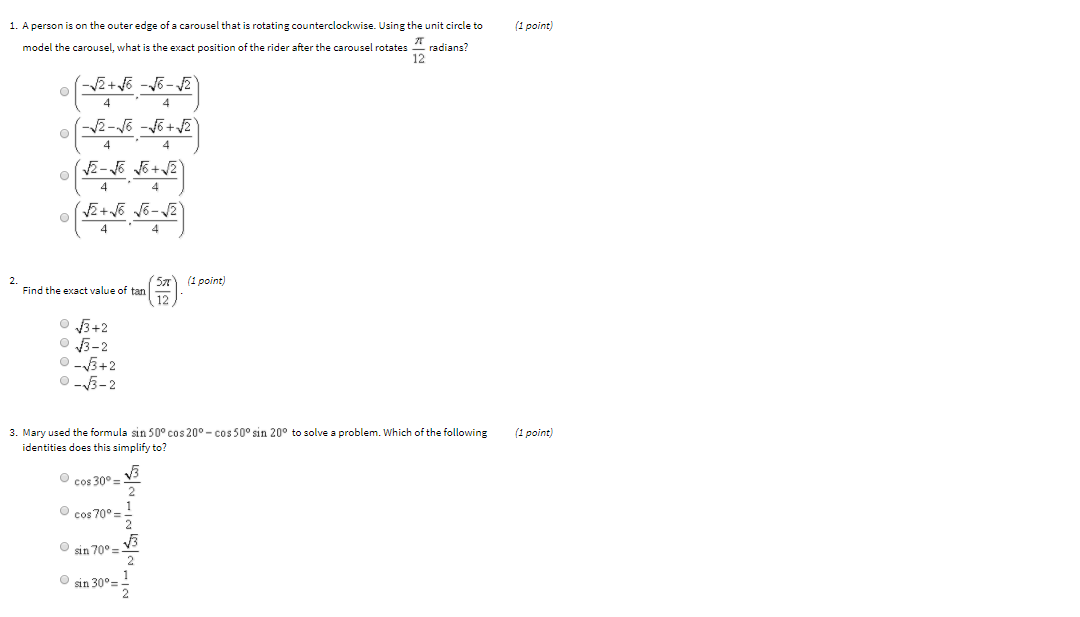
for the first one you need to find the coordinate (cos(theta), sin(theta)) since cos(pi/12) and sin(pi/12) are not on the unit circle you need to re-write pi/12 in terms of angles that ~are~ on the unit circle and use difference identities to find the exact value of cos(pi/12) and sin(pi/12)
Vocaloid:
as a hint, pi/12 = pi/3 - pi/4
kaylak:
so b
kaylak:
@Vocaloid
Vocaloid:
check your calculations again cos(pi/12) = cos(pi/3 - pi/4) then use the last cos identity to find cos(pi/12)
Vocaloid:
|dw:1520395065571:dw|
kaylak:
d maybe i see that both are in q1
Vocaloid:
|dw:1520395786442:dw|
Vocaloid:
perform the appropriate calculation for alpha = pi/3 and beta = pi/4
Vocaloid:
|dw:1520395834283:dw|
kaylak:
clockwise is apparently a negative rotation so means counterclockwise is positive
Vocaloid:
with all due respect I would appreciate it if you at least took what I have said into consideration, I've put a lot of thought into what I've written
Vocaloid:
we have re-written our equation as cos(pi/3 - pi/4), if we match this up with the cos difference formula we get alpha = pi/3 and beta = pi/4 plug this into our difference equation cos(alpha)cos(beta) + sin(alpha)sin(beta) = ?
kaylak:
it must be c im looking at some examples in my lesson too semi helpful can't wait till this unit is over no more trig
kaylak:
because 60 degrees and 45 degrees there is one similar i my examples not the same but close enough
kaylak:
@Vocaloid i solved pi/12 is 15 degrees and got c for answer
Join our real-time social learning platform and learn together with your friends!
 KBaby:
Verse 1 We left our names in the dust of the driveway Watched the old town shrink
KBaby:
Lyrics Generator Use AI to write the lyrics for a song. Suggested Genres: Pop Hip
KBaby:
Verse 1 We left our names in the dust of the driveway Watched the old town shrink
KBaby:
Lyrics Generator Use AI to write the lyrics for a song. Suggested Genres: Pop Hip
 aitexturegenerator:
How are you all handling AI-generated textures for 3D models and game assets without losing the hand-made feel? I've been doing a small stylized environment
aitexturegenerator:
How are you all handling AI-generated textures for 3D models and game assets without losing the hand-made feel? I've been doing a small stylized environment

 Demon25:
Woke up feeling like that girl and that dude well he still aint crap pluse the du
Demon25:
Woke up feeling like that girl and that dude well he still aint crap pluse the du
 playtsec:
how do I get rid of stress from teachers... I just feel like running out the classroom and leaving on my own.
playtsec:
how do I get rid of stress from teachers... I just feel like running out the classroom and leaving on my own.
 JohnnyLFowler0812:
What type of gamer would play something and then get off for a while. Why not sta
JohnnyLFowler0812:
Which is better? Metallica Rap Country R&B hiphop Medal Gospel Chill Which 3 opti
JohnnyLFowler0812:
What type of gamer would play something and then get off for a while. Why not sta
JohnnyLFowler0812:
Which is better? Metallica Rap Country R&B hiphop Medal Gospel Chill Which 3 opti