
 zarkam21:
Help pleasse
 Vocaloid:
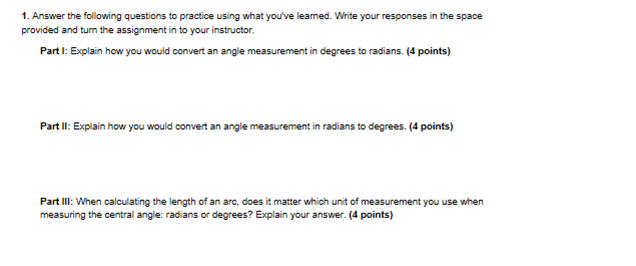
do you remember the degrees to radians / the radians to degrees formulas from before?
zarkam21:
1 degree is 0.01745329
Vocaloid:
well, I guess that works, but the answer they're probably looking for is to multiply by a specific conversion factor (to get a more precise answer)
Vocaloid:
|dw:1520385815242:dw|
Vocaloid:
so they're probably looking for something along the lines of "multiply the measurement by ____" where the appropriate conversion factor goes into the blank the advantage to using this method is that, since we use pi instead of a truncated decimal, we retain the precision of the measurement
Vocaloid:
I hope that makes sense, lmk if you're having trouble understanding or if you want to move on to part III :S
 zarkam21:
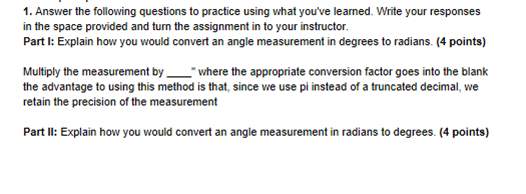
Obviously I am going to rephrase this, but like this?
Vocaloid:
I don't think you need all of that, you just need to explain that you would multiply by the conversion factor
zarkam21:
for I and II
Vocaloid:
the fluff at the bottom was just me explaining why we use these conversion factors instead of 1 degree = 0.01745329 it just needs to be "multiply by ___" [put the conversion factor into the blank]
zarkam21:
multiply by 0.01745329
Vocaloid:
remember what I said earlier - that is technically correct but we would not want to use this as the conversion because we lose significant digits/accuracy
Vocaloid:
|dw:1520386265722:dw|
Vocaloid:
^ use this as your reference
zarkam21:
Wouldn/t this be the answer like the formula
Vocaloid:
let's translate the first line into English radians = (pi/180) * degrees ^ this means that, to convert from degrees to radians, we would multiply the angle measurement by pi/180, make sense?
zarkam21:
Yes
Vocaloid:
so, for part I, we would write "to convert from degrees to radians, we would multiply the degree measurement by pi/180 degrees" can you try repeating this process/logic for part II, using the appropriate conversion factor?
zarkam21:
to convert from radians to degrees , we would divide the degree measurement by pi/180 degrees
Vocaloid:
|dw:1520386499257:dw|
Vocaloid:
^ keep in mind the conversion factor is not pi/180 for part II, it would be 180 degrees/pi
zarkam21:
to convert from radians to degrees , we would divide the radians measurement by 180 degrees/pi
Vocaloid:
|dw:1520386567737:dw|
Vocaloid:
that's a multiplication sign, not a division sign ^_^
zarkam21:
to convert from radians to degrees , we would multiply the radians measurement by 180 degrees/pi
Vocaloid:
awesome, that's it for parts I and II
Vocaloid:
for part III - any ideas/thoughts so far? can you think of any formula(s) for arc length and what the conditions are to use them?
zarkam21:
2π rad=360°=400 gr
zarkam21:
f we use degree: if the central angle is y degree, 2*pi*R*y/360 is the length of the arc
Vocaloid:
|dw:1520386803480:dw| remember this one? we've used it a few times before, do you remember what must be true to use this? it has something to do with theta
zarkam21:
If you measure the central angle in degress, you use the proportion circumference / 360° = length of arc / central angle in degrees,and if you measure the angle in radians, you use the proportion circumference / (2π) = length of arc / central angle in radians
Vocaloid:
(sorry if this is taking a while I'm just thinking of a good way to explain this ;_;)
zarkam21:
Why are you apologizing, it's me duh i apologize that i am potentially stressing you out
Vocaloid:
so, what you posted is getting on the right track - the arc length is a function of the central angle and circumference, but units ~are~ important, since the units of central and the units of the arc must be consistent. for ex. if the angle is in radians the arc must also be in radians, likewise for degrees
zarkam21:
Okay so the unit would be incorporated as well
Vocaloid:
yeah ^^" in short it does matter, it influences what formula you use and influences what units the end result will be in
zarkam21:
SO this for Part III (of course rephrased) : the arc length is a function of the central angle and circumference, but units are important, since the units of central and the units of the arc must be consistent.
Vocaloid:
yeah, that's how I'd do it, I hope your teacher finds that acceptable :S
zarkam21:
I'm sure she will ^~^
 Vocaloid:
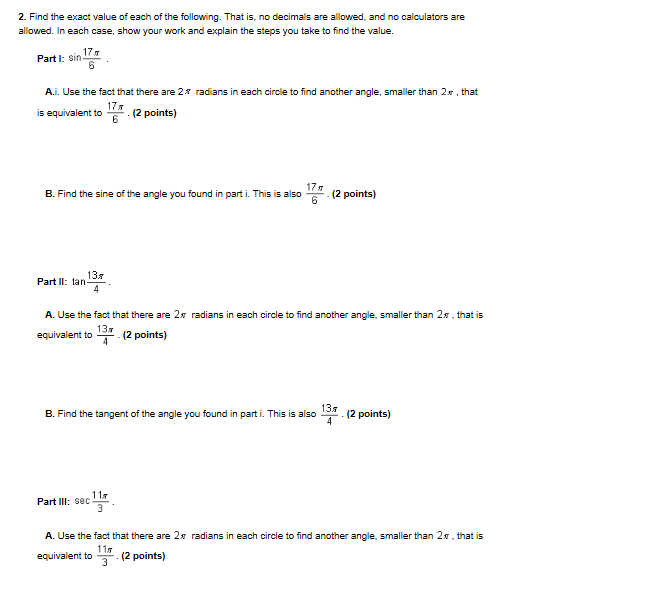
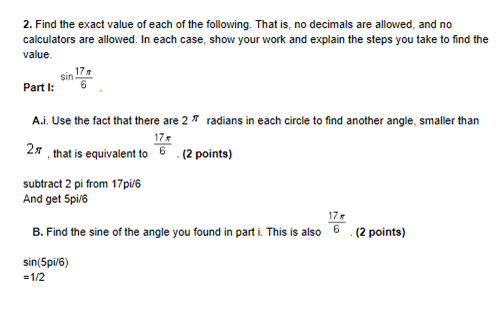
no calculators allowed, so we'll have to use the unit circle + our knowledge of equivalent angles for 17pi/6, you can subtract multiples of 2pi (so 2pi, 4pi, etc.) until you get a value that is within the unit circle (0 to 2pi) then you just need to read off the correct value from the Unit Circle
zarkam21:
I would use this right
Vocaloid:
yes if we subtract 2 pi from 17pi/6 what do we get?
zarkam21:
5pi/6
Vocaloid:
awesome, so A would be 5pi/6 as the equivalent angle, then for B you would just use the Unit Circle to find sin(5pi/6)
zarkam21:
1/2
Vocaloid:
awesome! so B is 1/2
Vocaloid:
for part II we just repeat a similar set of steps, first we would subtract multiples of 2pi from 13pi/4 until we get an angle btwn 0 and 2pi
zarkam21:
okay part II A
 zarkam21:
SO this so far right
Vocaloid:
yup perfect
Vocaloid:
any ideas for the angle on part IIA?
zarkam21:
Ugh no
Vocaloid:
to determine an equivalent angle, we just need to subtract 2 pi, until we get an angle btween 0 and 2pi so 13pi/4 - 2pi = ?
zarkam21:
5pi/4
Vocaloid:
awesome, so 5pi/4 is your angle for part A and then use the unit circle to find tan(5pi/4) for part B
zarkam21:
1
Vocaloid:
awesome, so that's part IIB
Vocaloid:
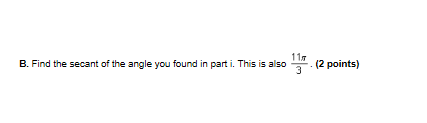
similar process for part IIIC, first subtract 11pi/3 - 2pi
Vocaloid:
** part IIIA
zarkam21:
5pi/3
Vocaloid:
good, then for B calculate sec(5pi/3) using the U.C. where sec = 1/cos
zarkam21:
2
Vocaloid:
awesome, is that it or is there a part IV
zarkam21:
that's it , but for this question. Are you busy or can you do more
Vocaloid:
yeah sure I can do a few more
 Vocaloid:
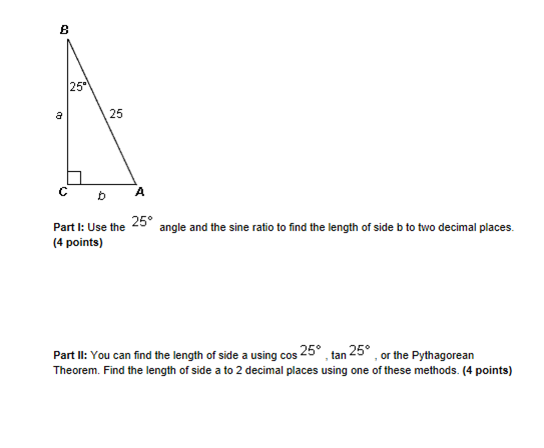
they want you to use sin and angle (25) so set up the function sin(theta) = opposite/hypotenuse, using angle 25 as theta, then find (b)
zarkam21:
sin(theta) = opposite/hypotenuse, sin(25)
Vocaloid:
good, but would you fill in for opposite/hypotenuse judging by the picture?
zarkam21:
b/25
Vocaloid:
awesome so sin(25) = b/25 solve for b, round to 2 decimal places
zarkam21:
10.57
Vocaloid:
awesome, so that's part I for part II we have 2 sides + the hypotenuse, so we would just plug a, b, and the hypotenuse into pythagorean theorem to find a
zarkam21:
10.57^2+25^2
Vocaloid:
hypotenuse goes on the right side a^2 + (10.57)^2 = 25^2, solve for a
zarkam21:
22.67
Vocaloid:
22.66 (since 22.6556 rounds to 22.66)
 zarkam21:
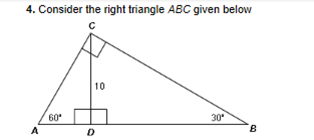
Part I: Triangle ABC is called a special right triangle. What kind of special right triangle is it (2 points) Part II: Triangle BCD is also a right triangle. What is the measure of angle BCD (2 points) Part III: Complete the sentence below. In a 30-60-90 right triangle, the length of the hypotenuse is ________ times the length of the short leg, and the length of the long leg is _______ times the length of the short leg. (4 points) Part IV: Using what you know about these special triangles, calculate the length of side BC. Show your work in words or equations. (4 points) Part V: Use your knowledge about the relationship between side lengths of this triangle to find the length of side AC. Show your work in words or equations. (4 points) Part VI: Find the length of the hypotenuse of triangle ABC (side AB). Show your work in words or equations. (4 points) 5. Imagine you are looking for a certain angle whose cosine is positive and whose sine is negative. Part I: Name the two quadrants in which cosine is positive. (2 points) Part II: Name the quadrants in which sine is negative (2 points) Part III: Use the information in parts a and b to identify the quadrant in which cosine is positive and sine is negative. (2 points) Part IV: Write down one angle, in degrees, that has a negative sine and a positive cosine. (2 points) Part V: Using your calculator, confirm your choice by writing the cosine of your angle and the sine of your angle below. (4 points)
zarkam21:
Oh :O you dont have to
Vocaloid:
nah i'm just joking i'll get on it :P
zarkam21:
Ha
Vocaloid:
Part I: Triangle ABC is called a special right triangle. What kind of special right triangle is it (2 points) since the angles are 30, 60 and 90, we call this a "30-60-90 triangle" as its name (so that would be it)
Vocaloid:
for part II: the sum of the angles in a triangle are 180 as usual so 90 + BCD + 30 = 180, solve for BCD
zarkam21:
70
Vocaloid:
almost, check your calculations again
zarkam21:
60
Vocaloid:
good, 60
Vocaloid:
Part III: Complete the sentence below. In a 30-60-90 right triangle, the length of the hypotenuse is ________ times the length of the short leg, and the length of the long leg is _______ times the length of the short leg. (4 points) this is just something you need to memorize length of the hypotenuse is twice the length of the short leg long leg is sqrt(3) times the length of the short leg
zarkam21:
twice as long as the shorter leg
zarkam21:
for the first blank
Vocaloid:
good, second would be sqrt(3)
zarkam21:
cool
Vocaloid:
Part IV: Using what you know about these special triangles, calculate the length of side BC. Show your work in words or equations. (4 points) we can use the answer for part III as a guide - the side BC is the hypotenuse and the short side is 10, so hypotenuse = ?
zarkam21:
20
zarkam21:
20
zarkam21:
20
Vocaloid:
awesome, 20 Part V: Use your knowledge about the relationship between side lengths of this triangle to find the length of side AC. Show your work in words or equations. (4 points) so, for AC, we consider only the small triangle on the left as our 30-60-90 triangle AC is the hypotenuse, and the long leg is 10 so if long leg = short leg *sqrt(3) what's the short leg? (you can leave it in radical form, don't convert it to a decimal)
 zarkam21:
like this
Vocaloid:
yes when you plug it into your calculator it's going to give it in decimal form so let's do it manually if we divide both sides by sqrt(3) short side = 10/sqrt(3) and the hypotenuse is just double the short side, so hypotenuse = 20/sqrt(3)
Vocaloid:
I know some schools are picky about not having radicals in the denominator so we can re-write this as 20*sqrt(3)/3 = hypotenuse
Vocaloid:
for part IV we need to treat the entire triangle as one big 30-60-90 triangle so let's put everything we know so far
Vocaloid:
|dw:1520390986461:dw|
Vocaloid:
|dw:1520390993347:dw|
Vocaloid:
we can use the pythagorean theorem to find the big hypotenuse at the bottom 20^2 + (20/sqrt(3))^2 = hypotenuse^2 solve for hypotenuse, leave your answer in radical form
zarkam21:
40sqrt3/3
Vocaloid:
awesome, just be careful how you write that, there should be a parentheses around the first 3 40sqrt(3) / 3
zarkam21:
Thanks!!
Join our real-time social learning platform and learn together with your friends!
 KBaby:
Verse 1 We left our names in the dust of the driveway Watched the old town shrink
KBaby:
Lyrics Generator Use AI to write the lyrics for a song. Suggested Genres: Pop Hip
KBaby:
Verse 1 We left our names in the dust of the driveway Watched the old town shrink
KBaby:
Lyrics Generator Use AI to write the lyrics for a song. Suggested Genres: Pop Hip

 aitexturegenerator:
How are you all handling AI-generated textures for 3D models and game assets without losing the hand-made feel? I've been doing a small stylized environment
aitexturegenerator:
How are you all handling AI-generated textures for 3D models and game assets without losing the hand-made feel? I've been doing a small stylized environment

 Demon25:
Woke up feeling like that girl and that dude well he still aint crap pluse the du
Demon25:
Woke up feeling like that girl and that dude well he still aint crap pluse the du
 playtsec:
how do I get rid of stress from teachers... I just feel like running out the classroom and leaving on my own.
playtsec:
how do I get rid of stress from teachers... I just feel like running out the classroom and leaving on my own.
 JohnnyLFowler0812:
What type of gamer would play something and then get off for a while. Why not sta
JohnnyLFowler0812:
Which is better? Metallica Rap Country R&B hiphop Medal Gospel Chill Which 3 opti
JohnnyLFowler0812:
What type of gamer would play something and then get off for a while. Why not sta
JohnnyLFowler0812:
Which is better? Metallica Rap Country R&B hiphop Medal Gospel Chill Which 3 opti