
 zarkam21:
Helppp
 Vocaloid:
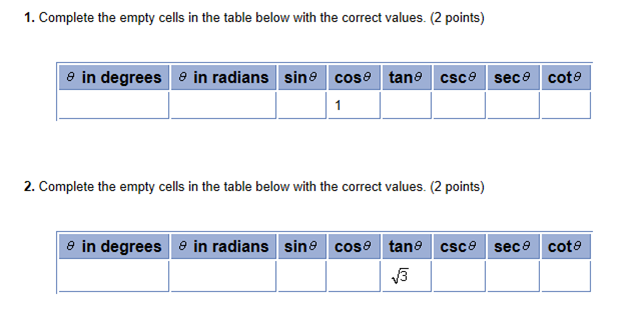
there are technically multiple answers for this but taking a look at the unit circle, what is theta when cos(theta) = 1?
Vocaloid:
|dw:1520394524773:dw|
zarkam21:
0?
Vocaloid:
awesome, so degrees theta = 0, and coincidentally radians theta is also 0 then just find sin, tan, etc. for theta = 0
zarkam21:
all 0
zarkam21:
well sin is 0
zarkam21:
tan is 0 as well
Vocaloid:
good what about csc, sec, and cot?
zarkam21:
csc=undefined sec=1 cot=undefined
Vocaloid:
awesome that's it
zarkam21:
4.71
Vocaloid:
so where on the UC do you think tan would be sqrt(3)?
zarkam21:
for radians
Vocaloid:
hm? since degrees are 0 radians are 0 as well
zarkam21:
wait aren't we on the second chart
zarkam21:
oh shoot i was doing the third chart sorry
zarkam21:
okay so degree and radians are 0
Vocaloid:
yes
zarkam21:
theta would be 270?
Vocaloid:
for chart 2? I don't think so, tan(270) is not sqrt(3)
Vocaloid:
as a hint - since tan(theta) = sin(theta)/cos(theta) so select the point on the UC where sin/cos = sqrt(3), you might have to do some mental math
zarkam21:
um 5
Vocaloid:
it's not immediately obvious, but if we see this point:|dw:1520395252556:dw|
Vocaloid:
if we divide sin/cos we get sqrt(3)/2 divided by 1/2 which ends up being sqrt(3) so your angle is 60 degrees, convert that to radians then perform the rest of the calculations
zarkam21:
1.05
zarkam21:
1.04719755
Vocaloid:
actually that's right but let's leave in terms of pi, pi/3
Vocaloid:
so the radians would be pi/3 (as a general rule, we don't want to round until it tells us too, b/c we'll lose significant digits)
Vocaloid:
then calculate sin, cos, etc. for pi/3 or 60 degrees
zarkam21:
okay so sin(pi/3) cos(pi/3)
Vocaloid:
good, what would those equal?
zarkam21:
sin(pi/3)=sqrt3/2 cos(pi/3)=1/2 csc(pi/3)=2sqrt3/2 sec(pi/3)=2 cot(pi/3)=sqrt3/3
Vocaloid:
check csc again it doesn't look quite right
zarkam21:
2sqrt3/3
Vocaloid:
good
Vocaloid:
I'm ready for chart 3 if you have it
 Vocaloid:
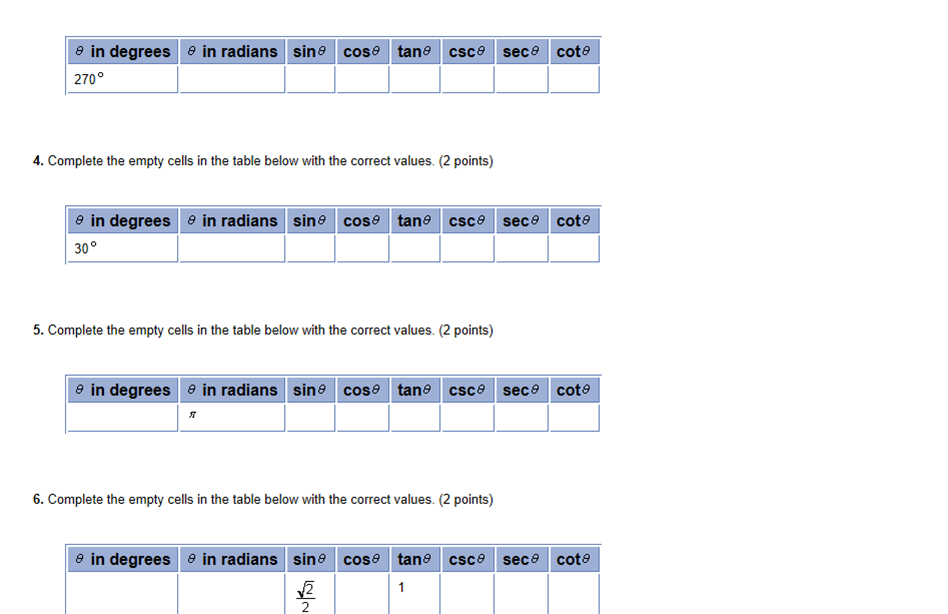
same process as before, simply convert 270 deg to radians, then fill out the rest of the table
zarkam21:
4.71
zarkam21:
for radians
Vocaloid:
good but let's try to leave it in terms of pi, that's a good general rule for radians 3pi/2
zarkam21:
sin(3pi/2)=-1 cos(3pi/2)=0 csc(3pi/2)=-1 sec(3pi/2)=undefined cot(3pi/2)=0
Vocaloid:
perfect
Vocaloid:
same thing w/ chart 4 just using 30 deg as the angle, convert to radians first, etc.
zarkam21:
0.52359878
zarkam21:
What would that be in terms of pi :/
Vocaloid:
when you multiply 30 degrees * (pi/180) without rounding pi, what do you get?
zarkam21:
pi/6
zarkam21:
right
Vocaloid:
yeah good, then just fill out the rest of the table
zarkam21:
sin(pi/6)=1/2 cos(pi/6)=sqrt2/3 tan(pi/6)=sqrt3/3 csc(pi/6)=2 sec(pi/6)=2sqrt3/3 cot(pi/6)=sqrt3
Vocaloid:
check cos again
zarkam21:
sqrt3/2
Vocaloid:
good, the rest are perfect
Vocaloid:
ok, so for #5 - if the angle is theta, convert this to degrees, then fill out the rest of the table
zarkam21:
180
Vocaloid:
good, then proceed w/ the calculations as usual
zarkam21:
it would just be sin(pi) righr
Vocaloid:
yes
zarkam21:
sin(pi)=0 cos(pi)=-1 tan(pi)=0 csc(pi)=undefined sec(pi)=-1 cot(pi)=undefined
Vocaloid:
perfect
Vocaloid:
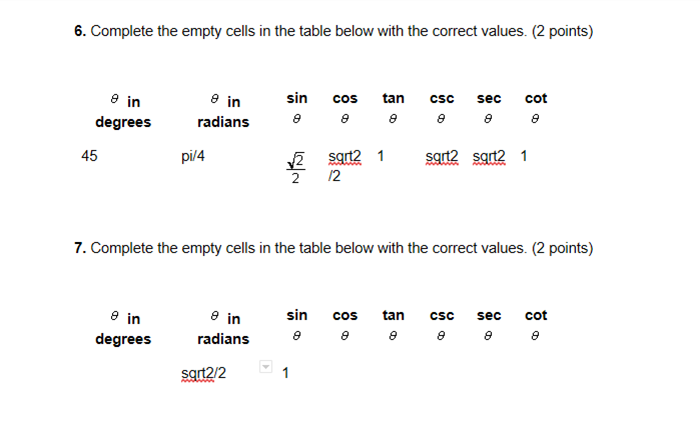
for #6 take a look at the Unit Circle and see which angle corresponds to sin(theta) = root(2)/2
zarkam21:
3/2
Vocaloid:
|dw:1520398222139:dw|
Vocaloid:
so the angle is 45 degrees, proceed w/ the conversion/calculation as usual
zarkam21:
0.78539816
Vocaloid:
remember, if we want to get the radians in terms of pi, you'll have to manually convert it by multiplying (45 deg) by (pi/180) and leaving pi unrounded
zarkam21:
pi/4 sin(pi/4)=sqrt2/2 cos(pi/4)=sqrt2/2 tan(pi/4)=1 csc(pi/4)=sqrt2 sec(pi/4)=sqrt2 cot(pi/4)=1
Vocaloid:
awesome
Vocaloid:
is there anything after chart 6
zarkam21:
one more chart if you are up to it?
zarkam21:
if not we can continue tomorrow
Vocaloid:
yeah sure let's do it
 Vocaloid:
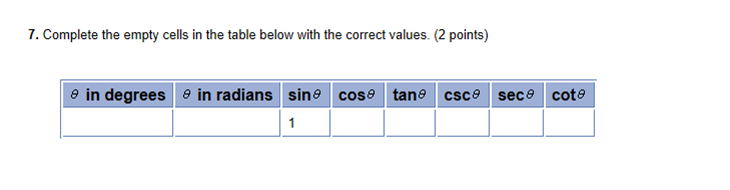
ok, take another look at the UC, what angle does sin(theta) = 1?
zarkam21:
um
Vocaloid:
remember, your x and y coordinates are cos(theta), sin(theta)
zarkam21:
(1,0)
Vocaloid:
sin(theta) would be the y-coordinate what ~angle~ would the y-coordinate be 1?
zarkam21:
1
Vocaloid:
|dw:1520399078686:dw|
Vocaloid:
what angle corresponds to this point?
zarkam21:
oh sqrt2/2
Vocaloid:
|dw:1520399123081:dw|
Vocaloid:
check again, what angle corresponds to this point? you must look at the angle measurements as well as the coordinate point
 zarkam21:
90
Vocaloid:
good, the angle is 90 degrees not root(2)/2
zarkam21:
1.57079633
zarkam21:
for radian qhich would be 1.57*(pi/180)
Vocaloid:
start with the degree measurement
Vocaloid:
90 * pi/180 = ?
Vocaloid:
[leave pi in its unrounded form]
zarkam21:
pi/2
Vocaloid:
good, then fill out the rest of the table
zarkam21:
cos(pi/2)=0 tan(pi/2)=undefined csc(pi/2)=1 sec(pi/2)=undefined cot(pi/2)=0
Vocaloid:
good
zarkam21:
Thank you, you can finally go to bed lol
Join our real-time social learning platform and learn together with your friends!
 KBaby:
Verse 1 We left our names in the dust of the driveway Watched the old town shrink
KBaby:
Lyrics Generator Use AI to write the lyrics for a song. Suggested Genres: Pop Hip
KBaby:
Verse 1 We left our names in the dust of the driveway Watched the old town shrink
KBaby:
Lyrics Generator Use AI to write the lyrics for a song. Suggested Genres: Pop Hip

 aitexturegenerator:
How are you all handling AI-generated textures for 3D models and game assets without losing the hand-made feel? I've been doing a small stylized environment
aitexturegenerator:
How are you all handling AI-generated textures for 3D models and game assets without losing the hand-made feel? I've been doing a small stylized environment

 Demon25:
Woke up feeling like that girl and that dude well he still aint crap pluse the du
Demon25:
Woke up feeling like that girl and that dude well he still aint crap pluse the du
 playtsec:
how do I get rid of stress from teachers... I just feel like running out the classroom and leaving on my own.
playtsec:
how do I get rid of stress from teachers... I just feel like running out the classroom and leaving on my own.
 JohnnyLFowler0812:
What type of gamer would play something and then get off for a while. Why not sta
JohnnyLFowler0812:
Which is better? Metallica Rap Country R&B hiphop Medal Gospel Chill Which 3 opti
JohnnyLFowler0812:
What type of gamer would play something and then get off for a while. Why not sta
JohnnyLFowler0812:
Which is better? Metallica Rap Country R&B hiphop Medal Gospel Chill Which 3 opti