
 kaylak:
help
kaylak:
@Vocaloid
 kaylak:
@Vocaloid
 Vocaloid:
|dw:1520479379634:dw|
Vocaloid:
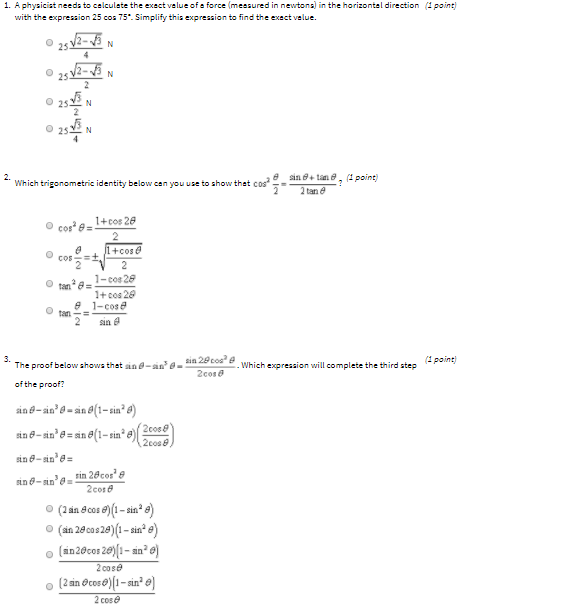
use the second angle identity to find cos(75) by letting theta = 150 degrees
kaylak:
cos 75=.258
Vocaloid:
we are looking for an exact value so we cannot just plug this into a calculator, you have to go through the formula + calculations.
kaylak:
b?
Vocaloid:
well done
kaylak:
2?
Vocaloid:
for #2? I think so, technically identity 1 would work but I think 2 is closer to what they want
Vocaloid:
as a hint for #3, you can re-write the product and put sin and cos together
kaylak:
is it d
kaylak:
for 2
kaylak:
3 give me a minute
kaylak:
c? c and almost look identical lol
kaylak:
d
Vocaloid:
good, D, the difference is where the 2 is wrt theta
kaylak:
is 2 d ?
Vocaloid:
for #2 I'm not 100% sure, C and D seem too far from what the identity needs, I was between A and B sort of leaning towards B? :S
kaylak:
oh ok b it is then you're the genius I try lol
kaylak:
you were right
kaylak:
can you help with more
Vocaloid:
I'll try
 Vocaloid:
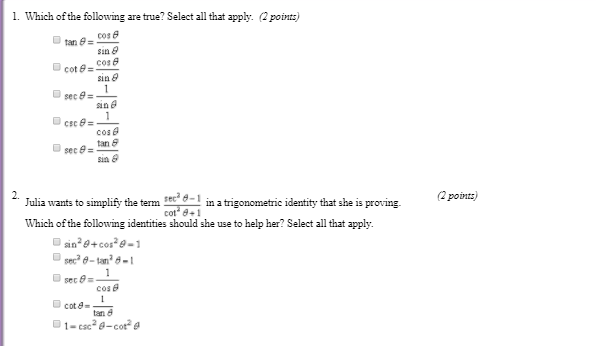
for 1) you just have to know the definitions of the functions, for example tan(theta) is sin/cos not the other way around, so check 1 is not marked off keep going with the other possibilities, eliminating the ones that are not mathematically correct
kaylak:
those are the identities i can probably find it
kaylak:
b is one
Vocaloid:
good, there's one more, it's pretty easy to find once you look at the csc and sec definitions
Vocaloid:
csc = 1/sin sec = 1/cos based on this which one(s) can you eliminate?
kaylak:
both because both in answer choices are wrong lol
Vocaloid:
good so it's just B + the last choice
kaylak:
is sec tan /sin
kaylak:
number 2?
Vocaloid:
if you re-write tan as sin/cos then sec = (sin/cos)/sin, then the sins cancel out and you get 1/cos which is equal to sec
Vocaloid:
anyway, for 2: I'm not 100% sure but we could at least eliminate a few choices that aren't helpful, like the first one probably isn't helpful since we're dealing with cot and sec in separate parts of the fraction
Vocaloid:
my best (?) guess would be to re-write everything in terms of tan, you'd use identifies B and D to do that :S so those two?
 Vocaloid:
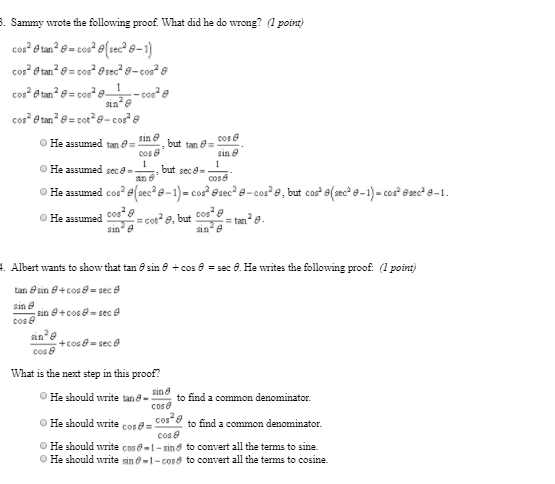
notice how he replaced sec^2 with 1/(sin^2) what do you think is the problem with that?
kaylak:
doesn't cos with sec not sec and sin
kaylak:
b lol
Vocaloid:
good, so sec^2 isn't 1/sin^2 it's 1/cos^2 making the error in answer choice B, well done
kaylak:
a?
Vocaloid:
for Albert's proof, C and D are factually incorrect so we immediately eliminate these you're on the right track, but he's already done tan(theta) = sintheta/costheta, he has to do something else to make the left side equal to the right side
Vocaloid:
if he re-writes that cos as cos^2 / cos then he can also re-write sec as 1/cos, giving them all common denominator cos, so B
 kaylak:
6 is a
Vocaloid:
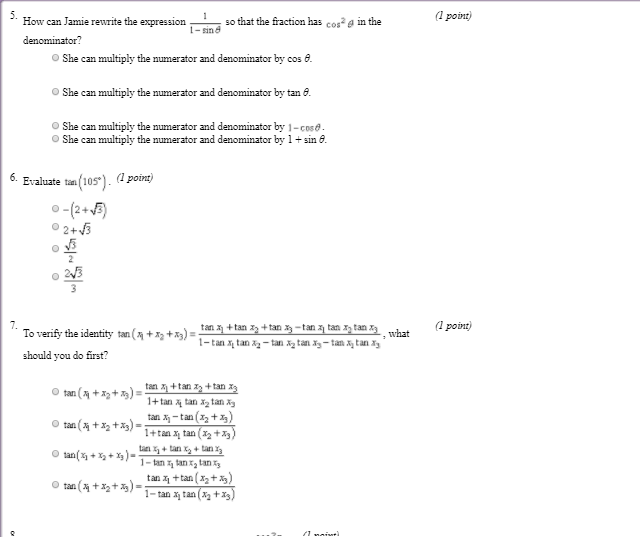
as a hint, cos^2 = 1 - sin^2 so what would we need to do to make the denominator 1 - sin^2 instead of 1 - sin? think back to algebra, difference of squares
kaylak:
multiply
Vocaloid:
good but multiply by what?
Vocaloid:
A^2 - B^2 = (A+B)*(A-B) 1^2 - sin^2 = ____ * (1-sin) fill in the blank
kaylak:
is answer d?
Vocaloid:
good, you'd multiply by 1 + sin following the rule, so D
kaylak:
6 is a
Vocaloid:
for 7, use the tan sum identity, treat "alpha" as x1 and "beta" as (x1+x2)
Vocaloid:
yeah 6 is a that's just a quick calculation check
Vocaloid:
|dw:1520482611500:dw|
kaylak:
b?
Vocaloid:
check the sign in the numerator, notice how it's positive
kaylak:
c
Vocaloid:
|dw:1520482844699:dw|
Vocaloid:
see how we plugged in x2 + x3 for beta, and how tan(x2+x3) has to keep x2 and x3 in parentheses?
kaylak:
oh its d okay same set up but different symbol ok
Vocaloid:
yup good
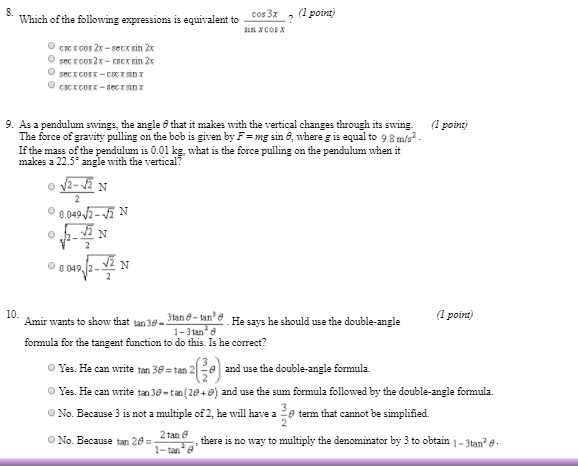 Vocaloid:
have to re-write cos(3x) as cos(2x + x) then use the cos sum formula to expand cos(3x)
Vocaloid:
cos(A+B)=cosAcosB−sinAsinB where A is 2x and B is x, then after that you need to keep expanding until you get something that looks like one of the choices
kaylak:
b
Vocaloid:
can you show me your calculations? still working on it myself
kaylak:
honestly mathway said that well something close to it it gave me an odd cal
Vocaloid:
I'll just get back to 8, I can't figure out the calculation yet anyway for 9 you just want to use the half angle formula to calculate sin(theta/2) where theta = 45|dw:1520483832309:dw|
Vocaloid:
please at least attempt the calculations
kaylak:
a
Vocaloid:
you're getting there but that's just the sin value, since the force is mg sin theta you must multiply the result from A by m and g (given in the problem so what do you get?)
kaylak:
c
Vocaloid:
m * g = 0.01 * 9.8 = 0.049/2 combine this with what we got from before
kaylak:
oh ok I think I got it maybe but d is the answer
Vocaloid:
we got sintheta = sqrt(2 - sqrt(2))/2 multiply this with 0.049 * 2 what do you get?
kaylak:
so the denominator is multiplied ? does that mean the answer is b kinda lost on this topic but am attempting
Vocaloid:
|dw:1520484678600:dw|
Vocaloid:
|dw:1520484709652:dw|
Vocaloid:
anyway, yeah it's B, I finally figured out # 8 so we can get back to that
kaylak:
okay thank you for hwlping I know I'm annoying
Vocaloid:
anyway, for cos(3x) we can split this into cos(2x + x) using the cos addition formula we get:
Vocaloid:
|dw:1520484811165:dw|
Vocaloid:
|dw:1520484819494:dw|
Vocaloid:
plugging 2x for alpha and x for beta cos(2x)cos(x) - sin(2x)sin(x) all of that goes over cos(x) sin(x) so we write it like:
Vocaloid:
|dw:1520484864460:dw|
Vocaloid:
we can split this fraction into two fractions like so:
Vocaloid:
|dw:1520484892827:dw|
Vocaloid:
|dw:1520484928186:dw|
Vocaloid:
we can cancel out common units like so:
Vocaloid:
|dw:1520484976185:dw|
Vocaloid:
anyway, if you remember our definitions of csc and sec from before, you can re-write these in terms of csc and sec, what would be your final answer?
Vocaloid:
|dw:1520485207707:dw|
Vocaloid:
does this make it a little more clear to see how it can be re-written in terms of sec and csc?
kaylak:
yes b and c are the only ones written in that form
Vocaloid:
|dw:1520485377143:dw|
Vocaloid:
substituting csc for 1/sin and sec for 1/cos gives us cos(2x)csc(x) - sin(2x)sec(x) answer choice A
Vocaloid:
anyway I still gotta think about #10, I know A is nonsense so it's out
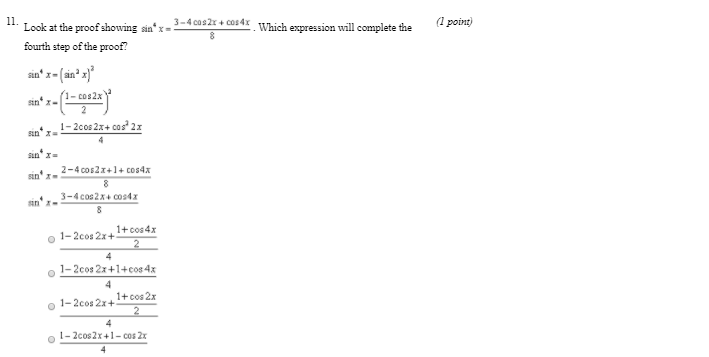 Vocaloid:
cos^(theta) = [ 1 + cos(2theta) ] /2 if we replace "theta" with "2theta" we get cos^(2theta) = [1 + cos(4theta) ] / 2 making the first answer choice the only one that is mathematically valid
kaylak:
for 10 or 11
Vocaloid:
11
kaylak:
sorry doing math and art history at the same time if you know an art history genius please let me know lol
Vocaloid:
anyway, for 10, I am not 100 on this but since we have tan(3theta) not tan(2theta) using the double angle formula would result in a tan(3theta/2) term which gets us "stuck" so C
Vocaloid:
anyway I hope that helps, sorry if there are any errors it's past midnight and I'm kind of burnt out
Vocaloid:
I'll ask around for art history
kaylak:
okay thank you and it's okay better than I would've gotten
Join our real-time social learning platform and learn together with your friends!
 Demon25:
For a hoco proposal with a cheerleader and football player, what else should be a
Demon25:
For a hoco proposal with a cheerleader and football player, what else should be a

 Breathless:
TOC: "MGF any confirmation on the commander? we require confirmation as soon as[radio static].
Breathless:
TOC: "MGF any confirmation on the commander? we require confirmation as soon as[radio static].
 EdwinJsHispanic:
I wrote something that I don't know if I want it as a poem or song, Please let me know on yours thoughts about it, I'm still doing this! "Broken promises an
EdwinJsHispanic:
I wrote something that I don't know if I want it as a poem or song, Please let me know on yours thoughts about it, I'm still doing this! "Broken promises an
 thehearken:
hi um I don't know if this is the right section for this, but can someone go over my poem and tell me if its good enough to give my English professor for a
thehearken:
hi um I don't know if this is the right section for this, but can someone go over my poem and tell me if its good enough to give my English professor for a
 heartlessprophet:
Aye what's 19z%u00f74p=9u03c0 my teacher thinking of impossible questions for us
heartlessprophet:
Aye what's 19z%u00f74p=9u03c0 my teacher thinking of impossible questions for us
 kippppp:
does anyone have any good tips for writing stories? i'm trying to write a dnd campaign but i'm not that great of a writer yet.
kippppp:
does anyone have any good tips for writing stories? i'm trying to write a dnd campaign but i'm not that great of a writer yet.
 GRIZZLEY19:
Y'all let me know what y'all think about this beat I made I took me like a hour maybe rate it 0/10 https://drive.
GRIZZLEY19:
Y'all let me know what y'all think about this beat I made I took me like a hour maybe rate it 0/10 https://drive.
 Ultrilliam:
Welcome to the 10th Anniversary Update! (Part 2) Sorry this one passed the date a
Ultrilliam:
Welcome to the 10th Anniversary Update! (Part 2) Sorry this one passed the date a
 Twaylor:
was walking downtown and my adhd brain wanted to make some (rock?) lyrics: There'
Twaylor:
was walking downtown and my adhd brain wanted to make some (rock?) lyrics: There'