
 zarkam21:
Given that the specific heat of water is 4.18 kJ/(kg·°C), how much heat does it take to raise the temperature of 3.5 kg of water from 25°C to 55°C?
 Vocaloid:
q = mc * deltaT where m = mass c = specific heat deltaT = change in Temperature
zarkam21:
3.5*4.18*20
zarkam21:
292.6
Vocaloid:
check the change in temperature again, 55 - 25 is 30 not 20
Vocaloid:
3.5*4.18*30 = ?
zarkam21:
438.9
Vocaloid:
good does your teacher care about significant figures (sig figs) or nah? b/c it would be 440 kJ if we round to significant digits
zarkam21:
I can put both :p
Vocaloid:
sure
zarkam21:
What is the mathematical equation for calculating the heat needed to change the temperature of a substance? Identify each variable and its units.
Vocaloid:
q = mc * deltaT, explanations are at the top
zarkam21:
q = mc * deltaT where m = mass c = specific heat deltaT = change in Temperature
Vocaloid:
yup, any thoughts on units?
zarkam21:
mass would be SI
Vocaloid:
[ok, so they gave you kg in the problem, but usually we would use grams for mass] so T is celcius m is grams specific heat = J/(g·°C)
Vocaloid:
oh, yeah, q is heat which is joules
zarkam21:
Sooo, q = mc * deltaT where m = mass c = specific heat deltaT = change in Temperature T is celcius m is grams specific heat = J/(g·°C)
Vocaloid:
yes
zarkam21:
Define specific heat capacity and latent heat of fusion. Specific heat capacity is the heat that is required to raise the temperature of the unit mass of a given substance. Latent heat of fusion is energy released or absorbed, by a body or a thermodynamic system, during a constant-temperature process that is specified in some way.
Vocaloid:
not bad but for latent heat of fusion it should be mentioned that this is the heat required to convert a substance from its solid to its liquid form (fusion)
zarkam21:
Specific heat capacity is the heat that is required to raise the temperature of the unit mass of a given substance. Latent heat of fusion is energy that is released or absorbed during a constant-temperature process that is pinpointed in some way. Also, the heat in a latent heat of fusion is the heat required to convert a substance from its solid to its liquid form
Vocaloid:
good
zarkam21:
How do particle motion and temperature change as a material absorbs heat?
zarkam21:
Particle motion and temperature both increase as a material absorbs heat.
Vocaloid:
good
zarkam21:
A physics student is sitting at the beach. She feels the warm Sun shining on her back, the warm sand under her feet, and a cool breeze blowing in from the water. Identify each type of heat transfer she is experiencing.
zarkam21:
warm Sun shining on her back- radiation warm sand under her feet- cool breeze blowing in from the water-
Vocaloid:
well there are only two other types of heat transfer, conduction and convection, which one would be conduction and which one would be convection
zarkam21:
warm Sun shining on her back- radiation warm sand under her feet-convection cool breeze blowing in from the water-conduction
Vocaloid:
other way around, conduction requires contact so that would be feet touching the sand
zarkam21:
a. Match the term to its correct description. (1 point) A. Convection B. Radiation C. Thermal conductor D. Thermal insulator E. Conduction _____ A substance that transfers heat poorly _____ Heat transfer through direct contact of particles _____ Heat transfer through motion of a fluid _____ Heat transfer through electromagnetic waves _____ A substance that transfers heat well
zarkam21:
Heat transfer through motion of a fluid is convection
Vocaloid:
good
zarkam21:
Heat transfer through electromagnetic waves is radiation
Vocaloid:
yup
zarkam21:
A substance that transfers heat well is conduction
Vocaloid:
that's not quite right, you're thinking of conductor
zarkam21:
__D___ A substance that transfers heat poorly __E___ Heat transfer through direct contact of particles __A___ Heat transfer through motion of a fluid __B___ Heat transfer through electromagnetic waves __C___ A substance that transfers heat well
Vocaloid:
awesome
 Vocaloid:
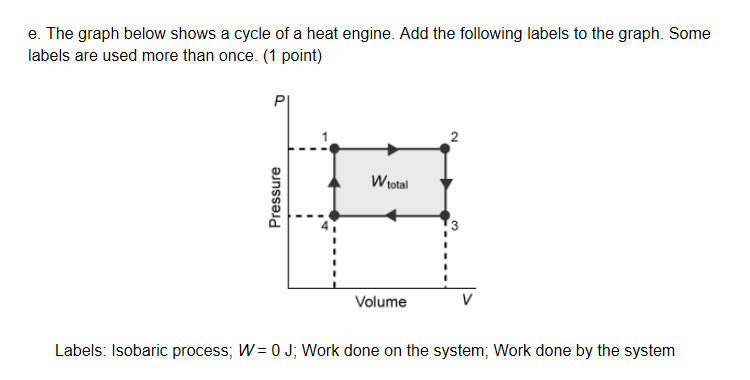
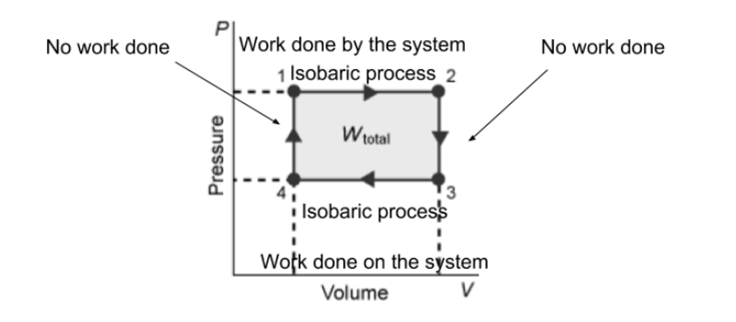
work = P*deltaV, where would work be 0?
zarkam21:
the bottom
Vocaloid:
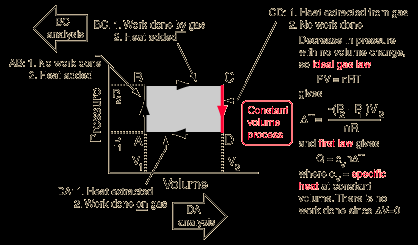
not quite, the volume is decreasing there so work would be nonzero where is the volume constant?
 zarkam21:
Would it be this
Vocaloid:
good, so the volume is constant on the left and right sides on the shape what about "isobaric process"? where is the pressure constant?
zarkam21:
Um on the left
Vocaloid:
hm, not quite, if you compare points 1 and 4 see how the pressure is different? that means the left side is a process with non-constant pressure where on the graph is the pressure the same across both points?
zarkam21:
top and bottom
Vocaloid:
awesome, so that would be your isobaric processes so, for work done on system, that means the volume must be going down, where would that be?
zarkam21:
left side
Vocaloid:
notice how the volume is the same on the left side between points 1 and 4
Vocaloid:
volume is on the x-axis, which side on the graph shows a decreasing x-value?
zarkam21:
the other side because points 1 and 4 show it going up
Vocaloid:
that's pressure not volume
Vocaloid:
|dw:1521646953811:dw|
Vocaloid:
|dw:1521646958611:dw|
Vocaloid:
what about work done by the system? that would be increasing volume, so which side?
zarkam21:
opposite of the decreasing
Vocaloid:
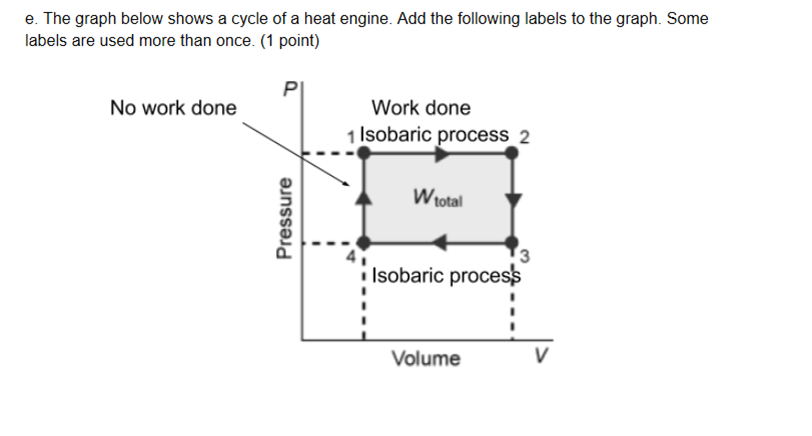
good, so the top side and that's it
 zarkam21:
Something like this right
Vocaloid:
good, it's a bit incomplete atm, ex. no work done needs to be on the right side to also, for "work done" you need to specify whether the system is doing work or having work done on it
Vocaloid:
*on the right side too
 Vocaloid:
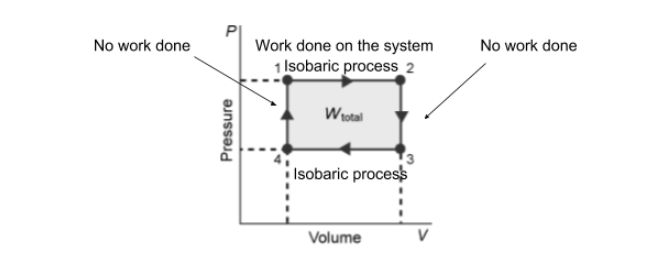
the top side is expansion, thats work done (by) system not on system work done on system = bottom side
 Vocaloid:
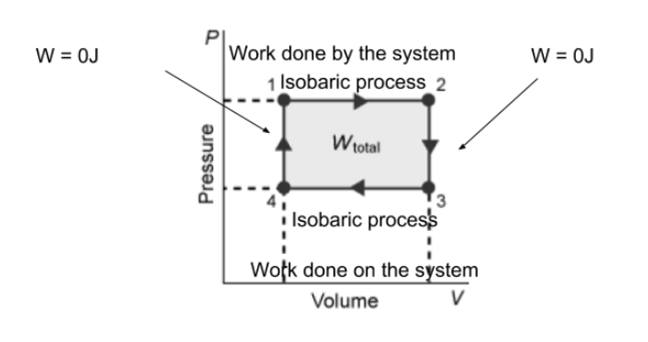
good as a minor issue the instructions say to label it as "W = 0J" not "no work done" so just change those labels and you'll be set
 Vocaloid:
good, that's it
 Vocaloid:
you're given e = W/Qin, work and heat-in are given in the problem, find e
zarkam21:
e = W/Qin e=300/600 e=0.5
Vocaloid:
good, efficiency is often a percentage so we could report this as 50%
 zarkam21:
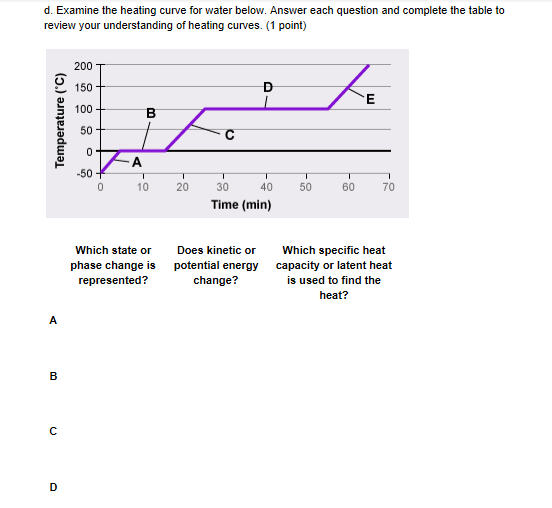
A is ice
Vocaloid:
good what about KE? does it change?
zarkam21:
b is freezing/melting ice or water
zarkam21:
no
Vocaloid:
for A) yes the KE does change (since heat is being put in + temp is changing) B) no since temp isn't changing
zarkam21:
A is ice Yes kinetic or potential energy does change B is freezing/melting ice or water No kinetic or potential energy doesn't change because the temperature is not changing C is water Yes kinetic or potential energy does change D is boiling/condensing water or gas Yes kinetic or potential energy does change
zarkam21:
E is gas No kinetic or potential energy does not change
Vocaloid:
check D and E again for KE changes
zarkam21:
D is boiling/condensing water or gas No kinetic or potential energy does not change E is gas Yes kinetic or potential energy does change
Vocaloid:
good, what about the last column, for each letter which heat capacity would you use?
Vocaloid:
hint - for the phase changes it would be "latent heat of ______" whatever phase change it is and for the parts where the temperature changes it would be "specific heat capacity of ____" whatever phase its in right now
zarkam21:
A. Specific heat capacity of solid B. Latent heat of C.Specific heat capacity of liquid D. Latent heat of E.Specific heat capacity of gas
Vocaloid:
for water, what would the names for its solid/liquid/ and gas forms be?
zarkam21:
ice water and um
Vocaloid:
water vapor
Vocaloid:
for the phase change names, what's the name for a substance turning from solid to liquid, and then from liquid to vapor?
zarkam21:
melting and evaporation
Vocaloid:
good but in chem/physics we usually call these fusion/vaporization so latent heat of melting/ latent heat of vaporization for B + D
zarkam21:
A. Specific heat capacity of solid B. Latent heat of melting C.Specific heat capacity of liquid D. Latent heat of vaporization E.Specific heat capacity of gas
Vocaloid:
replace solid/liquid/gas with the names of their forms for water replace melting with its scientific name, fusion
zarkam21:
A. Specific heat capacity of solid B. Latent heat of fusion C.Specific heat capacity of liquid D. Latent heat of vaporization E.Specific heat capacity of gas
Vocaloid:
\(\color{#0cbb34}{\text{Originally Posted by}}\) @Vocaloid *** replace solid/liquid/gas with the names of their forms for water *** replace melting with its scientific name, fusion \(\color{#0cbb34}{\text{End of Quote}}\)
zarkam21:
A. Specific heat capacity of ice B. Latent heat of fusion C.Specific heat capacity of water D. Latent heat of water vapor E.Specific heat capacity of gas
Vocaloid:
D is latent heat of vaporization E is specific heat capacity of water vapor
zarkam21:
A. Specific heat capacity of ice B. Latent heat of fusion C.Specific heat capacity of water D. Latent heat of vaporization E.Specific heat capacity of water vapor
Vocaloid:
good
Join our real-time social learning platform and learn together with your friends!
 KBaby:
Verse 1 We left our names in the dust of the driveway Watched the old town shrink
KBaby:
Lyrics Generator Use AI to write the lyrics for a song. Suggested Genres: Pop Hip
KBaby:
Verse 1 We left our names in the dust of the driveway Watched the old town shrink
KBaby:
Lyrics Generator Use AI to write the lyrics for a song. Suggested Genres: Pop Hip

 aitexturegenerator:
How are you all handling AI-generated textures for 3D models and game assets without losing the hand-made feel? I've been doing a small stylized environment
aitexturegenerator:
How are you all handling AI-generated textures for 3D models and game assets without losing the hand-made feel? I've been doing a small stylized environment

 Demon25:
Woke up feeling like that girl and that dude well he still aint crap pluse the du
Demon25:
Woke up feeling like that girl and that dude well he still aint crap pluse the du
 playtsec:
how do I get rid of stress from teachers... I just feel like running out the classroom and leaving on my own.
playtsec:
how do I get rid of stress from teachers... I just feel like running out the classroom and leaving on my own.
 JohnnyLFowler0812:
What type of gamer would play something and then get off for a while. Why not sta
JohnnyLFowler0812:
Which is better? Metallica Rap Country R&B hiphop Medal Gospel Chill Which 3 opti
JohnnyLFowler0812:
What type of gamer would play something and then get off for a while. Why not sta
JohnnyLFowler0812:
Which is better? Metallica Rap Country R&B hiphop Medal Gospel Chill Which 3 opti