
 kaylak:
help
 Vocaloid:
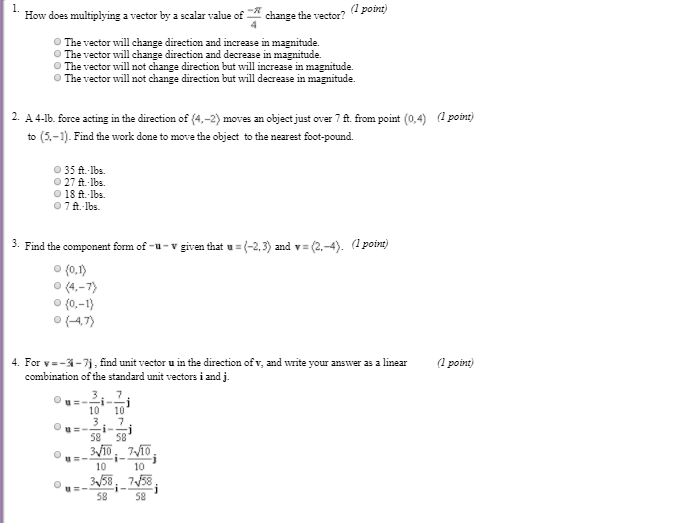
for 1: consider the sign and the magnitude of -pi/4 (whether the absolute value of -pi/4 is >1 or <1
kaylak:
b?
Vocaloid:
good, I'm still working on 2 but you would have to resolve the force into its vertical and horizontal components I believe and calculate F*distance in both directions
kaylak:
b again?
Vocaloid:
I think so :S technically it should be closer to 28 but that's not an option
kaylak:
oops i was looking at 3 lol
Vocaloid:
3 is something other than b, check your calculations again
kaylak:
d?
Vocaloid:
just look at the y-coordinates -u - v = -3 - (-4) = ?
kaylak:
1
Vocaloid:
good so the y-coordinate must be 1 making a the only possibility 4) just calculate the magnitude and divide the vector by the magnitude
kaylak:
d?
Vocaloid:
good
 Vocaloid:
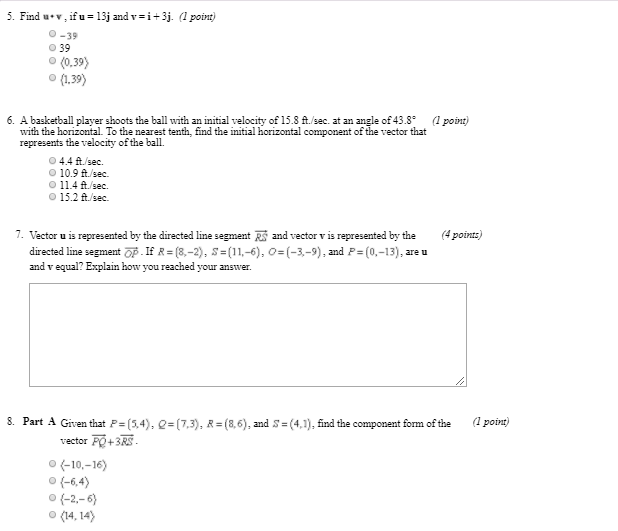
5 is just a dot product, it may be helpful to convert to vector notation <,>
kaylak:
d?
kaylak:
@Vocaloid
Vocaloid:
keep in mind u = 13j = <0,13> <0,13> dot <1,3> = ?
kaylak:
c
Vocaloid:
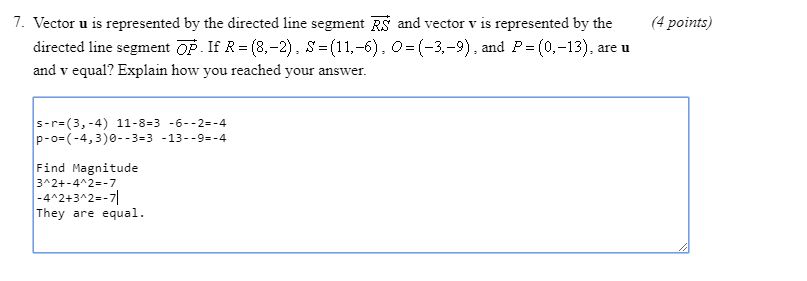
good for 6) since u is the line RS and v is the line OP you will need to find the length of RS and OP by subtracting S - R and P - O respectively, then finding the magnitudes of each segment
kaylak:
are you looking at 6 or 7 i think you are looking at 7
Vocaloid:
oh duh that's 7) 6) the horizontal component is just initial velocity * cos(theta)
kaylak:
c
Vocaloid:
good, lmk if you need help w/ 7
 Vocaloid:
well done as a minor nitpick, when you square a negative number you need to write that number in parentheses (-4)^2 not -4^2
Vocaloid:
anyway for 8 to find PQ, subtract Q - P and to find RS, subtract S - R, then perform the indicated operation PQ + 3RS
kaylak:
a
Vocaloid:
good
 kaylak:
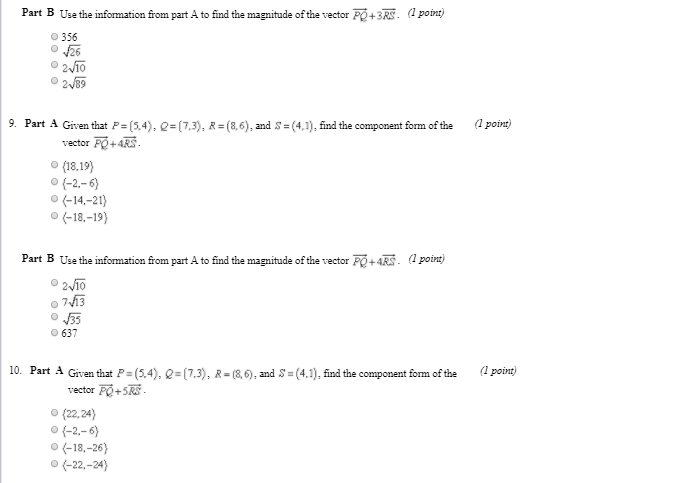
part b d?
Vocaloid:
good part 9 is basically the same thing just with PQ + 4RS instead
kaylak:
c
Vocaloid:
awesome then for part 9B you'd just calculate the magnitude based on that
kaylak:
b
Vocaloid:
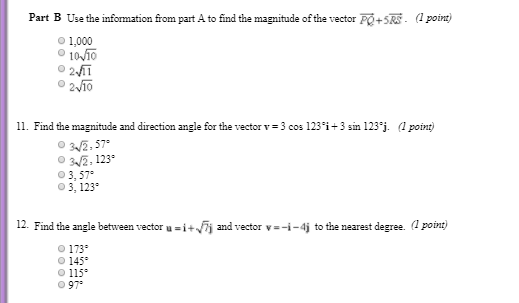
good 10A is just the same steps from 8 and 9 except with PQ + 5RS
kaylak:
c
Vocaloid:
good guessing part 10B is going to ask for the magnitude
 kaylak:
c? for b
Vocaloid:
10B I got something a little different magnitude = sqrt(18^2 + 26^2) = ?
kaylak:
b
Vocaloid:
good for 11: magnitude = sqrt(x^2 + y^2) as usual, angle is given by tan(theta) = y/x, lmk what you get
kaylak:
b
Vocaloid:
check the magnitude again [ 3cos(123) ] ^2 + [3 sin(123)] ^ 2 = ?
kaylak:
d
Vocaloid:
good for 12) follow the usual angle formula:
Vocaloid:
|dw:1522803844411:dw|
kaylak:
c
Vocaloid:
I got something a little different, what did you get as your denominator
kaylak:
b?
Vocaloid:
may I see your calculations so I can see where you might have made a mistake?
kaylak:
trying to multiply both u and v and then I'm lost
Vocaloid:
first convert the notation to <,> to make it a little easier <-1, sqrt(7)> dot <-1, -4> = ?
Vocaloid:
wait
Vocaloid:
<1, sqrt(7)> dot <-1, -4> = ?
Vocaloid:
should be a positive 1 at the beginning
kaylak:
2,-7
Vocaloid:
1. multiply the x-coordinates 2. multiply the y-coordinates 3. add the results from steps 1 and 2
kaylak:
let me check
kaylak:
d
Vocaloid:
may I know what you got for the dot product?
kaylak:
I did cos(97) I got about -12
Vocaloid:
let's try to take it one step at a time <1, sqrt(7)> dot <-1, -4> we multiply the x-coordinates to get -1 we multiply the y-coordinates to get -4sqrt(7) adding them together gives -1 - 4sqrt(7) as the dot product
Vocaloid:
then, simply find the magnitudes of the vectors <1, sqrt(7)> dot <-1, -4> to put in the denominator of our angle expression lmk what you get, you can leave things in radical form instead of decimals
kaylak:
-10.58
Vocaloid:
magnitudes are always positive so something must be amiss
kaylak:
that's for- 4* square root 7
Vocaloid:
let's leave things in radical form for now please calculate the magnitudes of <1, sqrt(7)> and <-1, -4>
kaylak:
18 23 took out all -
Vocaloid:
1^2 + sqrt(7) ^ 2 = ? (-1)^2 + (-4)^1 = ?
Vocaloid:
last exponent should be a 2
kaylak:
1+7=8 -1+-16=-17
Vocaloid:
good so your magnitudes are sqrt(8) and sqrt(17) putting everything together cos(theta) = (-1-4sqrt(7)) / (sqrt(8*17)) solve for theta
kaylak:
its a
Vocaloid:
well done
 Vocaloid:
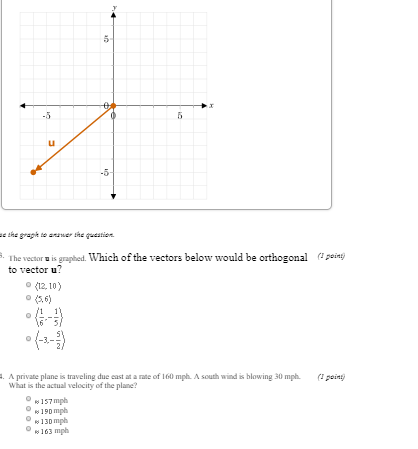
use the graph to determine what u would be in vector notation then see which dot product is 0
kaylak:
b?
Vocaloid:
check carefully the dot product of <-6,-5> and <5,6> is not 0
kaylak:
c
Vocaloid:
good
kaylak:
14?
Vocaloid:
try sketching the path of the plane (160 mph east and 30 mphs south) and calculate the magnitude of the vector
Vocaloid:
|dw:1522805765660:dw|
Vocaloid:
what's the magnitude of this vector?
kaylak:
d
Vocaloid:
good
kaylak:
15
Vocaloid:
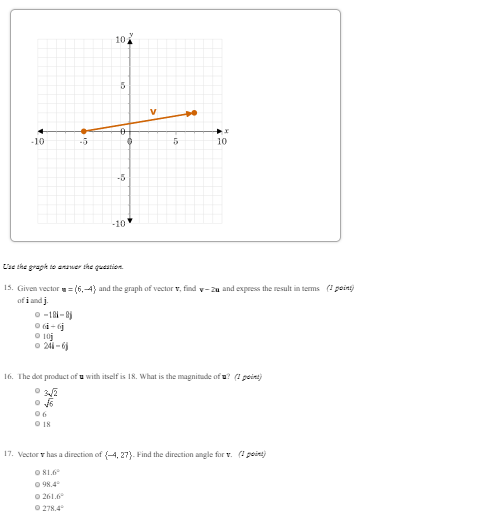
try to write what vector v would be based on the graph (hint - try finding the horizontal and vertical distance between the tip and tail and put those into a vector) then find u - 2v
kaylak:
a
Vocaloid:
check your calculations again what did you get for vector v?
kaylak:
d
Vocaloid:
may I ask what you got for vector v? it's easier to pinpoint mistakes and speed up the process if I know what steps you're doing
kaylak:
6*2=12 -4*2=-8
kaylak:
2--8=10
Vocaloid:
good, that's 2u, but what about vector v?
kaylak:
7-12=-5
Vocaloid:
|dw:1522806641088:dw|
Vocaloid:
|dw:1522806646524:dw|
Vocaloid:
vector v = <12,2> then v - 2u = <12, 2> - <12, -8> = ?
kaylak:
so it is 10
kaylak:
c
Vocaloid:
good, <0,10> = C
Vocaloid:
16: magnitude = sqrt of dot product as usual
kaylak:
a
Vocaloid:
awesome for 17: tan(theta) = y/x, solve for theta
Vocaloid:
as a hint for tan angles, you might need to add 180 once you get the angle
kaylak:
also a
kaylak:
6.77 and i had 6.75
Vocaloid:
hm, not quite tan(theta) = -27/4 so theta = arctan(-27/4) = ?
kaylak:
b
Vocaloid:
good
kaylak:
my calculator is putting the same thing but b and d are negative?
Vocaloid:
can we open a new question, this one has over 120 posts
Vocaloid:
anyway, for tan, you might get a negative angle but we can convert negative angles to positive angles by adding 180 (this only works for tan)
Join our real-time social learning platform and learn together with your friends!
 KBaby:
Verse 1 We left our names in the dust of the driveway Watched the old town shrink
KBaby:
Lyrics Generator Use AI to write the lyrics for a song. Suggested Genres: Pop Hip
KBaby:
Verse 1 We left our names in the dust of the driveway Watched the old town shrink
KBaby:
Lyrics Generator Use AI to write the lyrics for a song. Suggested Genres: Pop Hip
 aitexturegenerator:
How are you all handling AI-generated textures for 3D models and game assets without losing the hand-made feel? I've been doing a small stylized environment
aitexturegenerator:
How are you all handling AI-generated textures for 3D models and game assets without losing the hand-made feel? I've been doing a small stylized environment

 Demon25:
Woke up feeling like that girl and that dude well he still aint crap pluse the du
Demon25:
Woke up feeling like that girl and that dude well he still aint crap pluse the du
 playtsec:
how do I get rid of stress from teachers... I just feel like running out the classroom and leaving on my own.
playtsec:
how do I get rid of stress from teachers... I just feel like running out the classroom and leaving on my own.
 JohnnyLFowler0812:
What type of gamer would play something and then get off for a while. Why not sta
JohnnyLFowler0812:
Which is better? Metallica Rap Country R&B hiphop Medal Gospel Chill Which 3 opti
JohnnyLFowler0812:
What type of gamer would play something and then get off for a while. Why not sta
JohnnyLFowler0812:
Which is better? Metallica Rap Country R&B hiphop Medal Gospel Chill Which 3 opti