
 kaylak:
help @vocaloid
 kaylak:
I'm almost done with this lesson I promise
 Vocaloid:
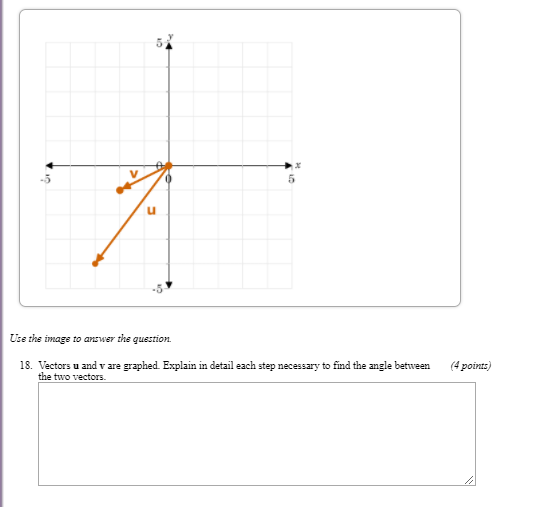
well you would copy down the formula from before, cos(theta) = u dot v/|u| |v| then explain that you would need to calculate the dot product for the numerator, the magnitudes for the denominator, solve for theta, etc.
Vocaloid:
well I guess the first step would be reading the graph and determining what the vectors for u and v would be in vector notation, then followed by those other steps
kaylak:
could we do the graph like work it out?
Vocaloid:
since both the vectors are at the origin, you just need to find the coordinates of the end points and then convert those to a vector to get your vector notation for example, the endpoint of v is (-2,-1) so the vector is <-2,-1> then repeat the same logic for vector u
kaylak:
-3,-4
Vocaloid:
good, that's vector u, so vector v = <-2,-1> and u = <-3,-4> then you would calculate cos(theta) = u dot v/|u| |v| based on this to find theta
Vocaloid:
I'm not sure if they want the actual numbers and calculations or if they just want the steps but that's how you'd do it
Vocaloid:
still there? is there anything that's still unclear?
kaylak:
yes and hold on
kaylak:
so would I do the multiplication and squared thing?
kaylak:
@Vocaloid
Vocaloid:
I'm not sure what you mean, but if you're talking about magnitude and dot product calculations then yes
kaylak:
ok so i did all that and got 4^2+6^2 =52 and then root and got 7.21
kaylak:
@Vocaloid
Vocaloid:
try to keep the magnitude calculations and the dot product calculations separate first, do the numerator calculation by 1. multiplying the x-coordinates 2. multiplying the y-coordinates 3. adding the answers from steps 1 and 2
kaylak:
got that
Vocaloid:
then, you would calculate the magnitude of u, magnitude of v and then calculate the denominator based on that
kaylak:
so 4^2 and 6^2
kaylak:
wouldn't I add those and root them?
Vocaloid:
nope, you would calculate u and v separately because the formula calls for the magnitudes of u and v separately
Vocaloid:
start with vector u, find the magnitude of <-2,-1> by taking r = sqrt(x^2 + y^2) and then move onto vector v
kaylak:
-5 for u
kaylak:
-2.24 for v
Vocaloid:
keep in mind magnitudes have to be positive. sqrt((-2)^2 + (-1)^2)) = ? sqrt((-3)^2 + (-4)^2)) = ?
kaylak:
5 25
Vocaloid:
don't forget the sqrts, so | u | = sqrt(5) and | v | = 5 then plug these into the denominator of the formula cos(theta) = u dot v/|u| |v| once you plug in the dot product of u and v then you can solve for theta
kaylak:
so i got 5 and 2.24
kaylak:
so how would I set it up exactly?
Vocaloid:
\(\color{#0cbb34}{\text{Originally Posted by}}\) @Vocaloid don't forget the sqrts, *** so | u | = sqrt(5) and | v | = 5 *** then plug these into the denominator of the formula cos(theta) = u dot v/|u| |v| once you plug in the dot product of u and v then you can solve for theta \(\color{#0cbb34}{\text{End of Quote}}\)
kaylak:
I got the square root part 25=5 5=2.24
Vocaloid:
we have just determined that |u| = sqrt(5) and |v| = 5 the formula cos(theta) = u dot v/|u| |v| gives us the angle for u and v simply plug in the magnitudes u and v, plug in the dot product, and calculate theta.
kaylak:
what was the dot product again I have steps down but it's kinda all over the place
Vocaloid:
\(\color{#0cbb34}{\text{Originally Posted by}}\) @Vocaloid try to keep the magnitude calculations and the dot product calculations separate first, do the numerator calculation by 1. multiplying the x-coordinates 2. multiplying the y-coordinates 3. adding the answers from steps 1 and 2 \(\color{#0cbb34}{\text{End of Quote}}\)
Vocaloid:
^ that's your dot product
kaylak:
so do i do the ^2 in dot product trying to not confuse myself
kaylak:
the dot product being 52 square root ?
Vocaloid:
the dot product does not involve squaring simply identify the x-coordinates of u and v, the y-coordinates of u and v, and calculate the dot product
kaylak:
ok and i just add them no squaring or root or anything?
Vocaloid:
no squaring or rooting, no
kaylak:
so then just 10
Vocaloid:
yeah good, then plug everything in and solve for theta
Vocaloid:
anyway I really need to take a shower and go to sleep cos(theta) = 10/(5sqrt(5)) theta = arccos(10/5sqrt(5)) then just chuck this into a calculator to get theta
kaylak:
you don't have time for 2 more questions?
Join our real-time social learning platform and learn together with your friends!
 KBaby:
Verse 1 We left our names in the dust of the driveway Watched the old town shrink
KBaby:
Lyrics Generator Use AI to write the lyrics for a song. Suggested Genres: Pop Hip
KBaby:
Verse 1 We left our names in the dust of the driveway Watched the old town shrink
KBaby:
Lyrics Generator Use AI to write the lyrics for a song. Suggested Genres: Pop Hip
 aitexturegenerator:
How are you all handling AI-generated textures for 3D models and game assets without losing the hand-made feel? I've been doing a small stylized environment
aitexturegenerator:
How are you all handling AI-generated textures for 3D models and game assets without losing the hand-made feel? I've been doing a small stylized environment

 Demon25:
Woke up feeling like that girl and that dude well he still aint crap pluse the du
Demon25:
Woke up feeling like that girl and that dude well he still aint crap pluse the du
 playtsec:
how do I get rid of stress from teachers... I just feel like running out the classroom and leaving on my own.
playtsec:
how do I get rid of stress from teachers... I just feel like running out the classroom and leaving on my own.
 JohnnyLFowler0812:
What type of gamer would play something and then get off for a while. Why not sta
JohnnyLFowler0812:
Which is better? Metallica Rap Country R&B hiphop Medal Gospel Chill Which 3 opti
JohnnyLFowler0812:
What type of gamer would play something and then get off for a while. Why not sta
JohnnyLFowler0812:
Which is better? Metallica Rap Country R&B hiphop Medal Gospel Chill Which 3 opti