
 kaylak:
@shadow
 kaylak:
@shadow
kaylak:
@Shadow
kaylak:
@Shadow
 SmokeyBrown:
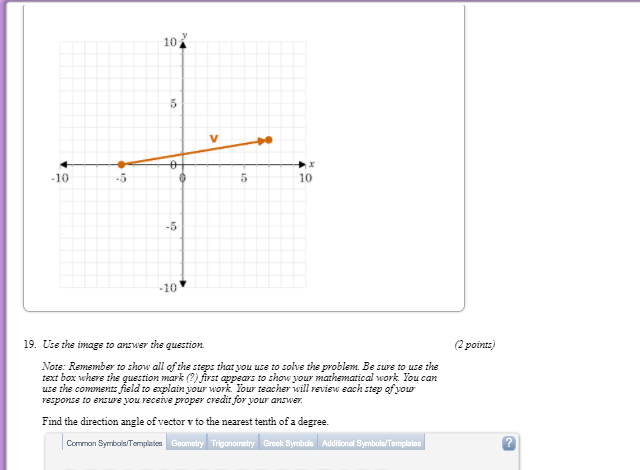
I'll assume that this involves trigonometry, in which case we'll want to make use of the sine or cosine ratios that apply to right triangles. Whether we use sine or cosine in this case is more a matter of preference. Please stop me if I'm getting ahead of myself.
SmokeyBrown:
As you may already know, the sine ratio of an angle in a right triangle is equal to the length of the opposite edge divided by the length of the adjacent edge; meanwhile, cosine is the reverse and would be calculated by the length of the adjacent edge divided by the opposite edge.
SmokeyBrown:
|dw:1522819514753:dw|
SmokeyBrown:
The diagram above may illustrate what I mean in clearer terms. For the angle of x degrees, sin(x) would be equal to opp/adj, and cos(x) would be equal to adj/opp.
SmokeyBrown:
So, how does this help us? Well, if you have a calculator or a table of sin and cos values, you can find the measure of an angle from its sin or cos value. In case you do not have a calculator, here is a link to a chart you can use. Unfortunately, the chart only gives angle measures to the nearest degree, not tenth of a degree, so you'll be better off using a calculator.
SmokeyBrown:
So, to summarize: Draw a right-triangle with the vector as the hypotenuse; find the lengths of both legs of that right triangle; calculate either the sin or cos of the angle using the ratio of the leg lengths with a calculator, use the inverse sin or inverse cos function to calculate the angle. I hope this helps!
SmokeyBrown:
http://cruzrich.com/sin-cos-tan-chart-uptodate/sin-cos-tan-chart-delux-drawing-table/ Oh, here's the chart I said I posted, if you want to use it as a reference
Join our real-time social learning platform and learn together with your friends!
 KBaby:
Verse 1 We left our names in the dust of the driveway Watched the old town shrink
KBaby:
Lyrics Generator Use AI to write the lyrics for a song. Suggested Genres: Pop Hip
KBaby:
Verse 1 We left our names in the dust of the driveway Watched the old town shrink
KBaby:
Lyrics Generator Use AI to write the lyrics for a song. Suggested Genres: Pop Hip
 aitexturegenerator:
How are you all handling AI-generated textures for 3D models and game assets without losing the hand-made feel? I've been doing a small stylized environment
aitexturegenerator:
How are you all handling AI-generated textures for 3D models and game assets without losing the hand-made feel? I've been doing a small stylized environment

 Demon25:
Woke up feeling like that girl and that dude well he still aint crap pluse the du
Demon25:
Woke up feeling like that girl and that dude well he still aint crap pluse the du
 playtsec:
how do I get rid of stress from teachers... I just feel like running out the classroom and leaving on my own.
playtsec:
how do I get rid of stress from teachers... I just feel like running out the classroom and leaving on my own.
 JohnnyLFowler0812:
What type of gamer would play something and then get off for a while. Why not sta
JohnnyLFowler0812:
Which is better? Metallica Rap Country R&B hiphop Medal Gospel Chill Which 3 opti
JohnnyLFowler0812:
What type of gamer would play something and then get off for a while. Why not sta
JohnnyLFowler0812:
Which is better? Metallica Rap Country R&B hiphop Medal Gospel Chill Which 3 opti