
 kaylak:
help @bananas
 kaylak:
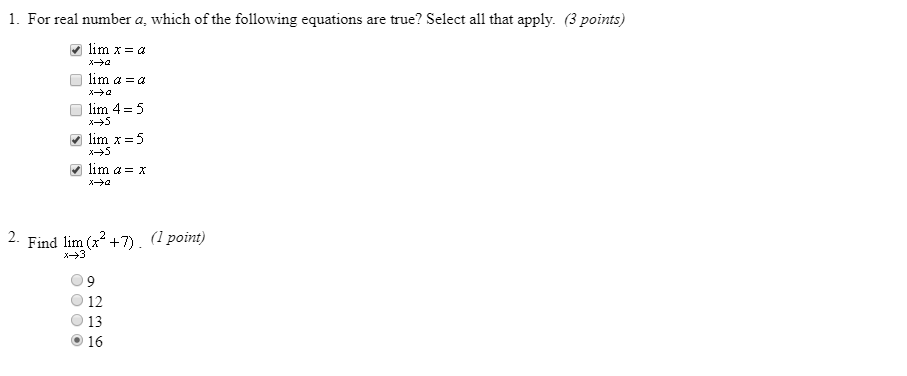
@bananas am I correct?
 bananas:
You're missing one option in #1
kaylak:
only 3 answer choices? 3 points 3 answers
bananas:
Oh I see, technically #2 would be correct too. There's no x term, so lim as x goes to a of a is equal to a
bananas:
Wait your last option is wrong in #1
kaylak:
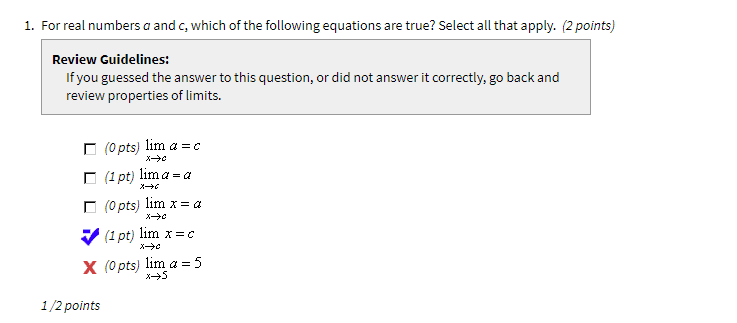
because x does not go to c that's wrong someone tried to tell me the same you are and I got it wrong last time
 bananas:
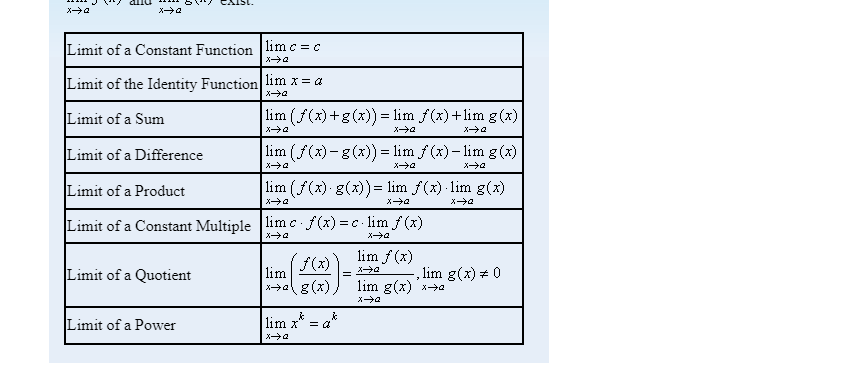
lim x->a (a) = a, not lim x->a (a) = x
kaylak:
talking about a=a x-> a when it could be to c
bananas:
2 is correct, first one should be b instead of d, everything else looks right.
kaylak:
constant function c=c x _>a
 bananas:
yes, constant function doesn't change |dw:1522852620305:dw|
bananas:
in the first one, you have a constant, in the 2nd one your constant is somehow turning into a function after taking a limit. It's b and not d
 bananas:
b is right, that's why you got it wrong last time
bananas:
(you didn't select it)
kaylak:
that's because someone else told me I was wrong so I didn't
kaylak:
did you not read what I said?
kaylak:
\(\color{#0cbb34}{\text{Originally Posted by}}\) @kaylak this is what I missed last time because someone told me b was wrong \(\color{#0cbb34}{\text{End of Quote}}\)
bananas:
So you're telling me, that you're not going to listen to me, because last time you listened to someone, you got it wrong?
kaylak:
no but the identity c=c x-> a so unless there's some funky rule that a=a x->a then wouldn't it be c. That would make sense?
bananas:
there are no funky rules. Not until you hit impossible limits anyway. If you see a limit of x->something, replace x with something in the expression and evaluate. If there is no x in the expression in the first place, then the answer is the expression itself.
kaylak:
so a,b, and d
bananas:
yes
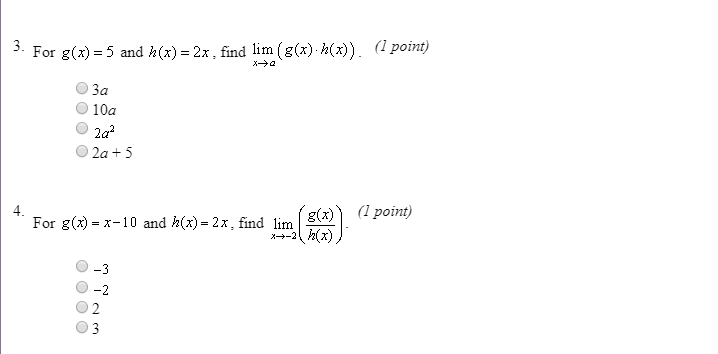 bananas:
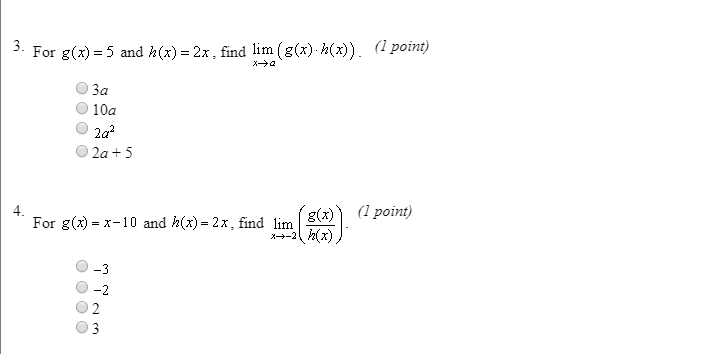
First find what g(x)*f(x) is (just multiply the 2 expressions)
kaylak:
b?
bananas:
yeah B
kaylak:
#4
bananas:
again just divide the expressions (x-10)/2x
bananas:
then take the limit
kaylak:
a?
bananas:
-12/-4
kaylak:
crap 3
kaylak:
d
kaylak:
so d?
kaylak:
@bananas no longer doubt your skills
bananas:
yeah d, sorry didn't see it. You shouldn't (in general). I have a math degree.
kaylak:
How old are you?
bananas:
24
kaylak:
wow
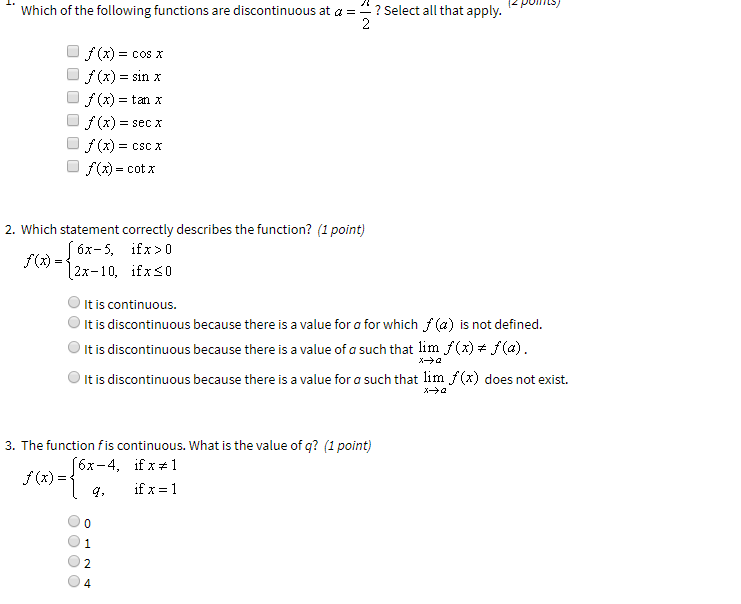 kaylak:
I thought only students were here
bananas:
discontinuous means the limit doesn't exist
kaylak:
a is wrong
kaylak:
b is wrong
kaylak:
c is right
kaylak:
looks like c and d
kaylak:
@bananas
kaylak:
@Shadow
Join our real-time social learning platform and learn together with your friends!
 KBaby:
Verse 1 We left our names in the dust of the driveway Watched the old town shrink
KBaby:
Lyrics Generator Use AI to write the lyrics for a song. Suggested Genres: Pop Hip
KBaby:
Verse 1 We left our names in the dust of the driveway Watched the old town shrink
KBaby:
Lyrics Generator Use AI to write the lyrics for a song. Suggested Genres: Pop Hip
 aitexturegenerator:
How are you all handling AI-generated textures for 3D models and game assets without losing the hand-made feel? I've been doing a small stylized environment
aitexturegenerator:
How are you all handling AI-generated textures for 3D models and game assets without losing the hand-made feel? I've been doing a small stylized environment

 Demon25:
Woke up feeling like that girl and that dude well he still aint crap pluse the du
Demon25:
Woke up feeling like that girl and that dude well he still aint crap pluse the du
 playtsec:
how do I get rid of stress from teachers... I just feel like running out the classroom and leaving on my own.
playtsec:
how do I get rid of stress from teachers... I just feel like running out the classroom and leaving on my own.
 JohnnyLFowler0812:
What type of gamer would play something and then get off for a while. Why not sta
JohnnyLFowler0812:
Which is better? Metallica Rap Country R&B hiphop Medal Gospel Chill Which 3 opti
JohnnyLFowler0812:
What type of gamer would play something and then get off for a while. Why not sta
JohnnyLFowler0812:
Which is better? Metallica Rap Country R&B hiphop Medal Gospel Chill Which 3 opti