
 zarkam21:
True or False: For a trigonometric function, y = f(x), then x = F-1(y). Explain your answer.
 SmokeyBrown:
If I'm interpreting this correctly, the statement is saying that in a trigonometric function if y is a certain value for a certain value of x, then x will always be a certain value for a certain value of y.
SmokeyBrown:
Now, thinking back to trig functions you've seen before, can you find any examples to support or disprove this statement?
zarkam21:
I guess, I am not really understanding this
SmokeyBrown:
Ok, so there's a test you can do to see if this statement is true or not. If you draw a horizontal line through the function, if the statement is true, the horizontal line should only pass through the curve of the function once. If the horizontal line passes through the function more than once, you know that any particular y value can match with many different x values, which disproves the statement.
zarkam21:
It is passed once , it think :/
zarkam21:
SO true because it passed the horizontal line test and pass through the curve of the function once
SmokeyBrown:
Ok, just checking, what function did you use the horizontal line test on?
zarkam21:
first one
zarkam21:
y = f(x),
SmokeyBrown:
Ah, gotcha. So, y=f(x) isn't really a specific function. It's just defining what a function needs to be: for every value of x in the domain there is 1 and only 1 value of y. You're going to want to test a specific function, like, particularly a trigonometric equation. These are equations that use trigonometric terms, like sine, cosine and tangent. You could use the cosine function from the question we did earlier, for instance.
zarkam21:
Okay so y = cosx
SmokeyBrown:
Sure. How does the horizontal line test work for y = cos(x)?
zarkam21:
nope it fails it
SmokeyBrown:
Great! So that means we've disproved the statement.
zarkam21:
So false, because it does not pass the horizontal line test. It passes through the curve of the function more than once
SmokeyBrown:
Yup. Sounds pretty good
zarkam21:
are you going to bed now?
SmokeyBrown:
Nah, I'll be up for a while.
zarkam21:
True or False: For a one-to-one function, y = f(x), then x = f-1(y). Explain your answer.
SmokeyBrown:
Ok, this one is pretty easy to explain. A one-to-one function, by definition, has one y value for every y value and one x value for every y value. No more, no less.
zarkam21:
So true
zarkam21:
and the explanation part is the defnition of what a one to one function is
SmokeyBrown:
Yup, you got it
SmokeyBrown:
I think that'd work, yes
zarkam21:
True or False: For any function, x = f-1(y), then y = f(x). Explain your answer.
SmokeyBrown:
For this one, you can think of it as similar to the first question in this series, only instead of "every y-value only has one x value" it's "every x value has only one y-value:"
zarkam21:
So it owld be the same answer right
SmokeyBrown:
By the definition of a function this has to be true. You can do the vertical line test to demonstrate this, but you know enough about functions to accept it at face value, I think.
zarkam21:
Except we would use the vertical line test
SmokeyBrown:
Yup
SmokeyBrown:
Oh, and you can use any function, not just trig functions
zarkam21:
True, because it passes the vertical line test. It does not pass through the curve of the function more than once.
SmokeyBrown:
I completely agree.
 SmokeyBrown:
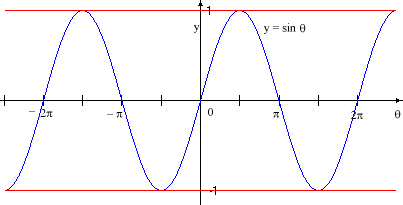
We can actually take a look at a the sine function to see whether this one is true or not
 zarkam21:
no it is not
zarkam21:
because it fails the horizontal line test
zarkam21:
or wait its the vertical line test right
SmokeyBrown:
So, this one is a little different from the others. It's asking about the direction of the line over a certain interval. So, between the two intervals mentioned, pi/2 and 3pi/2, does the function increase or decrease?
zarkam21:
increase
SmokeyBrown:
Yes, you got it!
zarkam21:
So true, because the direction of the lines over the two certain intervals are increasing within each other
SmokeyBrown:
Exactly
zarkam21:
Going to bed now??
SmokeyBrown:
Heheh, no, I don't have classes until late tomorrow. College is weird like that.
zarkam21:
Lol i bet
zarkam21:
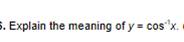
Explain the meaning of y = cos^-1x.
SmokeyBrown:
So, whenever anything is taken to the power of negative 1, it means you are getting the reciprocal of that value. For instance, 2^(-1) is the same as 1/2. 5^(-1) is the same as 1/5. in the same way, Cos(x)^-1 is the same as 1/cos(x)
SmokeyBrown:
It's difficult to tell with the notation here, but I think that is what you meant?
 zarkam21:
I screenshot it so you can see
SmokeyBrown:
Ok, so I did understand correctly. That's good. I stand by what I said.
zarkam21:
Okay so the meaning of y = cos^-1x is whenever anything is taken to the power of negative 1, it means you are getting the reciprocal of that value. From this function given, we can see that Cos(x)^-1 is the same as 1/cos(x)
SmokeyBrown:
Yup, I think you understand.
 zarkam21:
Thsi would be true
zarkam21:
If i remember correctly, when a function is undefined, it is undefined on an interval or at certain points. whether and/or where a function is undefined depends on the given domain of the function.
SmokeyBrown:
That's interesting. Keep in mind that sec(x) is equal to 1/cos(x). So, Sec(x)^-1, would be 1/sec(x), which is actually the same as cos(x). I would say that cos(0.5) is defined, so I would say the statement is false.
zarkam21:
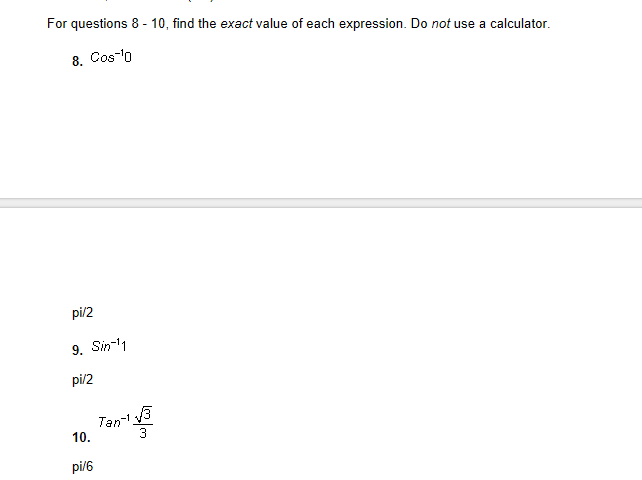
could you check this over
 SmokeyBrown:
I'd say your math checks out. And I also want to make a correction to what I said earlier. With plain numbers, what I said about something to the power of (-1) is true. In this case, it means you're taking the inverse of the function. You can think of this as moving backwards; usually, you'd convert x, the angle or arc length, to y, the value of, say, cosine for that particular value. With an inverse function, you're given the value of cosine and use the function to find the value of the angle or, in this case the arc length. Even with my wrong explanation, I'm impressed you got these right!
SmokeyBrown:
I think now is when I'm going to start going to sleep. Anything else before I head out?
zarkam21:
Nope, thats all Just to make sure even with your wrong explanation is there any specific question I need to correct, or are my answers still correct
SmokeyBrown:
Nah, you got it right
zarkam21:
Nvm, you can go to bed we can continue tomorrow or something. I don't want to hold you up
zarkam21:
Goodnight, and thank you for all your help.. I really do appreciate it
SmokeyBrown:
No worries. See you around!
Join our real-time social learning platform and learn together with your friends!
 KBaby:
Verse 1 We left our names in the dust of the driveway Watched the old town shrink
KBaby:
Lyrics Generator Use AI to write the lyrics for a song. Suggested Genres: Pop Hip
KBaby:
Verse 1 We left our names in the dust of the driveway Watched the old town shrink
KBaby:
Lyrics Generator Use AI to write the lyrics for a song. Suggested Genres: Pop Hip

 aitexturegenerator:
How are you all handling AI-generated textures for 3D models and game assets without losing the hand-made feel? I've been doing a small stylized environment
aitexturegenerator:
How are you all handling AI-generated textures for 3D models and game assets without losing the hand-made feel? I've been doing a small stylized environment

 Demon25:
Woke up feeling like that girl and that dude well he still aint crap pluse the du
Demon25:
Woke up feeling like that girl and that dude well he still aint crap pluse the du
 playtsec:
how do I get rid of stress from teachers... I just feel like running out the classroom and leaving on my own.
playtsec:
how do I get rid of stress from teachers... I just feel like running out the classroom and leaving on my own.
 JohnnyLFowler0812:
What type of gamer would play something and then get off for a while. Why not sta
JohnnyLFowler0812:
Which is better? Metallica Rap Country R&B hiphop Medal Gospel Chill Which 3 opti
JohnnyLFowler0812:
What type of gamer would play something and then get off for a while. Why not sta
JohnnyLFowler0812:
Which is better? Metallica Rap Country R&B hiphop Medal Gospel Chill Which 3 opti