
 zarkam21:
Is this correct? @vocaloid
 Vocaloid:
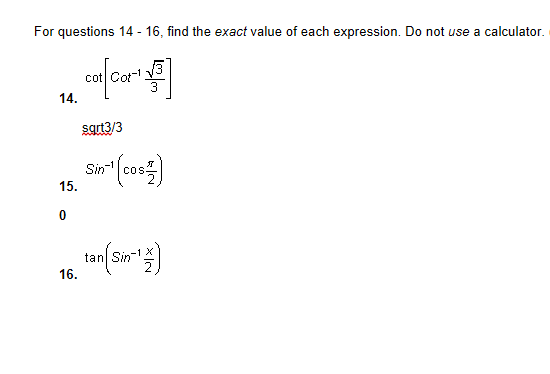
good for 14-15 I honestly have no clue how to solve 16 w/o a calculator, I'll try and find something on the web
Vocaloid:
ok here goes: we want to re-write the arcsin(x/2) as a sin so we introduce a new variable (let's call it "a") such that (x/2) = sin(a) and a = arcsin(x/2) which will replace the expression inside the parentheses
Vocaloid:
so instead of tan(arcsin(x/2)) we have tan(a) (since we replaced the arcsin with a) tan(a) = sin(a)/cos(a) just using the definition of tan cos(a) = sqrt(1-sin^2(a)) (using the cos^2 + sin^2 = 1 identity) so tan becomes: [let me draw this one]
Vocaloid:
|dw:1523552642148:dw|
Vocaloid:
now, we go back to the top where we said that (x/2) = sin(a) so we replace all the sin(a)'s with x/2
Vocaloid:
|dw:1523552726131:dw|
Vocaloid:
now, we can multiply the numerator and denominator by 2 to get rid of the fraction in the top
Vocaloid:
|dw:1523552776751:dw|
Vocaloid:
then simplify (x/2)^2 to get x^2/4
Vocaloid:
|dw:1523552857363:dw|
Vocaloid:
actually since they might not like having fractions within fractions let's take it a step further
Vocaloid:
|dw:1523553053621:dw|
Vocaloid:
we can change the 1/1 to a 4/4 so that both fractions in the denominator have the same denominator, then combine them to get:
Vocaloid:
|dw:1523553114051:dw|
Vocaloid:
sqrt(1/4) is just 1/2 and since we are dividing by 1/2 that's the same as multiplying by 2
Vocaloid:
|dw:1523553173769:dw|
Vocaloid:
|dw:1523553199742:dw|
Vocaloid:
cross out the 2's in the num/denom, then the final sol'n is|dw:1523553218889:dw|
Vocaloid:
x/sqrt(4-x^2) is a bit better than the first sol'n we got since it's a little easier to read
 Vocaloid:
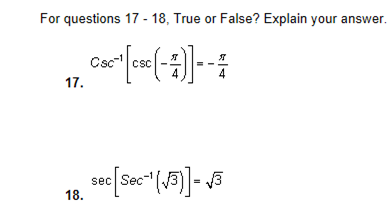
since the arc function and the corresponding non-arc function cancel out then yeah I'd say both are true
zarkam21:
Truen, because the arc function and the corresponding non-arc function cancel out
Vocaloid:
good
 zarkam21:
idid the first 2
Vocaloid:
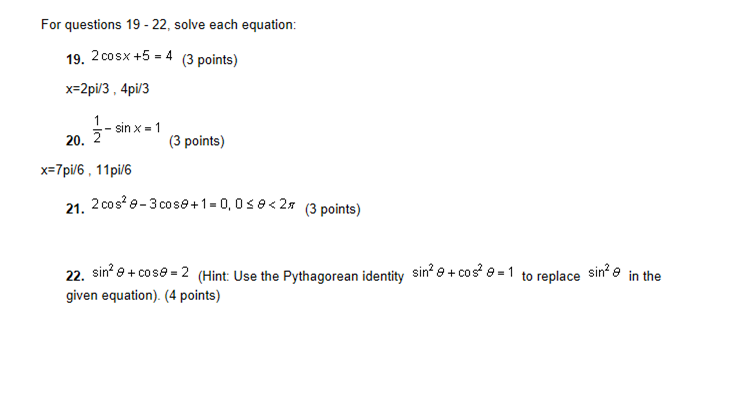
good for 21 and 22 you just want to solve by factoring for example 2cos^2(theta) - 3cos(theta) +1 = 0 is like solving 2x^2 - 3x + 1 = 0
Vocaloid:
when you factor 2x^2 - 3x + 1 = 0 what did you get for x?
zarkam21:
1,1/2
Vocaloid:
good, so we know that cos(theta) = 1 and cos(theta) = 1/2 are the factors, look on the unit circle to find the appropriate theta values
zarkam21:
pi/3
zarkam21:
no zero and pi/6
Vocaloid:
pi/6 would be sin(theta) = 1/2 not cos
Vocaloid:
|dw:1523555049590:dw|
Vocaloid:
|dw:1523555054560:dw|
zarkam21:
pi/3 , 0 , 5pi/3
Vocaloid:
good, repeat the same process for 21
zarkam21:
okay so factor it first and then use the unit circle right
Vocaloid:
yes they give you sin^2(theta) + cos(theta) = 2 we can replace sin^2(theta) with 1 - cos^2(theta) to get 1 - cos^2(theta)+ cos(theta) = 2 factor and use the unit circle to find theta
zarkam21:
1-x^2+x=2
zarkam21:
I'm trying to go off of what we did earlier
Vocaloid:
come to think of it this doesn't factor so hold on
zarkam21:
Sure
Vocaloid:
ok, I just double checked and there's no sol'n so I guess you could write 1 - cos^2(theta)+ cos(theta) = 2 has no real sol'n since this expression is not factorable
 zarkam21:
If you could check this, I would appreciate it
Vocaloid:
good
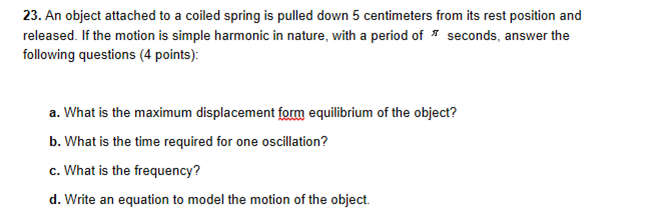 Vocaloid:
a) if it's been pulled 5 cm we would expect it to oscillate a maximum of 5 cm from the rest position, so 5 cm b) this is the same thing as period which is already given as pi c) frequency = 1/period d) y = Acos(Bx) where A is the max distance from equilibrium (5) and B can be found by solving period = 2pi/B
zarkam21:
A. 5cm B. 2pi C. 1/2pi
Vocaloid:
B) the period is pi not 2pi
zarkam21:
Okay and c would be 1/2pi
Vocaloid:
if the period is pi then 1/period = ?
zarkam21:
oh shoot, I'm sorry it would be 1/pi for c d. y=cos5(bx)
Vocaloid:
if period = pi = 2pi/B what does B equal?
zarkam21:
But i would solve for b so
Vocaloid:
the 5 needs to be at the front
Vocaloid:
y = 5cos(Bx)
zarkam21:
\[y = 5\cos(2x)\]
Vocaloid:
good that's it
zarkam21:
a. What is the maximum displacement form equilibrium of the object? 5cm b. What is the time required for one oscillation? pi c. What is the frequency? 1/pi d. Write an equation to model the motion of the object. y=5cos(2x)
Vocaloid:
yeah that's good
Vocaloid:
i've got like 15 minutes before I have to leave for class
zarkam21:
okay can we move ot physics
Vocaloid:
ok
Join our real-time social learning platform and learn together with your friends!
 KBaby:
Verse 1 We left our names in the dust of the driveway Watched the old town shrink
KBaby:
Lyrics Generator Use AI to write the lyrics for a song. Suggested Genres: Pop Hip
KBaby:
Verse 1 We left our names in the dust of the driveway Watched the old town shrink
KBaby:
Lyrics Generator Use AI to write the lyrics for a song. Suggested Genres: Pop Hip

 aitexturegenerator:
How are you all handling AI-generated textures for 3D models and game assets without losing the hand-made feel? I've been doing a small stylized environment
aitexturegenerator:
How are you all handling AI-generated textures for 3D models and game assets without losing the hand-made feel? I've been doing a small stylized environment

 Demon25:
Woke up feeling like that girl and that dude well he still aint crap pluse the du
Demon25:
Woke up feeling like that girl and that dude well he still aint crap pluse the du
 playtsec:
how do I get rid of stress from teachers... I just feel like running out the classroom and leaving on my own.
playtsec:
how do I get rid of stress from teachers... I just feel like running out the classroom and leaving on my own.
 JohnnyLFowler0812:
What type of gamer would play something and then get off for a while. Why not sta
JohnnyLFowler0812:
Which is better? Metallica Rap Country R&B hiphop Medal Gospel Chill Which 3 opti
JohnnyLFowler0812:
What type of gamer would play something and then get off for a while. Why not sta
JohnnyLFowler0812:
Which is better? Metallica Rap Country R&B hiphop Medal Gospel Chill Which 3 opti