
 SourMunchkin7806:
Confirm that f and g are inverses by showing that f(g(x)) = x and g(f(x)) = x. f of x equals four divided by x. and g of x equals four divided by x
SourMunchkin7806:
All i have so far is simply doing as your said and replacing f(x) and g(x) with y and then swapping x and y place
SourMunchkin7806:
i dont know where to go from here @Hero
 Hero:
Hero:
Okay, so with any math problem you have, there will always be "Givens". You start with that. In this case, you are given the following: \(f(x) = \dfrac{4}{x}\) and \(g(x) = \dfrac{4}{x}\). Problem is, when I list \(f(x)\) and \(g(x)\) as you've posted, then are not inverses of each other.
SourMunchkin7806:
But its telling me that i have to confirm that they are inverses of one another...
SourMunchkin7806:
not if they are or not.
Hero:
Where is this problem listed? I would like to see it as originally posted in the book or web source.
SourMunchkin7806:
Want a screen shot?
Hero:
Yes! Because I assure you, as you have stated it, they are not inverses. We'll see what the source says.
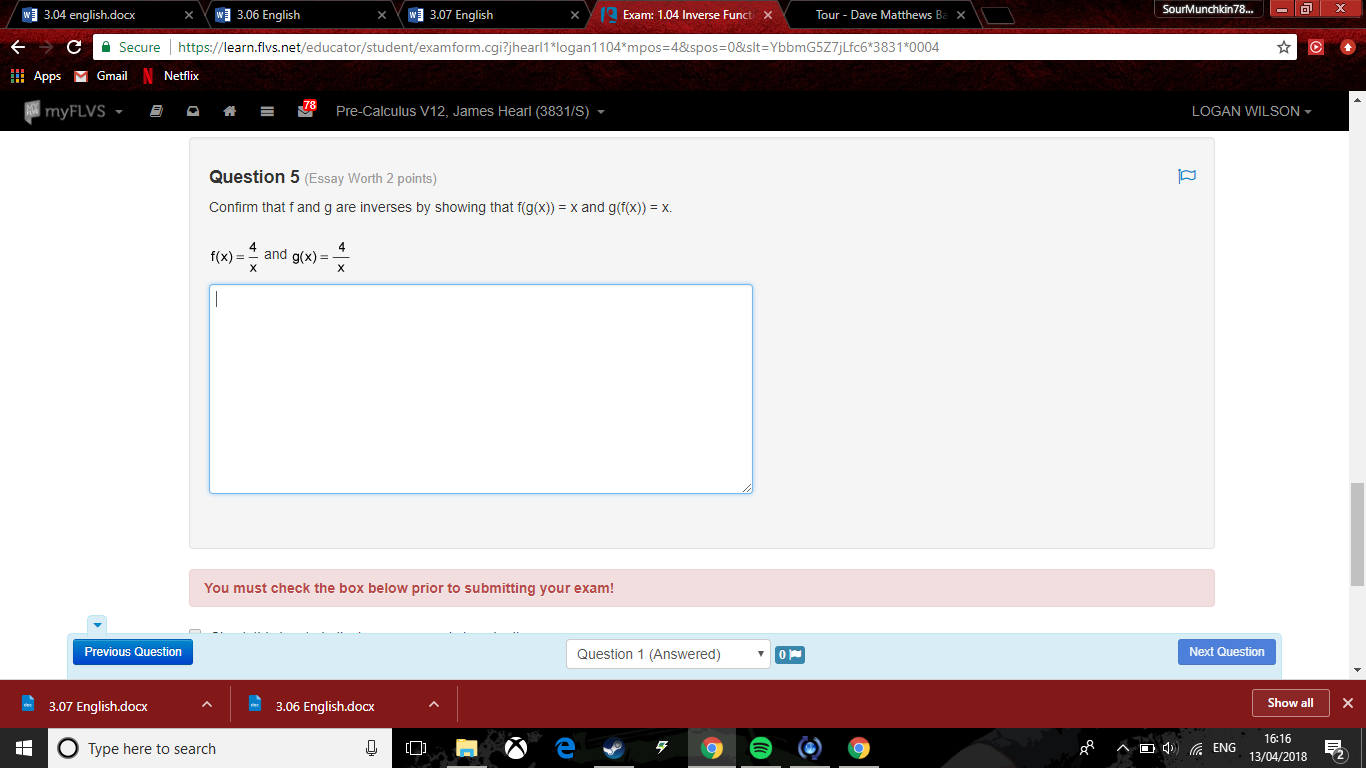 SourMunchkin7806:
Confirm that f and g are inverses of one another
Hero:
Hang on a minute
SourMunchkin7806:
ok...
Hero:
Okay, I stand corrected. They are inverses of each other. We have to show why.
Hero:
So to do that, we simply should evaluate \(f(g(x))\) and \(g(f(x))\).
Hero:
So how do we do this? We do this by simply replacing the inputs of f and g with the appropriate expressions.
Hero:
Notice that the input to f is \(g(x)\) and the input to g is \(f(x)\). Keep in mind, we were already given the expressions for both \(f(x)\) and \(g(x)\).
SourMunchkin7806:
so the input for f is 4/x and the input for g is 4/x?
Hero:
Correct. Would you mind writing that out using the draw feature?
SourMunchkin7806:
|dw:1523651062204:dw|
SourMunchkin7806:
that ?
Hero:
Well, actually, you said it correctly, you just did not write it correctly.
SourMunchkin7806:
oh
Hero:
If you wrote "The input to f is \(g(x)\)" as a mathematical expression, it would be:\) \(f(g(x))\). You already know the expression for \(g(x)\) so you would simply replace \(g(x)\) with that given expression.
SourMunchkin7806:
so the expression for g(x) is 4 over x? sorry im confused
Hero:
Yes, the expression for \(g(x)\) is \(\dfrac{4}{x}\).
SourMunchkin7806:
ok so it would be f(4/x) = x?
Hero:
Well, we're trying to SHOW that actually. But since you've already taken the liberty to do that. We can use it as our original setup like so. Here's what you want to say starting off. We are given that \(f(x) = \dfrac{4}{x}\) and \(g(x)= \dfrac{4}{x}\). We want to show that \(f(g(x)) = x\) and \(g(f(x)) = x\) And then write the replacements immediately below each to show naturally how the steps unfold. I'll show you that next but just for \(f(g(x))\)
SourMunchkin7806:
ok
Hero:
I know that looks confusing, but I'll try to explain.
SourMunchkin7806:
yea lol if you dont mind aha
Hero:
We will start from where you are stuck. You understand the first two equal signs at least, correct?
SourMunchkin7806:
yep yep
Hero:
Great. Also you understand that \(f(x) = \dfrac{x}{4}\) correct?
SourMunchkin7806:
yea
Hero:
Okay, so knowing all of that, tell me, if I asked you to evaluate \(f(8)\), would you be able to do so?
Hero:
If so, show me using the draw feature.
Hero:
Ah shucks, there's an annoying typo in what I was showing you above.
SourMunchkin7806:
we would divide f(8) by 8 right?
Hero:
You know what, I messed up the calculation so bad I have to start over. Let me recalculate then post again. Sorry.
SourMunchkin7806:
ok lol its ok thanks
Hero:
\(\begin{align*} x &=f(g(x)) \\&= f\left( \dfrac{4}{x}\right) \\&= \dfrac{4}{\dfrac{4}{x}} \\&=x \end{align*}\)
Hero:
There we go now it's fixed.
SourMunchkin7806:
ok
Hero:
So in order to figure out how to do these, we must know how to do basic calculations such as evaluating the function at a particular value.
Hero:
So if you were asked to evaluate \(f(8)\) you would do the following: Write out the original function: \(f(x) = \dfrac{4}{x}\) Then replace x with 8 everywhere you see x: \(f(8) = \dfrac{4}{8}\) Then simplify the left side of the equation: \(f(8) = \dfrac{1}{2}\)
Hero:
Take some time to think about what I just did, then evaluate \(f(2)\).
SourMunchkin7806:
f(x) = 4/x f(2) = 4/2 f(2) = 2?
Hero:
Correct. Now you have it. Now evaluate f(1/2)
SourMunchkin7806:
f(x) = 4/x f(1/2) = 4/.5 f(1/2) = 8?
Hero:
Yes, correct. So now, that you're getting the hang of it. What is f(x/2)?
SourMunchkin7806:
for the one we just did?
Hero:
Please do not get confused on me now bro. I showed you how to do f(8) and then you did f(2) and f(1/2) on your own with no problem. So now do f(x/2).
Hero:
You follow the same procedure as you did for the previous evaluations.
SourMunchkin7806:
i know but i had a number i get confused when the letters are thrown in...
Hero:
Please try your best. Use the draw feature this time.
SourMunchkin7806:
|dw:1523653645468:dw| this is where im stumped i dont know how to divide it by x/2
Hero:
\(f\left(\dfrac{x}{2}\right) = \dfrac{4}{\dfrac{x}{2}} = 4 \div \dfrac{x}{2} = 4 \times \dfrac{2}{x}\)
Hero:
Is that a good enough hint for you?
Hero:
@SourMunchkin7806 are you still alive?
Join our real-time social learning platform and learn together with your friends!
 Demon25:
For a hoco proposal with a cheerleader and football player, what else should be a
Demon25:
For a hoco proposal with a cheerleader and football player, what else should be a

 Breathless:
TOC: "MGF any confirmation on the commander? we require confirmation as soon as[radio static].
Breathless:
TOC: "MGF any confirmation on the commander? we require confirmation as soon as[radio static].
 EdwinJsHispanic:
I wrote something that I don't know if I want it as a poem or song, Please let me know on yours thoughts about it, I'm still doing this! "Broken promises an
EdwinJsHispanic:
I wrote something that I don't know if I want it as a poem or song, Please let me know on yours thoughts about it, I'm still doing this! "Broken promises an
 thehearken:
hi um I don't know if this is the right section for this, but can someone go over my poem and tell me if its good enough to give my English professor for a
thehearken:
hi um I don't know if this is the right section for this, but can someone go over my poem and tell me if its good enough to give my English professor for a
 heartlessprophet:
Aye what's 19z%u00f74p=9u03c0 my teacher thinking of impossible questions for us
heartlessprophet:
Aye what's 19z%u00f74p=9u03c0 my teacher thinking of impossible questions for us
 kippppp:
does anyone have any good tips for writing stories? i'm trying to write a dnd campaign but i'm not that great of a writer yet.
kippppp:
does anyone have any good tips for writing stories? i'm trying to write a dnd campaign but i'm not that great of a writer yet.
 GRIZZLEY19:
Y'all let me know what y'all think about this beat I made I took me like a hour maybe rate it 0/10 https://drive.
GRIZZLEY19:
Y'all let me know what y'all think about this beat I made I took me like a hour maybe rate it 0/10 https://drive.
 Ultrilliam:
Welcome to the 10th Anniversary Update! (Part 2) Sorry this one passed the date a
Ultrilliam:
Welcome to the 10th Anniversary Update! (Part 2) Sorry this one passed the date a
 Twaylor:
was walking downtown and my adhd brain wanted to make some (rock?) lyrics: There'
Twaylor:
was walking downtown and my adhd brain wanted to make some (rock?) lyrics: There'