
 zarkam21:
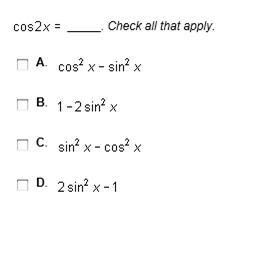
A & C ?
 Vocaloid:
A and C are not equivalent so they can't both be the correct solution A is true, now if we replace cos^2(x) with 1 - sin^(x) what do we get?
zarkam21:
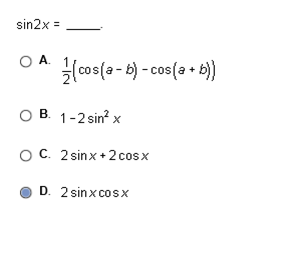
D
Vocaloid:
other way around cos^2(x) - sin^2(x) becomes 1 - sin^2(x) - sin^2(x) which results in B not D so A+B = your sol'n
 zarkam21:
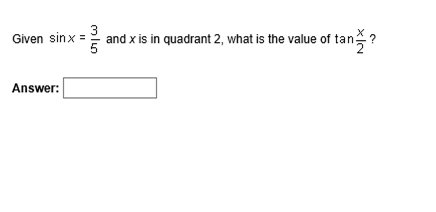
3/10
Vocaloid:
hm I got something a little different, I used the tan half angle identity:
Vocaloid:
|dw:1523842647831:dw|
Vocaloid:
sin(x) = 3/5 and cos(x) = -4/5 so tan(x/2) = (3/5)/(1 - 4/5) if I did this correctly
Vocaloid:
lemme just double check
zarkam21:
2.5
Vocaloid:
check your calculations again what is 3/5 divided by 1/5? as a hint you can cross out the denominators since they're equal
zarkam21:
3
Vocaloid:
good so that's your sol'n
 zarkam21:
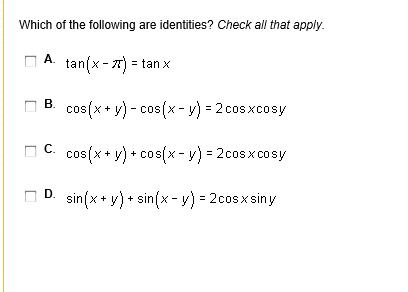
B and C
Vocaloid:
keep in mind, 2cos(x)cos(y) cannot be equal to both B and C, it has to be one or the other
zarkam21:
B
Vocaloid:
alright, the proof is very complex but I'll try to break it down cos(x+y) + cos(x-y) = 2cos(x)cos(y) using the double angle identity cos(x+y) = cos(x)cos(y) - sin(x)sin(y) [you just have to know this identity] cos(x-y) = cos(x)cos(y) + sin(x)sin(y) [you just have to know this identity] adding these together gives us cos(x+y) + cos(x-y) = 2cos(x)cos(y) [since the sin expressions cancel out]
Vocaloid:
that's why there needs to be a plus sign in between the cos expressions not a minus sign
Vocaloid:
anyway, besides that, there's one more correct identity, do you know what it might be?
Vocaloid:
well, there's only two options left, A and D let's look at tan(x-pi) = tan(x) do you remember what the period of tan is?
zarkam21:
A
Vocaloid:
good, since the period of tan is pi, then tan(x-pi) just shifts the graph over by pi units and ends up being equal to tan(x) so A+C = your sol'n
 zarkam21:
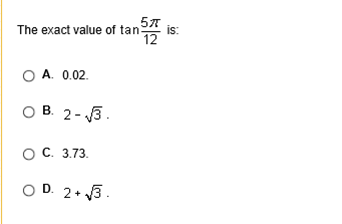
D
zarkam21:
well c too :/
Vocaloid:
keep in mind it's asking for the exact value; any decimal values are rounded not exact
zarkam21:
so d
Vocaloid:
good
 Vocaloid:
well done
 zarkam21:
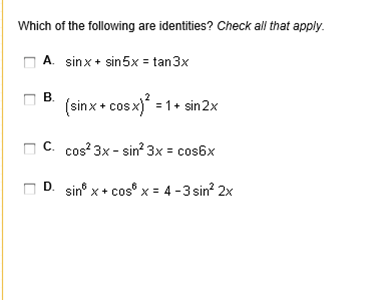
D And A ?
Vocaloid:
yikes this might take me a while to do the calculations ;-;
zarkam21:
Its fine, like can you like really just sum it up or no? If not, then I will just submit A and D. Don't worry about it.
Vocaloid:
well I have a pretty good hunch that A is not one of the options, I can't think of an identity that would relate sin and tan like that
Vocaloid:
anyway, if you take (cosx + sinx)^2 and expand this using foil what do you get?
zarkam21:
1+2cos(x)sin(x)
Vocaloid:
awesome! and if you remember from before, 2cos(x)sin(x) = sin(2x) so we get 1 + 2sin(x) making B true
Vocaloid:
anyway, if we look at C, we can use the identity cos^2(x) - sin^2(x) = cos(2x) if you replace "x" with "3x" is C true or false?
zarkam21:
true
Vocaloid:
good any thoughts on D? it's a pretty tedious calculation so I wouldn't really blame you too much if you just plugged it into a calculator ;_;
zarkam21:
False
Vocaloid:
good, so just B + C the proof is here if you ever have a spare moment ;_; http://lazi.vn/uploads/edu/answer/1506788483_3.jpg
 zarkam21:
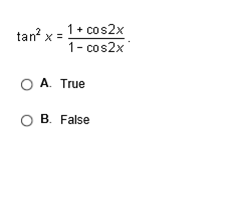
False
zarkam21:
Sory I am going through this fast. I have a fever and need to get this done :(
Vocaloid:
good
 zarkam21:
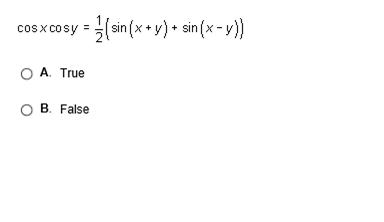
T
Vocaloid:
have to be careful on this one, the identity is cos(x)sin(y) not cos(y) so this ends up being false
zarkam21:
Yeah I just realized that:/
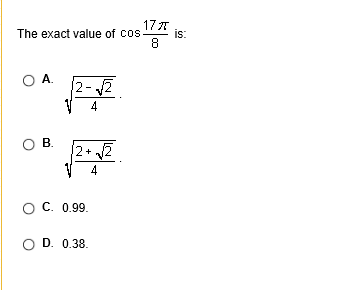 zarkam21:
A
zarkam21:
i get 2 for the denominator that is screwing me up
zarkam21:
I get the answer that is in choice B but with a denominator of 2
Vocaloid:
|dw:1523845265360:dw|
zarkam21:
SO B
Vocaloid:
using theta/2 = 17pi/8, you get theta = 17pi/4 therefore:
Vocaloid:
yeah, B, there's a plus sign not a minus sign due to the nature of the formula
Vocaloid:
I hope you feel better soon :S
zarkam21:
Oh hey thanks ^^
Join our real-time social learning platform and learn together with your friends!
 KBaby:
Verse 1 We left our names in the dust of the driveway Watched the old town shrink
KBaby:
Lyrics Generator Use AI to write the lyrics for a song. Suggested Genres: Pop Hip
KBaby:
Verse 1 We left our names in the dust of the driveway Watched the old town shrink
KBaby:
Lyrics Generator Use AI to write the lyrics for a song. Suggested Genres: Pop Hip

 aitexturegenerator:
How are you all handling AI-generated textures for 3D models and game assets without losing the hand-made feel? I've been doing a small stylized environment
aitexturegenerator:
How are you all handling AI-generated textures for 3D models and game assets without losing the hand-made feel? I've been doing a small stylized environment

 Demon25:
Woke up feeling like that girl and that dude well he still aint crap pluse the du
Demon25:
Woke up feeling like that girl and that dude well he still aint crap pluse the du
 playtsec:
how do I get rid of stress from teachers... I just feel like running out the classroom and leaving on my own.
playtsec:
how do I get rid of stress from teachers... I just feel like running out the classroom and leaving on my own.
 JohnnyLFowler0812:
What type of gamer would play something and then get off for a while. Why not sta
JohnnyLFowler0812:
Which is better? Metallica Rap Country R&B hiphop Medal Gospel Chill Which 3 opti
JohnnyLFowler0812:
What type of gamer would play something and then get off for a while. Why not sta
JohnnyLFowler0812:
Which is better? Metallica Rap Country R&B hiphop Medal Gospel Chill Which 3 opti