
 zarkam21:
A?
 Vocaloid:
this calculation is taking me a while
zarkam21:
I'm sorry i dont want you to have to do long calculations for me
zarkam21:
>.<
Vocaloid:
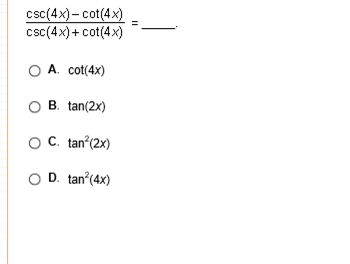
so what I have so far is that you would multiply the num and denom csc(4x) - cot(4x), that'll convert the denominator into csc^2(4x) - cot^2(4x) which is 1 I believe
zarkam21:
oh okay got what you are doing
Vocaloid:
I don't really like doing this but I can't think of a way to solve this w/o plugging in x values
 iGreen:
Well, you could express them all in cos & sin terms and then simplify from there.
iGreen:
Like this: \(\sf\dfrac{\frac{1}{sin(4x)}-\frac{cos(4x)}{sin(4x)}}{\frac{1}{sin(4x)}+\frac{cos(4x)}{sin(4x)}}\)
iGreen:
Combine the fractions in both the numerator and denominator: \(\sf\dfrac{\frac{1-cos(4x)}{sin(4x)}}{\frac{1+cos(4x)}{sin(4x)}}\)
iGreen:
Use the division rule: \(\sf\dfrac{(1-cos(4x))sin(4x)}{sin(4x)(1+cos(4x))}\)
iGreen:
Cancel out sin(4x): \(\sf\dfrac{(1-cos(4x))\cancel{sin(4x)}}{\cancel{sin(4x)}(1+cos(4x))}\) \(\sf\dfrac{1-cos(4x)}{1+cos(4x)}\)
zarkam21:
and get b ?
iGreen:
Not quite, try again.
zarkam21:
D
zarkam21:
because of the 4x
iGreen:
We could do: \(\sf\dfrac{1-cos(2\cdot 2x)}{1+cos(2\cdot 2x)}\)
zarkam21:
C :/
iGreen:
Ohhh, then we could multiply 1/2 to the numerator and denominator, then use the identities: \(\sf sin^2(x)=0.5(1-cos(2x))\) \(\sf cos^2(x)=0.5(1+cos(2x))\)
iGreen:
Which leaves us with: \(\sf\dfrac{sin^2(2x)}{cos^2(2x)}\) \(\sf tan^2(2x)\) \(\Huge\checkmark\)
zarkam21:
thank you so much I really do appreciate it
iGreen:
No problem.
Join our real-time social learning platform and learn together with your friends!
 KBaby:
Verse 1 We left our names in the dust of the driveway Watched the old town shrink
KBaby:
Lyrics Generator Use AI to write the lyrics for a song. Suggested Genres: Pop Hip
KBaby:
Verse 1 We left our names in the dust of the driveway Watched the old town shrink
KBaby:
Lyrics Generator Use AI to write the lyrics for a song. Suggested Genres: Pop Hip

 aitexturegenerator:
How are you all handling AI-generated textures for 3D models and game assets without losing the hand-made feel? I've been doing a small stylized environment
aitexturegenerator:
How are you all handling AI-generated textures for 3D models and game assets without losing the hand-made feel? I've been doing a small stylized environment

 Demon25:
Woke up feeling like that girl and that dude well he still aint crap pluse the du
Demon25:
Woke up feeling like that girl and that dude well he still aint crap pluse the du
 playtsec:
how do I get rid of stress from teachers... I just feel like running out the classroom and leaving on my own.
playtsec:
how do I get rid of stress from teachers... I just feel like running out the classroom and leaving on my own.
 JohnnyLFowler0812:
What type of gamer would play something and then get off for a while. Why not sta
JohnnyLFowler0812:
Which is better? Metallica Rap Country R&B hiphop Medal Gospel Chill Which 3 opti
JohnnyLFowler0812:
What type of gamer would play something and then get off for a while. Why not sta
JohnnyLFowler0812:
Which is better? Metallica Rap Country R&B hiphop Medal Gospel Chill Which 3 opti