
 Shadow:
@Angle
Shadow:
\[\sin \theta + \cos \theta = 1\] How would you solve this
Shadow:
Or maybe Sarah can use her brain for me
 bm717:
@umm ;) I think she can.
Shadow:
No you
 dude:
dude:
No u
Shadow:
Ms. Calculus
bm717:
Uh TGP IS CALLING ME GTG BYEEEE
Shadow:
\[0 \le \theta \le 2 \pi\]
 Nnesha:
solve for what ?
Shadow:
theta
Shadow:
Inky want to show me how to do this .-.
 nuts:
nuts:
you want just the answer or work
Nnesha:
use the identity \[\sin^2 \theta +\cos^2 \theta =1 \]
Shadow:
I want to understand, so the work would be good
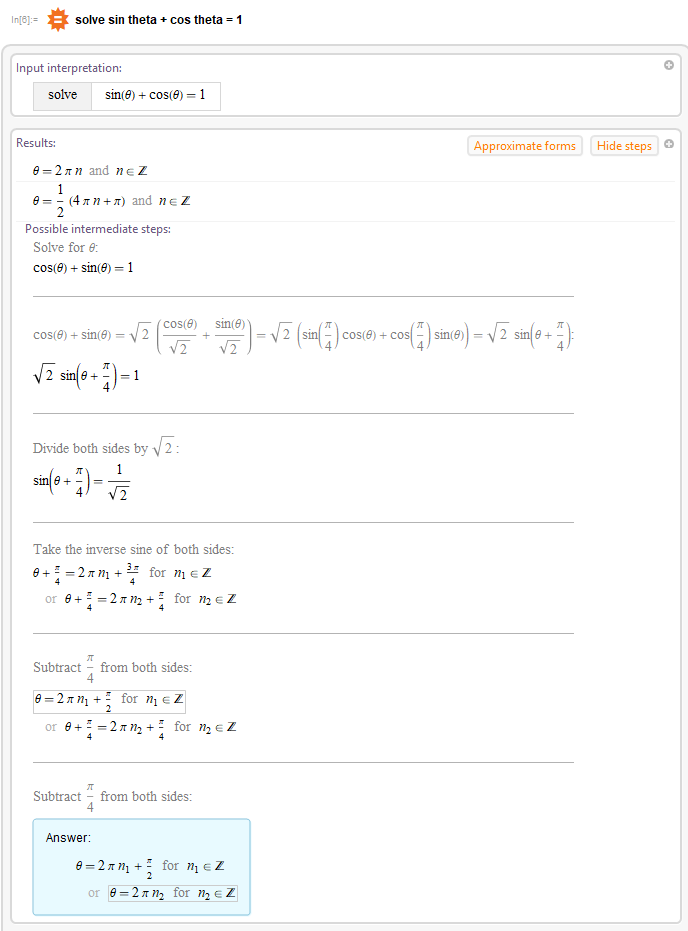 nuts:
nuts:
wait that's a janky way to solve it
nuts:
follow nnesha and then skip a few steps and use my answer
Nnesha:
\[\large\rm \cos^2 \theta = \sin^2 \theta -1 , \rightarrow cos \theta = \sqrt{sin^2 \theta -1} \] ^substitute that \[\large\rm \sin \theta +\cos \theta =1\] \[\sin \theta + \sqrt {\sin^2 \theta -1}=1\]
Nnesha:
\[\ \sqrt {\sin^2 \theta -1}=1-sin\theta \] square both sides and then solve for sin theta.
nuts:
ahh yeah that's the proper way to do it
nuts:
granted every time you do that square root and square operation you have to justify it based on signs
Shadow:
\[\frac{ \pi }{ 2 }\] ?
nuts:
ya
Nnesha:
there is another solution. work??
nuts:
oh yeah 0 i forgot
Shadow:
\[\frac{ 3\pi }{ 2 }\]
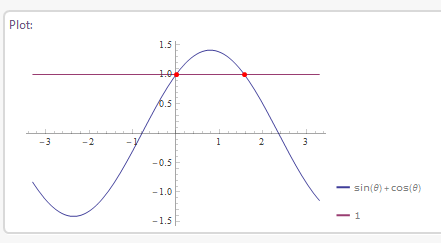 nuts:
nuts:
jk i'm a lazy liar and you should never trust me
nuts:
2pi, not 3pi/2
Shadow:
Okay I guess I should write out my steps and you guys tell me where I screwed up, lol
Nnesha:
The best way is to see the work in order to make the correction. otherwise ill be just guessing
Shadow:
\[\sin \theta + \cos \theta = 1\] \[\sin \theta + \sqrt \sin^2 \theta - 1 = 1\] Square it all \[\sin ^2 \theta + \sin^2 \theta - 1 = 1\] \[2 \sin^2 \theta = 2\] \[\sin \theta = \pm 1\] Referred to unit circle, and that's how I got \[\frac{ \pi }{ 2 } , \frac{ 3 \pi }{ 2 }\]
Shadow:
Where I got +-1 from \[2 \sin^2 \theta = 2 \] \[\sin^2 \theta = 1\] \[\sin^2 \theta - 1 = 0\] \[(\sin \theta + 1)( \sin \theta - 1)\] \[\sin \theta = -1, \sin \theta = 1\]
Shadow:
I'm kind of just going off copied notes for this since I was there for the lecture. Sorry lol. @Nnesha
Shadow:
wasnt'*
Nnesha:
2nd step is wrong..
Nnesha:
\(\color{#0cbb34}{\text{Originally Posted by}}\) @Nnesha \[\large\rm \cos^2 \theta = \sin^2 \theta -1 , \rightarrow cos \theta = \sqrt{sin^2 \theta -1} \] ^substitute that \[\large\rm \sin \theta +\cos \theta =1\] \[\sin \theta + \sqrt {\sin^2 \theta -1}=1\] \(\color{#0cbb34}{\text{End of Quote}}\) we know that \[\cos^2 \theta + \sin^2 \theta =1 \] solve for cos^2theta we will get \[\cos^2 \theta =1- \sin^2 \theta \] to get rid of the square root from left side take square to the both side of the equation (including the *-1*) \[\sqrt {\cos^2 \theta} =\sqrt{\sin^2 \theta -1}\] \[\cos \theta = \sqrt{\sin^2 \theta -1}\]
Shadow:
Yeah I inputted that in for cos
Nnesha:
\[\sin \theta + \sqrt \sin^2 \theta - 1 = 1\] sqrt of sin^2theta -1 not just the sin^2theta \[\sqrt{\sin^2 \theta-1} \cancel{=} \sin^2\theta\]
Shadow:
I know, but the sqrt doesn't extend all the way over for some reason.
Nnesha:
ohh one second
Shadow:
I treated it as: \[\sqrt (\sin^2 \theta - 1)\]
Nnesha:
sorry that's right i was thinking about (sin^2theta -1)^2 *faceplm*
Nnesha:
\[\sqrt {\sin^2\theta -1} = 1- \sin \theta \] \[(\sqrt {\sin^2 \theta -1})^2 = (1-\sin \theta)^2\] \[\sin^2 \theta -1= \] (1-sintheta)^2 = ?
 Hero:
Hero:
So the correct way to do this is to do the following steps: Given: \(\sin\theta + \cos\theta = 1\) Square Both Sides: \(\left(\sin\theta + \cos\theta\right)^2=1^2\) Expand the above to get: \(\sin^2\theta + \cos^2\theta + 2\sin\theta\cos\theta = 1\) Remember that \(\sin^2\theta + \cos^2\theta = 1\) so: \(1+ 2\cos\theta\sin\theta = 1\) Subtract 1 from both sides: \(2\sin\theta\cos\theta = 0\) Divide both sides by 2: \(\sin\theta\cos\theta = 0\) Then use the product property (if ab = 0, then a = 0 or b = 0) \(\sin\theta = 0\) or \(\cos\theta = 0\)
Hero:
Now you should be able to easily find your theta.
 Bob:
Bob:
ive heard of alpha, beta, omega, but no theta
Shadow:
In your third step, where does \[2 \sin \theta \cos \theta\] come from?
Hero:
It comes from expanding the binomial. Remember algebra \((x + y)^2 = x^2 + 2xy + y^2\)
Shadow:
yeah, facepalm
Shadow:
wow
Shadow:
Thank you Hero, I get it now. Those steps were pretty easy to follow.
Hero:
Don't forget to read that book I was telling you about.
Shadow:
Haha, I'll have time this summer to pour through books. Already have the great books you recommended on my reading list, I'll add that other one as well.
Hero:
Ah, I see. Good luck.
Nnesha:
That was an interesting question..\[\rm \sin^2 \theta +\cos ^2 \theta=1 \rightarrow cos \theta =\color{orange}{ \sqrt{1-sin^2 \theta}}\]\[\sin \theta + \color{orange}{\sqrt{1-\sin^2 \theta}}=1\]\[\rm \sqrt{1-\sin^2\theta}=1-\sin \theta\]\[\rm (\sqrt{1-\sin^2\theta})^2=(1-\sin \theta)^2\]\[\ \rm 1-\sin^2\theta = \sin^2\theta -2sin \theta +1\]\[2\sin \theta (\sin \theta -1)=0 \]\[\sin \theta = 0 ~,~ \sin \theta =1\] This messy approach is *algebraically* correct...however it gives an extra solution which does not satisfy the original equation, an *extraneous solution*..
Hero:
Except @Nnesha, your approach will not output possible values for theta that will satisfy the \(\cos(\theta)\) requirement. With my approach, we have \(\theta = \sin^{-1}(0) = 0\) \(\theta = \cos^{-1}(0) = \dfrac{\pi}{2}\) And thus \(\sin(0) + \cos(0) = 1\) or \(\sin\left(\dfrac{\pi}{2}\right) + \cos\left(\dfrac{\pi}{2}\right) = 1 \) So my approach finds two values of \(\theta\) that satisfy the equation.
Join our real-time social learning platform and learn together with your friends!
 KBaby:
Verse 1 We left our names in the dust of the driveway Watched the old town shrink
KBaby:
Lyrics Generator Use AI to write the lyrics for a song. Suggested Genres: Pop Hip
KBaby:
Verse 1 We left our names in the dust of the driveway Watched the old town shrink
KBaby:
Lyrics Generator Use AI to write the lyrics for a song. Suggested Genres: Pop Hip

 aitexturegenerator:
How are you all handling AI-generated textures for 3D models and game assets without losing the hand-made feel? I've been doing a small stylized environment
aitexturegenerator:
How are you all handling AI-generated textures for 3D models and game assets without losing the hand-made feel? I've been doing a small stylized environment

 Demon25:
Woke up feeling like that girl and that dude well he still aint crap pluse the du
Demon25:
Woke up feeling like that girl and that dude well he still aint crap pluse the du
 playtsec:
how do I get rid of stress from teachers... I just feel like running out the classroom and leaving on my own.
playtsec:
how do I get rid of stress from teachers... I just feel like running out the classroom and leaving on my own.
 JohnnyLFowler0812:
What type of gamer would play something and then get off for a while. Why not sta
JohnnyLFowler0812:
Which is better? Metallica Rap Country R&B hiphop Medal Gospel Chill Which 3 opti
JohnnyLFowler0812:
What type of gamer would play something and then get off for a while. Why not sta
JohnnyLFowler0812:
Which is better? Metallica Rap Country R&B hiphop Medal Gospel Chill Which 3 opti