
 Pixel:
Quadratic rate of change
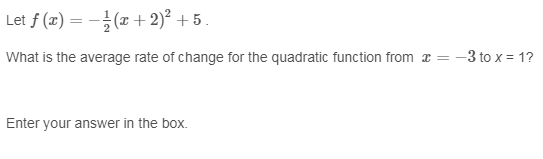 Pixel:
@Hero
Pixel:
I know the steps it's just the fraction that messes me up
 Hero:
Hero:
Rate of change formula for a quadratic function: \(\overline{\triangle} = \dfrac{f(b) - f(a)}{b - a}\), where a and b are any two values of \(x\) on the graphh of \(f(x)\)
Pixel:
I know how to do this it's the fraction that messes me up
Hero:
Pretty straight forward to me. What's supposedly confusing you about it?
Pixel:
-3 + 2 = 1^2 1 -1/2 x 1 = -1/2
Pixel:
Im just bad at fractions in general
Pixel:
-1/2 + 5 = 4 1/2
Pixel:
right?
Hero:
Why don't you try using the equation button to post your fraction?
Pixel:
too lazy
Pixel:
Are you going to help me?
Hero:
Use the drawing feature to post your answer. I need something better than what you posted above. It looks a little incoherent as currently presented.
Pixel:
|dw:1524507568895:dw|
Pixel:
5.5 = -3 -2 = 1
Hero:
What I mean is, show your work by applying the formula above.
Pixel:
|dw:1524507678108:dw|
Pixel:
|dw:1524507774413:dw|
Hero:
How about start with: \(\dfrac{f(1) - f(-3))}{1 -(-3)}\)
Pixel:
my teachers say differently
Pixel:
to get the x,y values then do the formula
Hero:
\(=\dfrac{-\dfrac{1}{2}(1 + 2)^2 + 5-(-\dfrac{1}{2}(-3 + 2)^2 + 5)}{1-(-3)}\) \(=\dfrac{1.5 -(2.5)}{1-(-3)}\) \(=-\dfrac{1}{4}\)
Pixel:
i got -1 with a rate of change calculator
Hero:
How do we know you entered the information correctly?
 Hero:
Hero:
\(=\dfrac{-\dfrac{1}{2}(1 + 2)^2 + 5-(-\dfrac{1}{2}(-3 + 2)^2 + 5)}{1-(-3)}\) \(=\dfrac{0.5 -(-2.5)}{1-(-3)}\) \(=\dfrac{3}{2}\)
Hero:
That's my next calculation. If that isn't it, then oh well. The important thing is understanding the method.
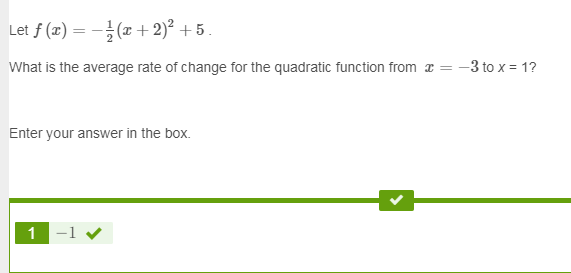 Pixel:
i got it right
 Nnesha:
|dw:1524508747031:dw|
Hero:
Next time I get a problem like this, I'm just going to do it on paper first rather than trying to type it all up and do ALL of the math mentally.
Hero:
Yep, it's -1. Did the math mentally. I see exactly where I messed up.
Join our real-time social learning platform and learn together with your friends!
 KBaby:
Verse 1 We left our names in the dust of the driveway Watched the old town shrink
KBaby:
Lyrics Generator Use AI to write the lyrics for a song. Suggested Genres: Pop Hip
KBaby:
Verse 1 We left our names in the dust of the driveway Watched the old town shrink
KBaby:
Lyrics Generator Use AI to write the lyrics for a song. Suggested Genres: Pop Hip

 aitexturegenerator:
How are you all handling AI-generated textures for 3D models and game assets without losing the hand-made feel? I've been doing a small stylized environment
aitexturegenerator:
How are you all handling AI-generated textures for 3D models and game assets without losing the hand-made feel? I've been doing a small stylized environment

 Demon25:
Woke up feeling like that girl and that dude well he still aint crap pluse the du
Demon25:
Woke up feeling like that girl and that dude well he still aint crap pluse the du
 playtsec:
how do I get rid of stress from teachers... I just feel like running out the classroom and leaving on my own.
playtsec:
how do I get rid of stress from teachers... I just feel like running out the classroom and leaving on my own.
 JohnnyLFowler0812:
What type of gamer would play something and then get off for a while. Why not sta
JohnnyLFowler0812:
Which is better? Metallica Rap Country R&B hiphop Medal Gospel Chill Which 3 opti
JohnnyLFowler0812:
What type of gamer would play something and then get off for a while. Why not sta
JohnnyLFowler0812:
Which is better? Metallica Rap Country R&B hiphop Medal Gospel Chill Which 3 opti