
 EndersWorld:
@hero Factoring
EndersWorld:
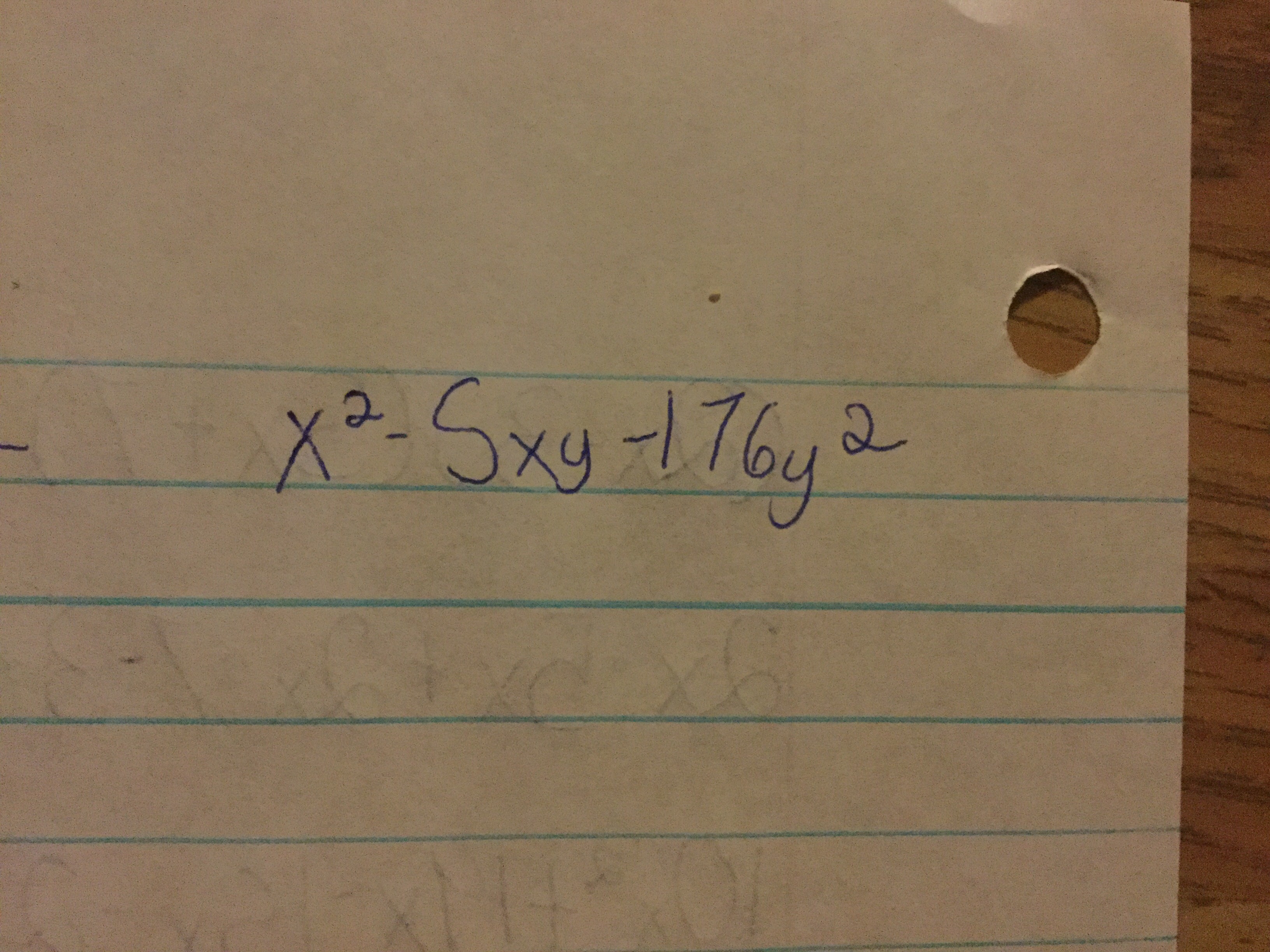
The expression \[x^2-5xy-176y^2\] is equivalent to (x-16y)(x+11y) (x-8y)(x-22y) (x-8y)(x+22y) (x+8y)(x-22y) (x+8y)(x+22y)
 Hero:
Hero:
If you are given a trinomial of the form \(ax^2 + bx + c\) and asked to factor it into some form of \((cx + d)(fx + g)\), you must first find two numbers that add to get \(b\) yet multply to get \(ac\) For example, if you are given something like \(3x^2 + 5x + 2\) do you know how to factor that @EndersWorld
EndersWorld:
In factor boxes... I can’t do it in my head.
Hero:
Can you do it using any method you've been shown so far?
Hero:
@EndersWorld, take your time
EndersWorld:
No. Boxes don’t work out.
Hero:
Ah, okay, good. Now that I have your complete undivided attention and interrupting forces are gone...
EndersWorld:
^_^
Hero:
Here's how to factor 3x^2 + 5x + 2 .... @jhonyy9 was on the right track, just not explaining completely enough. You do want to find two numbers that add to 5, but you also want to find two numbers that multiply to get (3)(2) or 6. Keep in mind, b = 5, a = 3, c = 2. So in general, you want to find two numbers that add to get b, yet multiply to get ac. You can set it up this way: If m and n represent the two numbers you wish to find then: m + n = 5 m x n = 6
EndersWorld:
Correct.
Hero:
Beginning with factors of 6: (6)(1) (3)(2) So those are the only two unique factors. Now you think to yourself, which of these would ADD to get 5. Only 3 and 2 would work in this case. so m = 3 and n = 2. Now you take that and REPLACE the b value (5) with (3 + 2) like so 3x^2 + 5x + 2 becomes 3x^2 + (3 + 2)x + 2 Next distribute the x: 3x^2 + 3x + 2x + 2 Afterwards, "Factor by Grouping" which means factor the first two terms then factor the last two terms like so: 3x is common to the first to terms and 2 is common to the last two terms therefore you should get 3x(x + 1) + 2(x + 1) as the next step in the factorization process. With me so far?
EndersWorld:
I think!
Hero:
Okay, I'll take that as a yes. so in the previous step we have 3x(x + 1) + 2(x + 1) and we still need to factor further to get the form (cx + d)(fx + g) so what do we do? Well remember what I was explaining to you earlier about the distributive property? Well guess what? In this case our a term is x + 1, our b term is 3x and our c term is 2. Remembering the distributive property a(b + c) = ac + ac, we can use that in reverse to complete the factorization. If we do that, we end up with (x + 1)(3x + 2) as the final factorization. Open to any questions you have about this.
EndersWorld:
Why does this exist?
Hero:
Why does WHAT exist? Factoring? Its one of the fundamental principles of mathematics a prerequisite to higher level mathematics such as calculus, probablity theory, statistics, calculus, linear algebra, discrete mathematics, abstract algebra, differential equations, topology, etc.
Hero:
Anyway, to help you understand more simply, I'll post the complete steps without all the explanation part so that you see the process more completely:
EndersWorld:
I think that would be beneficial
Hero:
3x^2 + 5x + 2 = 3x^2 + (3 + 2)x + 2 = 3x^2 + 3x + 2x + 2 = 3x(x + 1) + 2(x + 1) = (x + 1)(3x + 2) <-- Application of distributive property (in reverse)
Hero:
|dw:1524522115151:dw|
EndersWorld:
Nice handwriting ( ͡° ͜ʖ ͡°) :)
Hero:
Even further explanation here for each step: Original Problem: 3x^2 + 5x + 2 Replace 5 with (3 + 2) since m = 3 and n = 2: 3x^2 + (3 + 2)x + 2 Distribute the x using distributive property: 3x^2 + 3x + 2x + 2 Factor by Grouping (3x is common to the 1st 2 terms, 2 is common to the last 2): 3x(x + 1) + 2(x + 1) And remember the "a" term is (x+1) which is common to both factorizations so factor that out as well to get: = (x + 1)(3x + 2)
EndersWorld:
Ima try the problem now.
Hero:
Good luck although I must say, it is a slightly different problem.
EndersWorld:
You better stick around XD
 EndersWorld:
Since b is -5 should I just do like -2+-3?
Hero:
Well, this one is definitely a slightly different problem and for it, I would use a different method. It's a bit more complicated than what I have already shown you thus far. I don't know if you'd be able to keep up.
EndersWorld:
Should I try using factor boxes?
Hero:
Nevertheless, you don't have to worry about the a term since it equals 1 in this case, so you should be able to use factors of -176 that add to get -5.
EndersWorld:
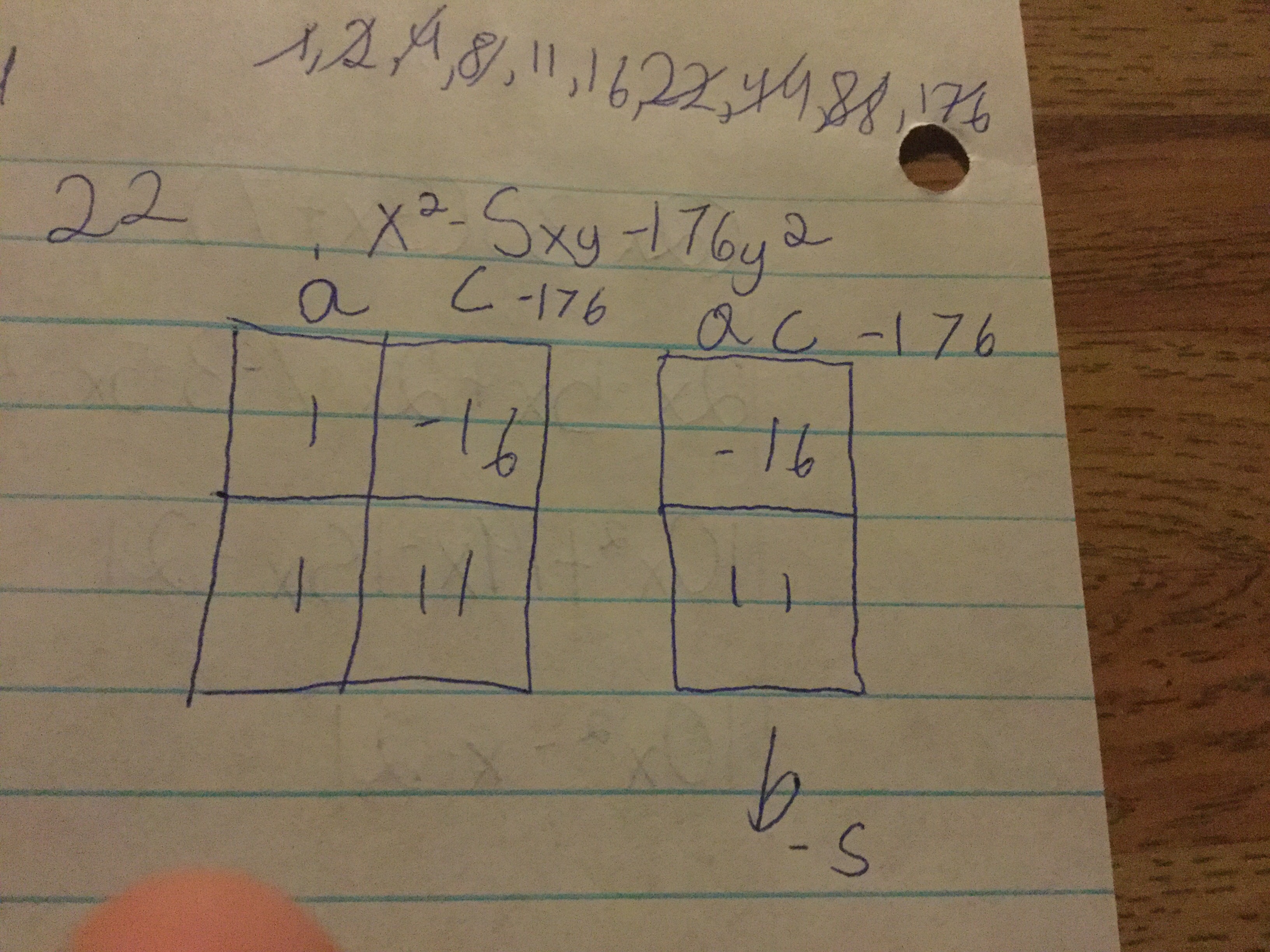
-16 and 11
Hero:
By the way, if they did not give you the answer choices and you had to find the factors of 176, here's what I would do if I were you. Factor like so, ALWAYS start with 1: (1)(176) (2)(88) is 88 divisible by 3, no. is 88 divisible by 4, yes: 4(44) 44 is divisible by 4 so (4)(4)(11) Now we only need two factorizations so: (16)(11) But what we have needs to add to -5 so how can 16 and 11 add to get -5. Well, as you put it above 16 must be negative so the two factors are -16 and 11.
Hero:
You should be able to factor from there.
 EndersWorld:
(x-16y)(x+11y)
EndersWorld:
I don’t have your answer as a answer choice :0
Hero:
Sorry, I forgot the y, just a typo (x - 11y)(x + 16y)
Hero:
Oh, I messed up further than that I think. Hang on.
Hero:
Oh I see where I messed up. Sorry about that.
Hero:
The 5 in the original problem, the factors of that are 16 and -11 which is what I replaced in the original problem so what I should have done was this:
Hero:
x^2 - 5xy - 176y^2 = x^2 - (16 - 11)xy - 176y^2 = x^2 -(16xy - 11xy) - 176y^2 = x^2 - 16xy + 11xy - 176y^2 = x(x - 16y) + 11y(x - 16y) = (x - 16y)(x + 11y)
Hero:
There we go. Good catch. I was typing too fast and didn't catch myself making that mistake to begin with. When I factor these I usually don't mess with the negative number until I absolutely have to.
EndersWorld:
Same. I hate it.
Hero:
Yeah, but I don't usually make that mistake. I just haven't done these in a while. You reminded me of my own fail safe. Never deal with the negative number until you absolutely have to. If you use my method correctly, you can just find the positive factors of 176 and then replace that with the positive 5 but leave the negative on the outside of the parentheses and distribute it in later.
EndersWorld:
Moving onto the next one :0
Hero:
Yep, that was probably a good stopping point.
Join our real-time social learning platform and learn together with your friends!
 KBaby:
Verse 1 We left our names in the dust of the driveway Watched the old town shrink
KBaby:
Lyrics Generator Use AI to write the lyrics for a song. Suggested Genres: Pop Hip
KBaby:
Verse 1 We left our names in the dust of the driveway Watched the old town shrink
KBaby:
Lyrics Generator Use AI to write the lyrics for a song. Suggested Genres: Pop Hip

 aitexturegenerator:
How are you all handling AI-generated textures for 3D models and game assets without losing the hand-made feel? I've been doing a small stylized environment
aitexturegenerator:
How are you all handling AI-generated textures for 3D models and game assets without losing the hand-made feel? I've been doing a small stylized environment

 Demon25:
Woke up feeling like that girl and that dude well he still aint crap pluse the du
Demon25:
Woke up feeling like that girl and that dude well he still aint crap pluse the du
 playtsec:
how do I get rid of stress from teachers... I just feel like running out the classroom and leaving on my own.
playtsec:
how do I get rid of stress from teachers... I just feel like running out the classroom and leaving on my own.
 JohnnyLFowler0812:
What type of gamer would play something and then get off for a while. Why not sta
JohnnyLFowler0812:
Which is better? Metallica Rap Country R&B hiphop Medal Gospel Chill Which 3 opti
JohnnyLFowler0812:
What type of gamer would play something and then get off for a while. Why not sta
JohnnyLFowler0812:
Which is better? Metallica Rap Country R&B hiphop Medal Gospel Chill Which 3 opti