
 zarkam21:
B?
 Shadow:
What do you think?
 bm717:
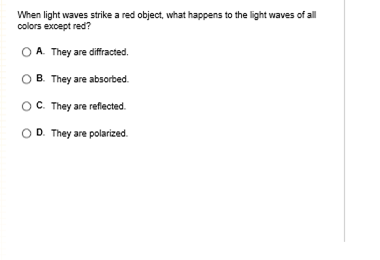
'Colors of objects We usually view objects when they are illuminated by white light, usually sunlight or ordinary room light. White light is a mixture of all colors, in roughly equal proportions. White objects look white because they reflect back all the visible wavelengths of light that shine on them - so the light still looks white to us. Colored objects, on the other hand, reflect back only some of the wavelengths; the rest they absorb. For example, if white light shines on a red ball, the ball reflects back mostly red light, and so we see red. Most of the greens and blues that are part of white light are absorbed by the ball so we cannot see them. Likewise, a blue book is reflecting the blue part of the white light spectrum. The red and green parts are absorbed by the book. What happens when red light shines on a red ball? It continues to reflect the red light, and so it is still red -- but a white ball would also look red in red light, because it reflects all colors. If instead we shine blue light on a red ball, it will look dark, because it does not reflect blue light. It cannot look red unless there is red light coming to it from the light source. And it cannot look blue because the red ball absorbs blue light. So when we ask what color an object is, the answer is not simple - it depends on what color light we are using to see the object. One consequence of the fact that different colored objects absorb different wavelengths of light is that darker objects heat up faster in the sun than white ones do - because they absorb many of the different wavelengths of light energy, while white objects reflect most of the wavelengths. (More on this in the section on light energy.)' According to this paragraph, what does it say about light and the colors?
 Bob:
Bob:
zarkam's little sister is afk
zarkam21:
it reflects
zarkam21:
?
bm717:
@Shadow Correct, right? I agree with C.
Shadow:
No
Shadow:
Everything except red gets absorbed. Something is red because only red light is reflected.
Bob:
wow direct answer
bm717:
Ban hammer.
Bob:
^
Shadow:
Sarah already explained it by copying and pasting. I am just clarifying.
zarkam21:
Yeah so B, I thought i wasn't right
Bob:
well if @zarkam21 doesn't know the answer after the explanation, she's still confused, and therefore, she needs more explaining.
zarkam21:
That is what I originally said
Bob:
and one doesnt tend to want to read paragraphs pasted from google
zarkam21:
Thats not true ^ :/
Bob:
then why didnt you read it
zarkam21:
I thought I wasn't right which is why I changed my answer
bm717:
I did not copy and paste ;)
zarkam21:
I did read it
Shadow:
I didn't read it. I scanned it for reflect/absorb. You could learn the answer from the paragraph easily that way.
Bob:
how could you read it and come up with C "What happens when red light shines on a red ball? It continues to reflect the red light..."
bm717:
Shut up, @bob. LOL
bm717:
Wait, absorbing wasn't C?
zarkam21:
It was b which is what I originally said
zarkam21:
But people think I am just guessing
bm717:
Oh. I thought B was C for some reason. holup I need some new contacts.
Bob:
sure -_-
zarkam21:
Your being really rude for someone who just needs some academic help
bm717:
me? Sorry.
zarkam21:
to*
Shadow:
We are talking about all the other light, excluding red light. First hint: " White objects look white because they reflect back all the visible wavelengths of light that shine on them" Reflects back light that are the color of the object. "Colored objects, on the other hand, reflect back only some of the wavelengths; the rest they absorb." Objects with color reflects back only certain light, the rest they absorb. This indicates that color absorption/reflection is based on some discrimination. "For example, if white light shines on a red ball, the ball reflects back mostly red light, and so we see red. Most of the greens and blues that are part of white light are absorbed by the ball so we cannot see them. " You should have the answer by now as white light (if anyone did not know) consists of all light. The fact that only red is mostly reflected back should indicate what's already been hinted at. Then the quote says that most of the other colors get 'absorbed.'
 Angle:
OK OK so it seems that the way the helpers phrased things made it sound like zark's first guess was wrong, when it was actually correct so zark tried changing their answer and miscommunication/misunderstanding followed
Angle:
I think we're good now
Shadow:
At that point it's clear that objects only absorb light that aren't the color of itself, and reflect back colors that represent itself.
zarkam21:
@Angle thank you that is exactly what happened thank you
Join our real-time social learning platform and learn together with your friends!
 Demon25:
For a hoco proposal with a cheerleader and football player, what else should be a
Demon25:
For a hoco proposal with a cheerleader and football player, what else should be a

 Breathless:
TOC: "MGF any confirmation on the commander? we require confirmation as soon as[radio static].
Breathless:
TOC: "MGF any confirmation on the commander? we require confirmation as soon as[radio static].
 EdwinJsHispanic:
I wrote something that I don't know if I want it as a poem or song, Please let me know on yours thoughts about it, I'm still doing this! "Broken promises an
EdwinJsHispanic:
I wrote something that I don't know if I want it as a poem or song, Please let me know on yours thoughts about it, I'm still doing this! "Broken promises an
 thehearken:
hi um I don't know if this is the right section for this, but can someone go over my poem and tell me if its good enough to give my English professor for a
thehearken:
hi um I don't know if this is the right section for this, but can someone go over my poem and tell me if its good enough to give my English professor for a
 heartlessprophet:
Aye what's 19z%u00f74p=9u03c0 my teacher thinking of impossible questions for us
heartlessprophet:
Aye what's 19z%u00f74p=9u03c0 my teacher thinking of impossible questions for us
 kippppp:
does anyone have any good tips for writing stories? i'm trying to write a dnd campaign but i'm not that great of a writer yet.
kippppp:
does anyone have any good tips for writing stories? i'm trying to write a dnd campaign but i'm not that great of a writer yet.
 GRIZZLEY19:
Y'all let me know what y'all think about this beat I made I took me like a hour maybe rate it 0/10 https://drive.
GRIZZLEY19:
Y'all let me know what y'all think about this beat I made I took me like a hour maybe rate it 0/10 https://drive.
 Ultrilliam:
Welcome to the 10th Anniversary Update! (Part 2) Sorry this one passed the date a
Ultrilliam:
Welcome to the 10th Anniversary Update! (Part 2) Sorry this one passed the date a
 Twaylor:
was walking downtown and my adhd brain wanted to make some (rock?) lyrics: There'
Twaylor:
was walking downtown and my adhd brain wanted to make some (rock?) lyrics: There'