
 Shadow:
Series Circuits Master Page: https://questioncove.com/study#/updates/5ae2c3a7293a9d6f092ba200
 Shadow:
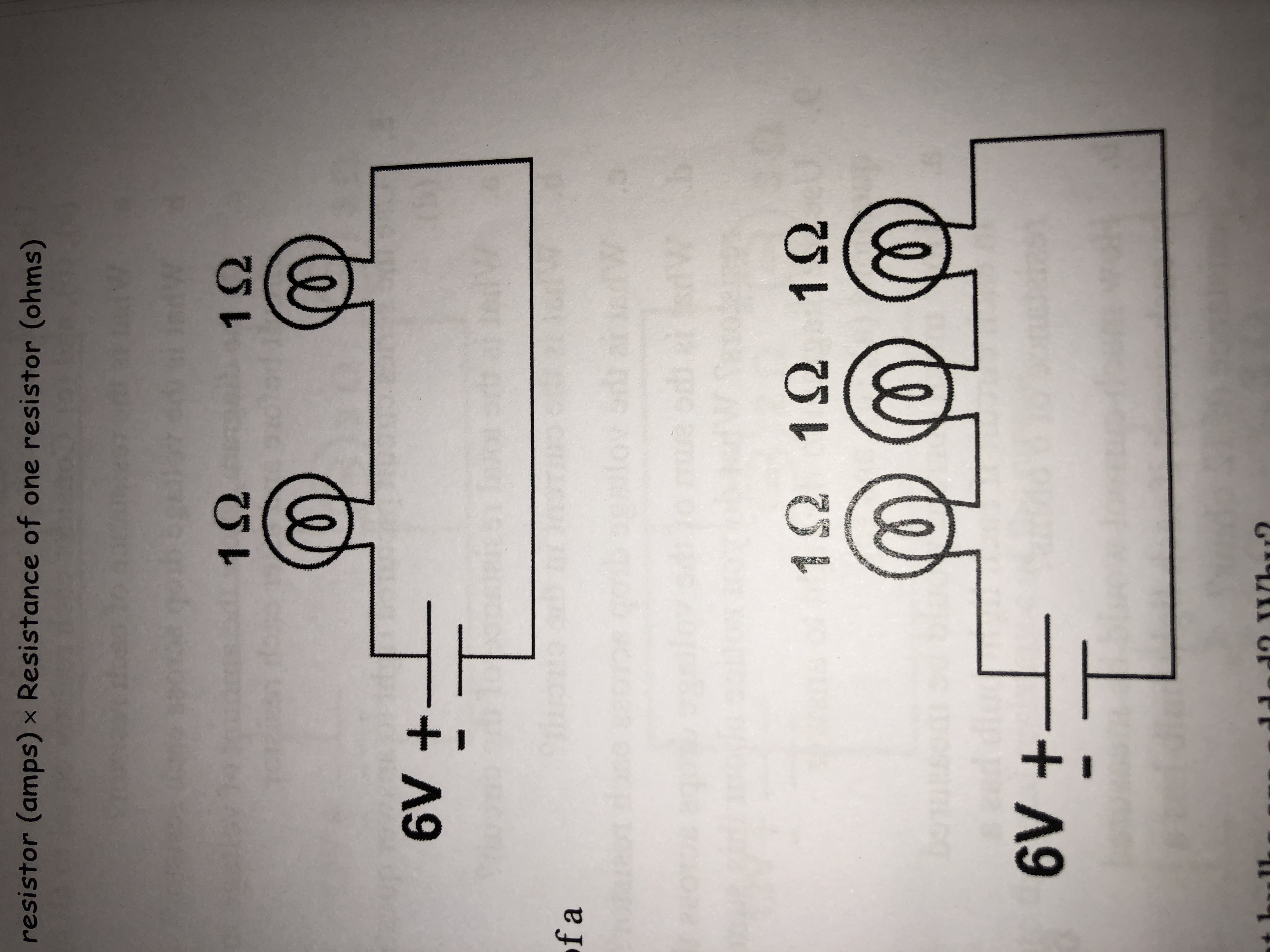
^Circuits for problems #1 and #2
Shadow:
1. Use the series circuit to answer questions (a)-(e). a. What is the total voltage across the bulbs? \[V _{1} + V _{1} = V_{total} \] \[V_{total} = 6 V\] b. What is the total resistance of the circuit? \[R_{total} = 1 + 1 = 2 \Omega\] c. What is the current in the circuit? \[(I) = \frac{ V }{ R }\] \[(I) = \frac{ 6 }{ 2 } = 3 A\] d. What is the voltage drop across each light bulb? (Remember that voltage drop is calculated by multiplying current in the circuit by the resistance of a particular resistor: V = IR.) \[V_{1} = (3)(1) = 3 V\] Voltage drop of 3V for both light bulbs. e. Draw the path of the current on the diagram Positive (longer stick of the batter) goes up, round, back to the short end (negative).
Shadow:
1. Use the series circuit to answer questions (a)-(e). a. What is the total voltage across the bulbs? \[V _{1} + V _{1} = V_{total} \] \[V_{total} = 6 V\] b. What is the total resistance of the circuit? \[R_{total} = 1 + 1 = 2 \Omega\] c. What is the current in the circuit? \[(I) = \frac{ V }{ R }\] \[(I) = \frac{ 6 }{ 2 } = 3 A\] d. What is the voltage drop across each light bulb? (Remember that voltage drop is calculated by multiplying current in the circuit by the resistance of a particular resistor: V = IR.) \[V_{1} = (3)(1) = 3 V\] Voltage drop of 3V for both light bulbs. e. Draw the path of the current on the diagram Positive (longer stick of the batter) goes up, round, back to the short end (negative). 2. Use the series circuit to answer questions (a)-(e). a. What is the total voltage across the bulbs? \[V_{1} + V_{1} + V_{1} = V_{total}\] \[V_{total} = 6 V\] b. What is the total resistance of the circuit? \[R_{total} = 1 + 1 + 1 = 3 \Omega\] c. What is the current in the circuit? \[(I) = \frac{ 6 }{ 3 } = 2 A\] d. What is the voltage drop across each light bulb? \[V = (2)(1) = 2 V\] Voltage drop of 2V for each light bulb (since same resistance). e. Draw the path of the current on the diagram Positive (longer stick of the battery) goes up, round, back to the short end (negative).
Shadow:
3. What happens to the current in a series circuit as more light bulbs are added? Why? More light bulbs means more resistance, so the value of the current would decrease due to the inverse proportional relationship to the resistance. The current would remain constant through each resistor (light bulb) though. 4. What happens to the brightness in a series circuit as more light bulbs are added? Why? Voltage is not constant across each resistor (unlike parallel circuits). Since the power determines the brightness, and Power = Current times Voltage, the voltage drop across each resistor in a series circuit results in a lower power for each light bulb, which means there is a decreased brightness.
 Shadow:
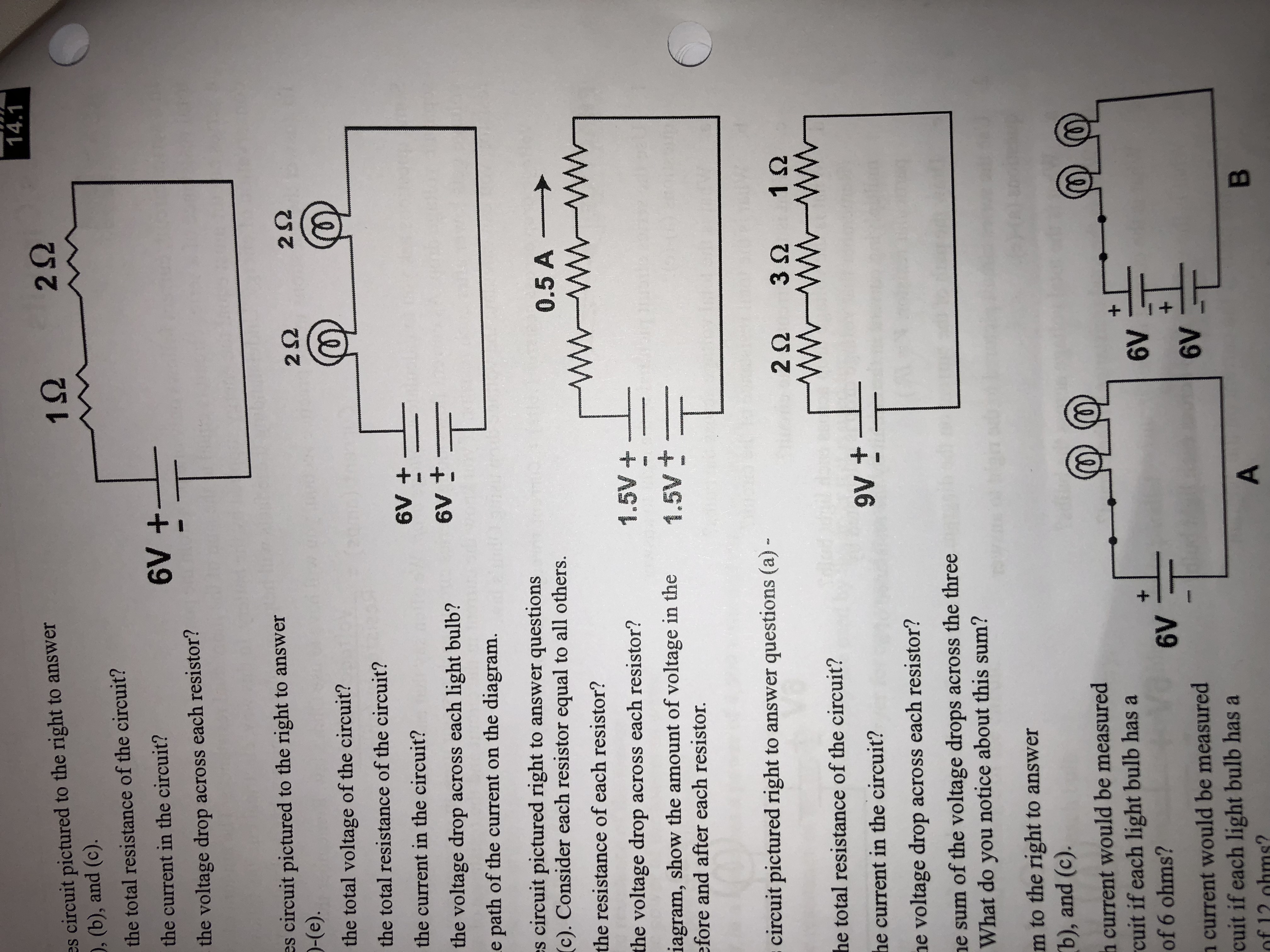
^Circuits for problems #5 - #9
Shadow:
5. Use the series circuit to answer questions (a), (b), and (c). a. What is the total resistance of the circuit? \[R_{total} = 1 + 2 = 3 \Omega\] b. What is the current in the circuit? \[(I) = \frac{ 6 }{ 3 } = 2 A\] c. What is the voltage drop across each resistor? \[V = IR \] \[V_{1} = 2(1) = 2 V\] \[V_{2} = (2)(2) = 4 V\]
Shadow:
6. Use the series to answer questions (a)-(e) a. What is the total voltage of the circuit? \[V = 12 V\] b. What is the total resistance of the circuit? \[R_{total} = 2 + 2 = 4 \Omega\] c. What is the current in the circuit? \[(I) = \frac{ 12 }{ 4 } = 3 A\] d. What is the voltage drop across each light bulb? \[V = RI\] \[V= 2(3) = 6 V\] For each 2 ohm resistor e. Draw the path of the current on the diagram Out the long end, back through the short end
Shadow:
7. Use the series circuit to answer questions (a), (b), and (c). Consider each resistor equal to all others. a. What is the resistance of each resistor? \[3R = \frac{ V }{ I }\] \[3R = \frac{ 3 }{ 0.5 } \] \[3R = 6\] \[R = 2 \Omega\] b. What is the voltage drop across each resistor? V = RI \[V = 0.5(2) = 1 V\] For each resistor, since all same resistance c. On the diagram, show the amount of voltage in the circuit before and after each resistor? 3-> 2->1-> 0
Shadow:
8. Use the series to answer questions (a)-(d) a. What is the total resistance of the circuit? \[R_{total} = 2 + 3 + 1 = 6 \Omega\] b. What is the current in the circuit? \[(I) = \frac{ 9 }{ 6 } = 1.5 A\] c. What is the voltage drop across each resistor? \[V = RI\] \[V_{2} = (1.5)(2) = 3 V\] \[V_{3} = (1.5)(3) = 4.5 V\] \[V_{1} = (1.5)(1) = 1.5 V\] d. What is the sum of the voltage drops across the three resistors? What do you notice about this sum? \[V_{2} + V_{3} + V_{1} = 9 V\] This is the total voltage of the battery.
Shadow:
9. Use the diagram to answer questions (a), (b), and (c). a. How much current would be measured in each circuit if each light bulb has a resistance of 6 ohms? \[R_{total} = 6 + 6 = 12 \Omega\] \[V_{total, A} = 6 V\] \[V_{total, B} = 12 V\] \[I_{total, A} = \frac{ 6 }{ 12 } = 0.5 A\] \[I_{total, B} = \frac{ 12 }{ 12 } = 1 A\] b. How much current would be measured in each circuit if each light bulb has a resistance of 12 ohms? \[R_{total} = 12 + 12 = 24 \Omega\] \[V_{total, A} = 6 V\] \[V_{total, B} = 12 V\] \[I_{total, A} = \frac{ 6 }{ 24 } = 0.25 A\] \[I_{total, B} = \frac{ 12 }{ 24 } = 0.5 A\] c. What happens tot he amount of current in a series circuit as the number of batteries increases? The current increases as more voltage means a higher current due to the directly proportional relationship.
Join our real-time social learning platform and learn together with your friends!
 Demon25:
For a hoco proposal with a cheerleader and football player, what else should be a
Demon25:
For a hoco proposal with a cheerleader and football player, what else should be a

 Breathless:
TOC: "MGF any confirmation on the commander? we require confirmation as soon as[radio static].
Breathless:
TOC: "MGF any confirmation on the commander? we require confirmation as soon as[radio static].
 EdwinJsHispanic:
I wrote something that I don't know if I want it as a poem or song, Please let me know on yours thoughts about it, I'm still doing this! "Broken promises an
EdwinJsHispanic:
I wrote something that I don't know if I want it as a poem or song, Please let me know on yours thoughts about it, I'm still doing this! "Broken promises an
 thehearken:
hi um I don't know if this is the right section for this, but can someone go over my poem and tell me if its good enough to give my English professor for a
thehearken:
hi um I don't know if this is the right section for this, but can someone go over my poem and tell me if its good enough to give my English professor for a
 heartlessprophet:
Aye what's 19z%u00f74p=9u03c0 my teacher thinking of impossible questions for us
heartlessprophet:
Aye what's 19z%u00f74p=9u03c0 my teacher thinking of impossible questions for us
 kippppp:
does anyone have any good tips for writing stories? i'm trying to write a dnd campaign but i'm not that great of a writer yet.
kippppp:
does anyone have any good tips for writing stories? i'm trying to write a dnd campaign but i'm not that great of a writer yet.
 GRIZZLEY19:
Y'all let me know what y'all think about this beat I made I took me like a hour maybe rate it 0/10 https://drive.
GRIZZLEY19:
Y'all let me know what y'all think about this beat I made I took me like a hour maybe rate it 0/10 https://drive.
 Ultrilliam:
Welcome to the 10th Anniversary Update! (Part 2) Sorry this one passed the date a
Ultrilliam:
Welcome to the 10th Anniversary Update! (Part 2) Sorry this one passed the date a
 Twaylor:
was walking downtown and my adhd brain wanted to make some (rock?) lyrics: There'
Twaylor:
was walking downtown and my adhd brain wanted to make some (rock?) lyrics: There'