
 Pixel:
Math
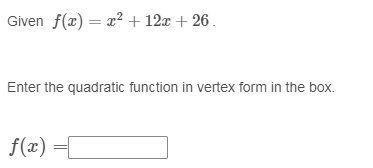 Pixel:
@Hero
Pixel:
@563blackghost
Pixel:
@Angle
 Angle:
so here we should try to do something called: "Completing the square"
Angle:
I'll give an example say, we want to complete the square for f(x) = x^2 + 4x + 5 we try to think of a similar/easier version of that equation like, say, (x+2)^2 = (x+2)(x+2) = x^2 + 4x + 4 > see how the only difference is the last number?
Pixel:
there is a difference?
Angle:
\(x^2 + 4x + 5\) versus \(x^2 + 4x + 4\)
Pixel:
oh
Angle:
so while we can say that \(x^2 + 4x + 4 = (x+2)(x+2)\) it doesn't really work the same for \(x^2 + 4x + 5\)
Pixel:
can you do an example that is similar to my question because im not following
Angle:
ok, so the main point I was trying to say is that \(x^2 + 4x + 5 = x^2 + 4x + (4 + 1) = (x^2 + 4x + 4) + 1 = (x+2)(x+2) + 1\)
Pixel:
._.
Pixel:
can you do my question but i do the work
Angle:
hmm sure, sorry for the confusion x'D I was trying a different approach so for your question: first try solving: (x+6)^2 = ?
Pixel:
2x+36
Angle:
\((x + 6)^2 = (x+6)(x+6) = ?\)
Pixel:
36x?
Pixel:
WAIT its (x+6)^2
Pixel:
right?
Angle:
can you try expanding it?
Pixel:
(x+6)(x+6)
Angle:
good and you can expand it further
Pixel:
x^2+12x
Pixel:
/*
Angle:
close! I think it's missing something
Pixel:
+26
Pixel:
?
Angle:
(x+6)(x+6) = (x)*(x) + (x)*(6) + (6)*(x) + (6)*(6) you got = x^2 + 12x + _(6*6)_ ?
Pixel:
.-.
Pixel:
OH
Angle:
yeah 6 times 6 = 36 not 26
Pixel:
+36
Angle:
wonderful! so (x+6)^2 = x^2 + 12x + 36 now, how is this different from your question?
Pixel:
+36 ~= +26
Pixel:
^not equal sign fail
Angle:
exactly! you see it, that's great :) so the idea is that we can add and subtract numbers at the same time and not change anything like 13 + 10 - 10 is still 13 with this idea \(x^2 + 12x + 26 + 10 - 10\) still equals the original question right?
Pixel:
Yes
Angle:
then we can add parts of it but not others like this: \((x^2 + 12x + 36) - 10\) I added the 26 + 10 parts together, see?
Pixel:
yuh
Angle:
then we said before that (x+6)^2 = x^2 + 12x + 36 right?
Pixel:
yes
Angle:
so we can say \(x^2 + 12x + 26\) \(= (x+6)^2 -10 \)
Pixel:
Thats what my calculator said, but i wanted the steps for future reference, Thanks
Join our real-time social learning platform and learn together with your friends!
 Demon25:
For a hoco proposal with a cheerleader and football player, what else should be a
Demon25:
For a hoco proposal with a cheerleader and football player, what else should be a

 Breathless:
TOC: "MGF any confirmation on the commander? we require confirmation as soon as[radio static].
Breathless:
TOC: "MGF any confirmation on the commander? we require confirmation as soon as[radio static].
 EdwinJsHispanic:
I wrote something that I don't know if I want it as a poem or song, Please let me know on yours thoughts about it, I'm still doing this! "Broken promises an
EdwinJsHispanic:
I wrote something that I don't know if I want it as a poem or song, Please let me know on yours thoughts about it, I'm still doing this! "Broken promises an
 thehearken:
hi um I don't know if this is the right section for this, but can someone go over my poem and tell me if its good enough to give my English professor for a
thehearken:
hi um I don't know if this is the right section for this, but can someone go over my poem and tell me if its good enough to give my English professor for a
 heartlessprophet:
Aye what's 19z%u00f74p=9u03c0 my teacher thinking of impossible questions for us
heartlessprophet:
Aye what's 19z%u00f74p=9u03c0 my teacher thinking of impossible questions for us
 kippppp:
does anyone have any good tips for writing stories? i'm trying to write a dnd campaign but i'm not that great of a writer yet.
kippppp:
does anyone have any good tips for writing stories? i'm trying to write a dnd campaign but i'm not that great of a writer yet.
 GRIZZLEY19:
Y'all let me know what y'all think about this beat I made I took me like a hour maybe rate it 0/10 https://drive.
GRIZZLEY19:
Y'all let me know what y'all think about this beat I made I took me like a hour maybe rate it 0/10 https://drive.
 Ultrilliam:
Welcome to the 10th Anniversary Update! (Part 2) Sorry this one passed the date a
Ultrilliam:
Welcome to the 10th Anniversary Update! (Part 2) Sorry this one passed the date a
 Twaylor:
was walking downtown and my adhd brain wanted to make some (rock?) lyrics: There'
Twaylor:
was walking downtown and my adhd brain wanted to make some (rock?) lyrics: There'