
 zarkam21:
Yes Yes No No Yes
 Vocaloid:
good
zarkam21:
Im having trouble with the reasoning
Vocaloid:
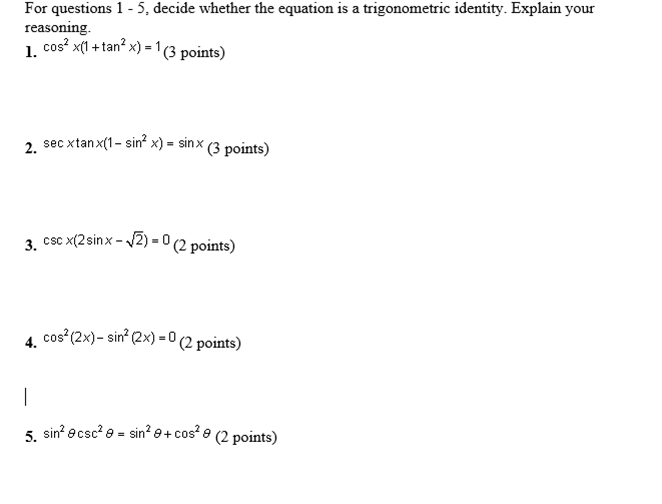
well let's go one by one 1. cos^2(x)(1+tan^2(x)) if we re-write tan in terms of sin and cos cos^2(x) * (1 + sin^2/cos^2x) distributing gives us cos^2(x) + sin^2(x) = 1 ^ done, proved.
Vocaloid:
2. sec(x)tan(x)(1-sin^2(x)) similar reasoning here, re-write tanx as sinx/cosx and sec(x) as 1/cos(x) (1/cos(x)) * sin(x)/cos(x) * (1 - sin^2(x)) distribute sin(x)/cos^2(x) - sin^3(x)/cos^2(x) combining these into one expression sin(x) - sin^3(x) / cos^2(x) --> let me draw this out so it'll be a little easier to see
Vocaloid:
|dw:1525489428165:dw|
Vocaloid:
|dw:1525489476769:dw|
Vocaloid:
3 is not an identity, we can attempt to disprove this by re-writing csc as 1/sin and distributing (1/sinx)(2sin(x) - sqrt(2) = 2 - sqrt(2)/sin(x) there's no reason for this to be equal to 0 under all circumstances thus disproving the statement
Vocaloid:
4 is not an identity either, using the identity cos(2x) = cos^2(x) - sin^2(x) we can apply this to the original problem to get cos^2(2x) - sin^2(4x) = cos(4x) which is not equal to 0 under all circumstances thus disproving the identity
Vocaloid:
5 is easy, if we re-write csc^2 as 1/sin^2(x) the left side cancels out to 1 which gives us the real identity cos^2(x) + sin^2(x) = 1 QED
Vocaloid:
anyhoo that's a lot to take in but lmk if something was unclear
zarkam21:
wow tthat is a alot to take in but i thin k i get it
Join our real-time social learning platform and learn together with your friends!
 Demon25:
For a hoco proposal with a cheerleader and football player, what else should be a
Demon25:
For a hoco proposal with a cheerleader and football player, what else should be a

 Breathless:
TOC: "MGF any confirmation on the commander? we require confirmation as soon as[radio static].
Breathless:
TOC: "MGF any confirmation on the commander? we require confirmation as soon as[radio static].
 EdwinJsHispanic:
I wrote something that I don't know if I want it as a poem or song, Please let me know on yours thoughts about it, I'm still doing this! "Broken promises an
EdwinJsHispanic:
I wrote something that I don't know if I want it as a poem or song, Please let me know on yours thoughts about it, I'm still doing this! "Broken promises an
 thehearken:
hi um I don't know if this is the right section for this, but can someone go over my poem and tell me if its good enough to give my English professor for a
thehearken:
hi um I don't know if this is the right section for this, but can someone go over my poem and tell me if its good enough to give my English professor for a
 heartlessprophet:
Aye what's 19z%u00f74p=9u03c0 my teacher thinking of impossible questions for us
heartlessprophet:
Aye what's 19z%u00f74p=9u03c0 my teacher thinking of impossible questions for us
 kippppp:
does anyone have any good tips for writing stories? i'm trying to write a dnd campaign but i'm not that great of a writer yet.
kippppp:
does anyone have any good tips for writing stories? i'm trying to write a dnd campaign but i'm not that great of a writer yet.
 GRIZZLEY19:
Y'all let me know what y'all think about this beat I made I took me like a hour maybe rate it 0/10 https://drive.
GRIZZLEY19:
Y'all let me know what y'all think about this beat I made I took me like a hour maybe rate it 0/10 https://drive.
 Ultrilliam:
Welcome to the 10th Anniversary Update! (Part 2) Sorry this one passed the date a
Ultrilliam:
Welcome to the 10th Anniversary Update! (Part 2) Sorry this one passed the date a
 Twaylor:
was walking downtown and my adhd brain wanted to make some (rock?) lyrics: There'
Twaylor:
was walking downtown and my adhd brain wanted to make some (rock?) lyrics: There'