
 zarkam21:
Need someone to check this for me? @vocaloid @smokeybrown @angle
 Vocaloid:
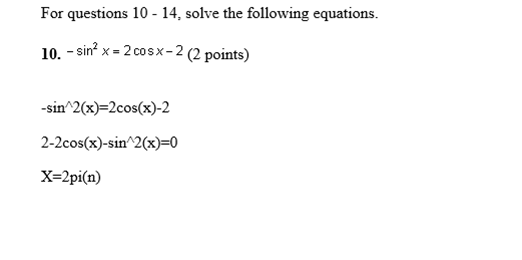
for 10 the sol'n is right but I would include a few more steps b/c it's not clear how you got x = 2pi*n from 2-2cos(x)-sin^2(x) = 0 you could substitute sin^2(x) for 1 - cos^2(x) to get 2 - 2cos(x) - (1 - cos^2(x)) = 0 cos^2(x) - 2cos(x) + 1 = 0 then factor that, and show that x = 2pi*n using the unit circle
Vocaloid:
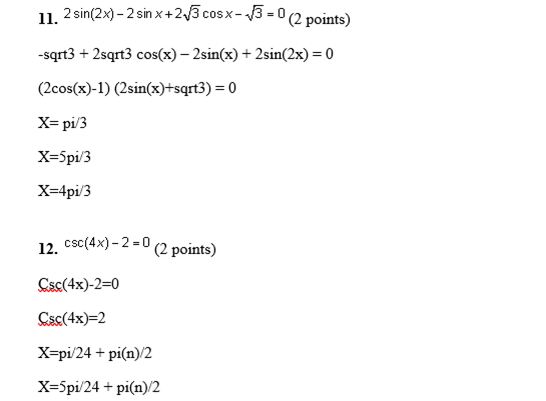
11 is also correct but there's a key step missing, you need to expand 2sin(2x) to get 2[2cos(x)sin(x)] and ~then~ it will factor into (2cos(x)-1)(2sin(x)+sqrt(3)) = 0
Vocaloid:
12, also good, they might want you to write out that csc(4x) = 1/sin(4x) = 2 giving us sin(4x) = 1/2 and x = pi/24 and 5pi/24 using the UC
Vocaloid:
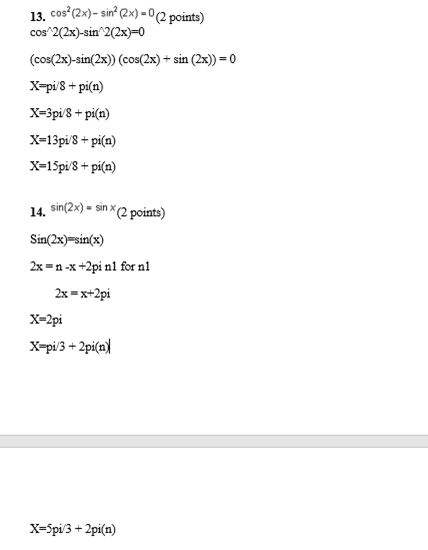
13. cos^2(2x) - sin^2(2x) = cos(4x) = 0 cos equals 0 when the angle = pi/2 or 3pi/2 so dividing this by 4 we get pi/8 + 2pi*n and 3pi/8 + 2*pi*n because cos repeats itself every 2pi*n units not every pi*n
Vocaloid:
14 is almost good, the last two solutions are good since sin(2x) = sin(x) when sin(x) = 0 the other solutions are 0 + 2pi*n and pi + 2pi*n
Vocaloid:
lmk if anything was unclear
zarkam21:
that was very clear
 Vocaloid:
hm.|dw:1525703165682:dw|
Vocaloid:
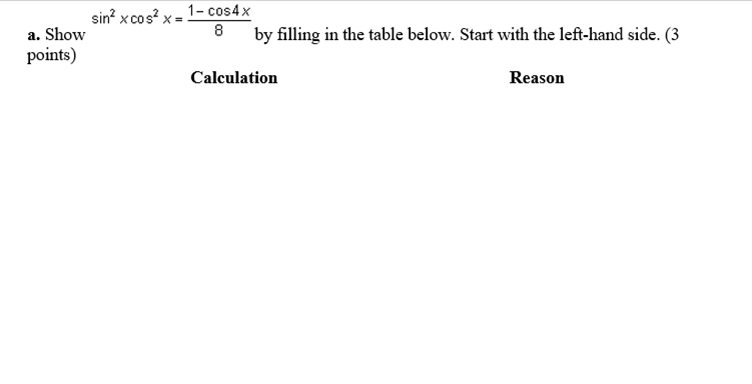
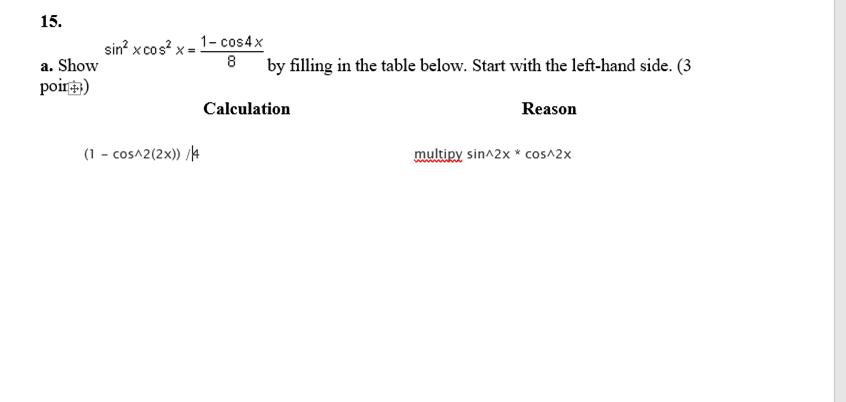
multiplying sin^2(x) * cos^2(x) gives us [1 - cos^2(2x) ] / 4, still figuring out where to go from there
 zarkam21:
tup that is what i got so far, stuck on the rest
Vocaloid:
ok, I got it, you re-use the identity cos^2(u) = [1 + cos(2u)]/2 to re-write [1 - cos^2(2x) ] / 4 as [1 - (1 + cos(4x)/2] / 4 multiplying the numerator and denominator by 2 gives us [2 - (1 + cos(4x)]/8 = [1 - cos(4x)]/8 thus proving the original statement
Join our real-time social learning platform and learn together with your friends!
 KBaby:
Verse 1 We left our names in the dust of the driveway Watched the old town shrink
KBaby:
Lyrics Generator Use AI to write the lyrics for a song. Suggested Genres: Pop Hip
KBaby:
Verse 1 We left our names in the dust of the driveway Watched the old town shrink
KBaby:
Lyrics Generator Use AI to write the lyrics for a song. Suggested Genres: Pop Hip

 aitexturegenerator:
How are you all handling AI-generated textures for 3D models and game assets without losing the hand-made feel? I've been doing a small stylized environment
aitexturegenerator:
How are you all handling AI-generated textures for 3D models and game assets without losing the hand-made feel? I've been doing a small stylized environment

 Demon25:
Woke up feeling like that girl and that dude well he still aint crap pluse the du
Demon25:
Woke up feeling like that girl and that dude well he still aint crap pluse the du
 playtsec:
how do I get rid of stress from teachers... I just feel like running out the classroom and leaving on my own.
playtsec:
how do I get rid of stress from teachers... I just feel like running out the classroom and leaving on my own.
 JohnnyLFowler0812:
What type of gamer would play something and then get off for a while. Why not sta
JohnnyLFowler0812:
Which is better? Metallica Rap Country R&B hiphop Medal Gospel Chill Which 3 opti
JohnnyLFowler0812:
What type of gamer would play something and then get off for a while. Why not sta
JohnnyLFowler0812:
Which is better? Metallica Rap Country R&B hiphop Medal Gospel Chill Which 3 opti