
 jhonyy9:
given numberline A={a,b,c,d} and B={e,f,g,h} ,where a,b,c,d,e,f,g and h are naturals question: how many will be the product of A and B ?
jhonyy9:
my opinion : multiply term by term A×B= { a*e,a*f,a*g,a*h,b*e,b*f,b*g,b*h,c*e,c*f,c*g,c*h,d*e,d*f,d*g,d*h} is this correct solved ?
 Ultrilliam:
@Vocaloid @Shadow When you have a chance
 Vocaloid:
not really sure, I would think that's the right place to start @hero @Angle
 Angle:
I feel like the question is phrased a little confusingly? If the question is: How many (of a, b, c, d, e, f, g, h) will be a product of A and B? then the answer would be none, as "a" or "b" alone would never be a product of A and B by itself without an identity If the question is: How many products are there of A and B? then you are correct A×B= { a*e,a*f,a*g,a*h,b*e,b*f,b*g,b*h,c*e,c*f,c*g,c*h,d*e,d*f,d*g,d*h} is the correct product and there are 16 elements
Angle:
It could also be nice to note that the Natural Numbers are "closed" under multiplication. Which means that any product between two natural numbers is also a natural number.
 Hero:
Hero:
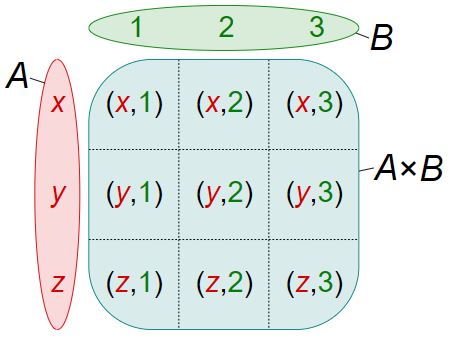
It's called Cartesian Product: If you're given two sets \(A\) and \(B\), the Cartesian product \(A × B\) is the set of all ordered pairs \((a, b)\) where \(a ∈ A\) and \(b ∈ B\). Products can be specified using set-builder notation. For example: \(A \times B = \{(a,b) | a \in B \text{ and } b \in B\}\) Simple Example: \(A = {1,2}; B = {3,4} \\A × B = \{1,2\} × \{3,4\} = \{(1,3), (1,4), (2,3), (2,4)\} \\B × A = \{3,4\} × \{1,2\} = \{(3,1), (3,2), (4,1), (4,2)\}\) Source: Wikipedia
 jhonyy9:
ty all your help so my qustion is more much complicated bc. in reality A={5,7,11,13} and B=A so how can i getting A×A so that i need getting 5*5=25 and 5*7=35 so 5*11=55 and so much term by term ?
Hero:
@jhonyy9 would you mind uploading the question as stated in the original document?
jhonyy9:
sorry @Hero this is my new idea togheter with my one colleg to getting in an easy way all prims greater than 3 and look that is right just we dont know again how we can getting these products starting with 5*5 and 5*7 and so much so this is why i have asked it here in this way
Hero:
I understand, but the problem is the language that you're using to express your question is not clear enough. The question you're posting needs to be stated in mathematical language that is clear enough to understand. Are you saying that the question you're posing is related to a concept other than Cartesian Product?
jhonyy9:
sorry and yes now this mean that you understand it right - yes we need getting these product different the Cartesian Product - so do you know any way to get these so how i have wrote it above ,please ?
Angle:
so you're saying you want something like {5*5, 5*7, 5*11, 5*13, 7*5, 7*7, 7*11, 7*13, 11*5, 11*7, 11*11, 11*13, 13*5, 13*7, 13*11, 13*13} ? or {5*5, 5*7, 5*11, 5*13, 7*7, 7*11, 7*13, 11*11, 11*13, 13*13} ? or something entirely different?
jhonyy9:
yes @Angle exactly
Angle:
which one? I gave two suggestions
jhonyy9:
ok the last one - sorry
jhonyy9:
every term multiplied by every term but just one time
jhonyy9:
bc. 5*7=7*5
Hero:
"an easy way to get all primes greater than three". Not sure this is the way. And those prime products are not producing any prime numbered results btw.
jhonyy9:
@Hero please believe me we ,i togheter with my college have made the calcules and this is one right way getting every primes just we need subtracting from these number line every product of these terms how i have wrote it above and how have wrote @Angel in the last one case
Angle:
The crossed out boxes are the ones you don't want |dw:1525640413347:dw|
jhonyy9:
yes @Angle really this was my first idea too in this way but i hope so much that exist one clearly mathematics way getting these products using multiplication or any different way
jhonyy9:
or may dont exist so we need using this way how you made above
jhonyy9:
@Hero please do you understand it now my question ,problem please ?
Hero:
I understand what @Angle is doing, but not anything you've said.
Hero:
I also understand that Romanian and Hungarian are your native languages, but English is not.
jhonyy9:
ok ty . so how you think there exist any way in mathematics getting these products of these numberlines or just the way what have wrote @Angle above in this table ?
Angle:
I do know that you can figure out amount of elements you get in the end as "n!" however, I do not know of a short cut or formula for you to skip multiplying every element with every other element individually
jhonyy9:
@Angle using factorials - how ? please - with these numberlines
Angle:
oh wait, sorry, It's not a factorial I was referring to how {5*5, 5*7, 5*11, 5*13, 7*7, 7*11, 7*13, 11*11, 11*13, 13*13} gives you 10 terms because {5, 7, 11, 13} is 4 terms and 4 + 3 + 2 + 1 = 10
jhonyy9:
ok. np. but please you @Angle and @Hero and indifferent everybody who has an idea what can helping in this case how we can getting these products - please reply me - thank you in advance all your help
Hero:
@Angle posted the correct approach to this. You perform the cartesian product \(A \times B\) where \(B = A\) in this case so \(A = \{5, 7, 11, 13\} \\ B = \{5, 7, 11, 13\}\) Therefore \(A \times B \\= \{5, 7, 11, 13\} \times \{5, 7, 11, 13\} \\=\{(5,5), (5,7), (5,11), (5,13),(7,7),(7,11),(7,13),(11,11),(11,13),(13,13)\}\)
jhonyy9:
ty @Hero so i think that finaly this will be the right way mathematicaly what using we can getting easy all primes
 Zarkon:
that is not the product
Hero:
Yeah, it's not the entire product. I'm aware of this, but @jhonyy had some strict specifications for what he wanted the result to be.
Zarkon:
we should use a different notation then
Hero:
If you want to make a contribution to this, my all means. Be my guest.
Zarkon:
I know of no standard notation what works for this particular, but we probably shouldn't use \[A\times B\]
Zarkon:
'this particular problem'
Hero:
I'm all eyes to see what you will recommend as far as correct notation.
Zarkon:
\[\{(a,b)|a\in A,b\in B,a\leq b\}\]
Hero:
I see. Yes, that's it.
Hero:
That's the formula he's looking for I believe.
Join our real-time social learning platform and learn together with your friends!
 KBaby:
Verse 1 We left our names in the dust of the driveway Watched the old town shrink
KBaby:
Lyrics Generator Use AI to write the lyrics for a song. Suggested Genres: Pop Hip
KBaby:
Verse 1 We left our names in the dust of the driveway Watched the old town shrink
KBaby:
Lyrics Generator Use AI to write the lyrics for a song. Suggested Genres: Pop Hip

 aitexturegenerator:
How are you all handling AI-generated textures for 3D models and game assets without losing the hand-made feel? I've been doing a small stylized environment
aitexturegenerator:
How are you all handling AI-generated textures for 3D models and game assets without losing the hand-made feel? I've been doing a small stylized environment

 Demon25:
Woke up feeling like that girl and that dude well he still aint crap pluse the du
Demon25:
Woke up feeling like that girl and that dude well he still aint crap pluse the du
 playtsec:
how do I get rid of stress from teachers... I just feel like running out the classroom and leaving on my own.
playtsec:
how do I get rid of stress from teachers... I just feel like running out the classroom and leaving on my own.
 JohnnyLFowler0812:
What type of gamer would play something and then get off for a while. Why not sta
JohnnyLFowler0812:
Which is better? Metallica Rap Country R&B hiphop Medal Gospel Chill Which 3 opti
JohnnyLFowler0812:
What type of gamer would play something and then get off for a while. Why not sta
JohnnyLFowler0812:
Which is better? Metallica Rap Country R&B hiphop Medal Gospel Chill Which 3 opti