
 Moon:
Moon:
MCAT Mini-Tutorial: Understanding the Periodic Table
Moon:

Moon:
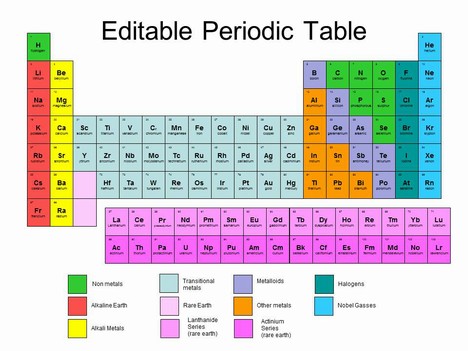
Moon:
\({\bf{Basic~Layout:}}\) - period: rows - group: columns, elements in a group tend to share chemical properties - group 1: alkali earth (red on this diagram, excludes hydrogen), very reactive - group 2: alkaline earth metals (yellow), reactive but less so than group 1 - transition metals: d-block, light blue, partially filled d orbitals allow them to react w/, combine w/ other elements - rare earth elements: f-block, pink, first row is actinides and second row is lanthanides - group 7: halogens, very reactive - group 8: noble gases, non-reactive - transition metals: the blue-ish "staircase" between the transition metals and the nonmetals \({\bf{Classifying~Elements}}\) - metals: conductive, ductile, malleable, solid at room temp. - nonmetals: nonconductive, brittle, gaseous at room temp - metalloids: intermediary properties between metals and nonmetals \({\bf{Periodic~Trends:}}\) - atomic radius: 1/2 the distance between adjacent nuclei > decrease across period (more protons, same energy level, stronger effective nuclear charge) > increase down group (increase of shielding from lower energy levels) - first ionization energy: energy required to remove electron in gaseous state > increases across period (more protons, same energy level, stronger effective nuclear charge) > decrease down group: (increase of shielding from lower energy levels, easier to remove electrons) > subsequent ionization energy: increases as more electrons are removed (removing electrons increases the effective nuclear charge per remaining electron) - electron affinity: energy change of gaining an electron in gaseous state > same trends as ionization energy - electronegativity: affinity for electrons > same trends as ionization energy > metals have low EN, nonmetals have high EN, noble gases are not given EN since they are not reactive misc: - francium has lowest EN and largest radius - cesium is the most reactive
Moon:
Anyway, that's the end of my tutorial, I hope it was a helpful resource. Source material is the 2nd Edition Barron's Prep book for the new MCAT
Join our real-time social learning platform and learn together with your friends!
 Demon25:
For a hoco proposal with a cheerleader and football player, what else should be a
Demon25:
For a hoco proposal with a cheerleader and football player, what else should be a

 Breathless:
TOC: "MGF any confirmation on the commander? we require confirmation as soon as[radio static].
Breathless:
TOC: "MGF any confirmation on the commander? we require confirmation as soon as[radio static].
 EdwinJsHispanic:
I wrote something that I don't know if I want it as a poem or song, Please let me know on yours thoughts about it, I'm still doing this! "Broken promises an
EdwinJsHispanic:
I wrote something that I don't know if I want it as a poem or song, Please let me know on yours thoughts about it, I'm still doing this! "Broken promises an
 thehearken:
hi um I don't know if this is the right section for this, but can someone go over my poem and tell me if its good enough to give my English professor for a
thehearken:
hi um I don't know if this is the right section for this, but can someone go over my poem and tell me if its good enough to give my English professor for a
 heartlessprophet:
Aye what's 19z%u00f74p=9u03c0 my teacher thinking of impossible questions for us
heartlessprophet:
Aye what's 19z%u00f74p=9u03c0 my teacher thinking of impossible questions for us
 kippppp:
does anyone have any good tips for writing stories? i'm trying to write a dnd campaign but i'm not that great of a writer yet.
kippppp:
does anyone have any good tips for writing stories? i'm trying to write a dnd campaign but i'm not that great of a writer yet.
 GRIZZLEY19:
Y'all let me know what y'all think about this beat I made I took me like a hour maybe rate it 0/10 https://drive.
GRIZZLEY19:
Y'all let me know what y'all think about this beat I made I took me like a hour maybe rate it 0/10 https://drive.
 Ultrilliam:
Welcome to the 10th Anniversary Update! (Part 2) Sorry this one passed the date a
Ultrilliam:
Welcome to the 10th Anniversary Update! (Part 2) Sorry this one passed the date a
 Twaylor:
was walking downtown and my adhd brain wanted to make some (rock?) lyrics: There'
Twaylor:
was walking downtown and my adhd brain wanted to make some (rock?) lyrics: There'