
 zarkam21:
Helpp

 Hero:
Hero:
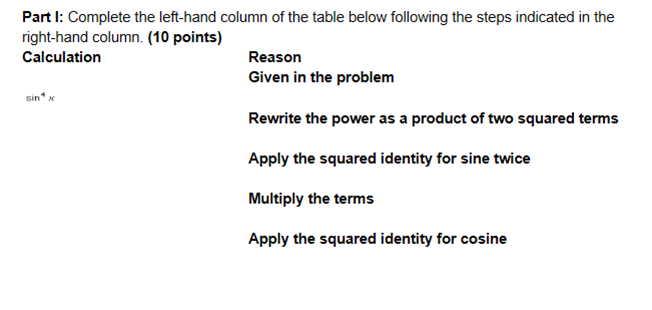
@zarkam21 were you able to rewrite the expression as a product of two squares ?
 jhonyy9:
sorry but i just given an example and really i dont see clearly the power of sin on this posted image -
Hero:
So the 4 in \(\sin^{4}x\). What do you suppose the 4 means in this case?
zarkam21:
like 4 times sin
zarkam21:
\(\color{#0cbb34}{\text{Originally Posted by}}\) @jhonyy9 @zarkam21 for example sin^4 x = sin^2 x *sin^2 x \(\color{#0cbb34}{\text{End of Quote}}\)
zarkam21:
So this is what you were asking?
Hero:
Basically, \(\sin^{4}x = (\sin^{2}x)(\sin^{2}x)\)
Hero:
So there you go. That's like a freebie for you.
zarkam21:
okay so that would be the answer to power as a product of two squared terms
Hero:
Yes, correct. The next step would be to find the identity that corresponds to \(\sin^2x\)
zarkam21:
2 sin x cos x
Hero:
That's the identity for \(\sin(2x)\) which is a double angle identity which is different from \(\sin^2x\)
zarkam21:
1-cos^2 x
zarkam21:
=)
Hero:
Yes, much better
zarkam21:
so thats it right for this step =) now on multiplying the terms
Hero:
You'd have to insert that expression in place of the previous for both instances of \(\sin^2x\)
Hero:
I have a question though. Where is the original equation associated with this trigonometric manipulation?
zarkam21:
sin4x=(1-cos^2 x)(1-cos^2 x)
Hero:
That's the original equation?
zarkam21:
sin^4x
Hero:
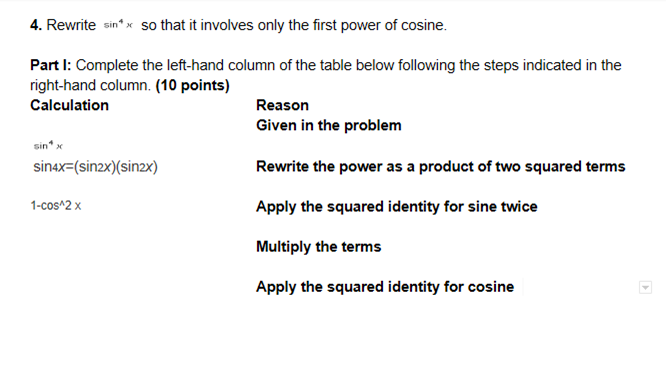
Are you sure about that? Post the image of the original equation.
 Hero:
Hero:
Okay, I see now. So the step where you are currently is \(\sin^4x= (1 - \cos^2x)(1 - \cos^2x)\) And they want you to multiply that out.
Hero:
The RHS that is (Right Hand Side)
Hero:
I would suggest that you use the distributive property. Substitution can also be useful in performing this step.
zarkam21:
sin 4x=1-cos(2)(x)^2
Hero:
What method did you use to multiply \((1 - \cos^2x)(1 - \cos^2x)\)?
Hero:
Distributive Property, FOIL, Stack Multiplication, Substitution ...?
zarkam21:
hold on. i made a mistake
zarkam21:
multiplication
Hero:
Okay, see if you can post your steps here. You can either use the drawing board or \(\LaTeX\)
Hero:
Or you can write it on paper and post a screenshot.
zarkam21:
|dw:1525734689653:dw|
Hero:
So are you saying that you're finished multiplying?
zarkam21:
sin^4(x)
Hero:
Is English your 1st or 2nd language @zarkam21 I'm asking if you think you're done multiplying \((1 - \cos^2x)(1 - \cos^2x)\)
zarkam21:
Yes
zarkam21:
English is my first , fyi
Hero:
Okay, so do you understand what it is I'm asking you? If so, paraphrase it.
zarkam21:
Your asking me if i am done multiplying the two equations that we have here
Hero:
And the answer to that is what?
zarkam21:
I simplified it down and got sin^4(x)
zarkam21:
is that not the answer?
Hero:
Except that isn't the goal. The goal is to express the answer in terms of powers of cosine following the sequence of steps they have laid out for you.
zarkam21:
ugh
zarkam21:
i thought you told me to multiply so i multiplied and got that
Hero:
Yes, but when you multiply two binomials, you have to use the distributive rule for that.
Hero:
\(a(b + c) = ab + ac\)
Hero:
Do you know how to multiply \((1 - x)(1 - x)\)
Hero:
If so, show me the steps.
zarkam21:
OKay..
zarkam21:
(1-x)(1-x) combine like terms (1-x)(1-x)=(1-x)^2
Hero:
Multiply implies expanding, not simplifying.
Hero:
At least not in this instance.
zarkam21:
okay i wil use FOIL THEN
zarkam21:
LOOK:
Hero:
YES, you use FOIL
zarkam21:
(1-x)(1-x) 1-2x+x^2
zarkam21:
Still wrong?
Hero:
It's either FOIL or distributive property for multiplying two binomials. When they say multiply they mean EXPAND it. So try again with multiplying \((1 - \cos^2x)(1 - \cos^2x)\).
zarkam21:
\[\sin^2(x)(1-\cos^2(x))\]
Hero:
Did you apply FOIL?
zarkam21:
\[\sin^2(x)\sin^2(x)\]
Hero:
FOIL. No substitution. You already showed me you know how to FOIL.
zarkam21:
\[sinx ^{2+2}\]
zarkam21:
ugh
zarkam21:
Im expanding it
Hero:
Remember, the goal is to express in terms of COSINE and NOT sine.
zarkam21:
\(\color{#0cbb34}{\text{Originally Posted by}}\) @Hero It's either FOIL or distributive property for multiplying two binomials. When they say multiply they mean EXPAND it. So try again with multiplying \((1 - \cos^2x)(1 - \cos^2x)\). \(\color{#0cbb34}{\text{End of Quote}}\)
zarkam21:
isn't that what you asked
Hero:
Yes EXPAND using FOIL and Distributive Property, NOT substitution.
Hero:
Try again.
zarkam21:
using foil i got: \[(-\cos^2(x)+1)(-\cos^2(x)+1)=\cos^4(x)-2\cos^2(x)+1\]
zarkam21:
Am I right now
Hero:
Wow, you actually got it finally.
Hero:
Still though you have to now apply the squared identity for cosine next.
zarkam21:
dont know how to do that
Hero:
By the way, in case you didn't know, \(\cos^2x = \dfrac{1}{2}[\cos(2x)+1]\)
zarkam21:
oh okay
Hero:
Also, BTW, the expression you wrote can be re-written as: \((\cos^2x)^2 - 2\cos^2x + 1\)
Hero:
So now all you have to do is just replace \(\cos^2x\) with its corresponding identity.
zarkam21:
1-sin^2x
Hero:
I have a question for you: What do you think it means when the problem says "Re-write \(\sin^4x\) so that it involves only the first power of cosine."?
zarkam21:
that the problem is simplified to have only the first power of cos
Hero:
So that means at every step we're moving away from any use of sine.
Hero:
Or at least that's the goal.
zarkam21:
correct because we have to end up with cos
Hero:
Yes, so that means any use of sin going forward is probably taboo.
Hero:
Well sort of.
Hero:
There may be an instance where we would use it again, but for now, no.
Hero:
We still have to re-write the expression \((\cos^2x)^2 - 2\cos^2x + 1\) given the following identity: \(\cos^2x = \dfrac{1}{2}[\cos(2x)+1]\)
zarkam21:
\[1/2[\cos(2x)+1 ] 2 −2 (\frac{ 1 }{ 2} [\cos(2x)+1]\]
Hero:
Hang on...
zarkam21:
ok
Hero:
How much time do you have to submit this?
zarkam21:
i guess we can do it tomorrow or something doesn't need to be done right this instant
Hero:
Actually, I have it and it was much more involved than I anticipated.
Hero:
Going to type all this out ....
Hero:
\(\begin{align*} \sin^4x &= (\sin^2x)(\sin^2x) \\&=(1 - \cos^2x)(1 - \cos^2x) \\&=1 - 2\cos^2x + \cos^{4}x \\&=1 - 2\cos^2x + (\cos^2x)^2 \\&=1 - 2\left[\dfrac{1}{2}\left(\cos(2x)+1\right)\right]+\left(\dfrac{1}{2}\left(\cos(2x)+1\right)\right)^2 \end{align*}\) Have this so far ....
Hero:
Continuing from that last step \(\begin{align*}\\&=1 - 2\left[\dfrac{1}{2}\left(\cos(2x)+1\right)\right]+\left(\dfrac{1}{2}\left(\cos(2x)+1\right)\right)^2 \\&=1 - \cos(2x) + 1+\left(\dfrac{\cos(2x)}{2}+\dfrac{1}{2}\right)^2 \\&=2 - \cos(2x)+ \left(\dfrac{\cos(2x)+1}{2}\right)^2 \\&=2-\cos(2x)+\left(\dfrac{(\cos(2x)+1)^2}{4}\right) \\&=2 - \cos(2x)+\dfrac{1}{4}(\cos(2x) + 1)^2 \end{align*}\) Have that so far ...
zarkam21:
yeah im just studying what you re doing. so if im not replying you know why
Hero:
Continuing from the last step .... \(\begin{align*} \\&=2 - \cos(2x)+\dfrac{1}{4}(\cos(2x) + 1)^2 \\&=2 - \cos(2x)+\dfrac{1}{4}(\cos^2(2x)+2\cos(2x)+1) \\&=2 - \cos(2x)+\dfrac{1}{4}\cos^2(2x)+\dfrac{1}{2}\cos(2x)+\dfrac{1}{4} \\&=2 - \cos(2x) + \dfrac{1}{4}\left(\dfrac{1}{2}\left[\cos(4x)+1\right]\right)+\dfrac{\cos(2x)}{2}+\dfrac{1}{4} \end{align*}\)
Hero:
You could simplify further from there, but no need. The expression is finally expressed in terms of just the first power of cosine.
zarkam21:
Okay so lol this is only completion of the first power of cosine
zarkam21:
Ha Joking
Hero:
It was much more involved than I originally thought for sure.
zarkam21:
Well def looks like it :/ I thought we would be done
Hero:
Let me see if I can simplify it further so it matches the expression on wolfram alpha: http://www.wolframalpha.com/input/?i=sin%5E4(x)
Hero:
Continuing from above: \(\begin{align*} \\&=2 - \cos(2x) + \dfrac{1}{4}\left(\dfrac{1}{2}\left[\cos(4x)+1\right]\right)+\dfrac{\cos(2x)}{2}+\dfrac{1}{4} \\&=2 +\dfrac{2}{4}+\dfrac{\cos(2x)}{2}-\dfrac{2\cos(2x)}{2}+\dfrac{1}{8}\cos(4x) \\&=\dfrac{10}{4}-\dfrac{\cos(2x)}{2}+\dfrac{1}{8}\cos(4x) \\&=\dfrac{1}{8}(20 - 4\cos(2x)+\cos(4x)) \\&=\dfrac{1}{8}(-4\cos(2x)+\cos(4x) + 20) \end{align*}\)
Hero:
I'm only off by about 17 units
zarkam21:
wow, is this the simplest form
Hero:
Yes
Join our real-time social learning platform and learn together with your friends!
 KBaby:
Verse 1 We left our names in the dust of the driveway Watched the old town shrink
KBaby:
Lyrics Generator Use AI to write the lyrics for a song. Suggested Genres: Pop Hip
KBaby:
Verse 1 We left our names in the dust of the driveway Watched the old town shrink
KBaby:
Lyrics Generator Use AI to write the lyrics for a song. Suggested Genres: Pop Hip

 aitexturegenerator:
How are you all handling AI-generated textures for 3D models and game assets without losing the hand-made feel? I've been doing a small stylized environment
aitexturegenerator:
How are you all handling AI-generated textures for 3D models and game assets without losing the hand-made feel? I've been doing a small stylized environment

 Demon25:
Woke up feeling like that girl and that dude well he still aint crap pluse the du
Demon25:
Woke up feeling like that girl and that dude well he still aint crap pluse the du
 playtsec:
how do I get rid of stress from teachers... I just feel like running out the classroom and leaving on my own.
playtsec:
how do I get rid of stress from teachers... I just feel like running out the classroom and leaving on my own.
 JohnnyLFowler0812:
What type of gamer would play something and then get off for a while. Why not sta
JohnnyLFowler0812:
Which is better? Metallica Rap Country R&B hiphop Medal Gospel Chill Which 3 opti
JohnnyLFowler0812:
What type of gamer would play something and then get off for a while. Why not sta
JohnnyLFowler0812:
Which is better? Metallica Rap Country R&B hiphop Medal Gospel Chill Which 3 opti