
 zarkam21:
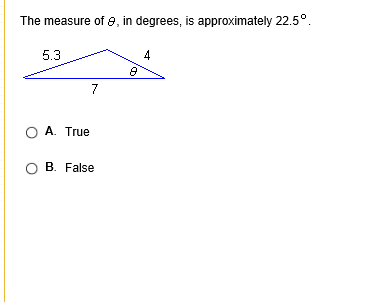
True?
 Vocaloid:
I got something a little different than 22.5, are you familiar with the law of cosines?
Vocaloid:
|dw:1525876773907:dw|
Vocaloid:
if you let theta be capital C, and lowercase c the side across from C (so c = 5.3) while a and b are the other two sides (4 and 7) you should be able to plug everything into the formula and solve for capital C (theta)
zarkam21:
5.3^2=4^2+7^2-2(4*7)cosC C=0.85 C=5.43
 MARC:
MARC:
\(C=cos^{-1}(\frac{a^2+b^2-c^2}{2ab})\)
Vocaloid:
better to convert your solutions to degrees since that's what's given in the problem
zarkam21:
C=0.85 degrees C=5.43 degrees
MARC:
hmm,I got a diff answer
Vocaloid:
0.85 is in radians, you need to convert this to degrees
MARC:
Ah I c...makes sense,now
zarkam21:
48.70 311
zarkam21:
so false
Vocaloid:
good, 48.70 degrees so the original answer is false
 zarkam21:
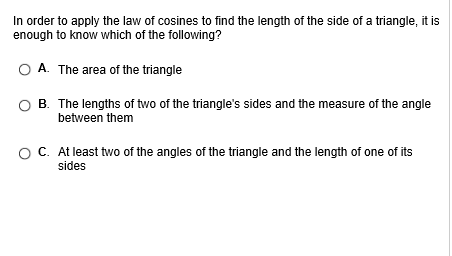
B
Vocaloid:
good
 zarkam21:
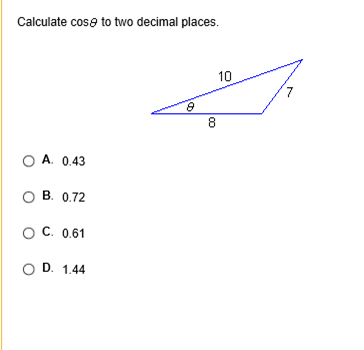
This would be the same concept as the first question right
Vocaloid:
yes, just be sure you are solving for cos(theta) not just theta
zarkam21:
10 would be c right
zarkam21:
10^2=8^2+7^2-2*7*8 Cos
Vocaloid:
I got something a little different, remember that c^2 is the side across from the angle so 7^2 = 10^2+8^2 - 2(10)(8)cos(x)
zarkam21:
0.77 5.51
Vocaloid:
keep in mind they are not asking for the value for x, they asking for cos(x) so you need to solve for cos(x)
zarkam21:
B
zarkam21:
0.72
Vocaloid:
good
 zarkam21:
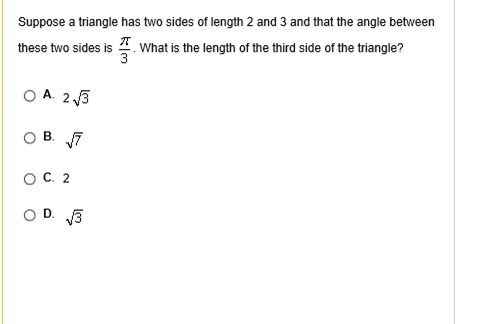
so solving for c^2 this time right
zarkam21:
c^2=2^2+3^2-(2*2*3)cos(pi/3)
zarkam21:
im getting eroor on the calc though
zarkam21:
not sure if i did something rong
zarkam21:
you there?
Vocaloid:
yeah i'm still there i was just working on someone else's problem ;_; anyway we can try doing some manual work if the calculator is being a butt c^2=2^2+3^2-(2*2*3)cos(pi/3) becomes c^2 = 4 + 9 - (12)(1/2) so c^2 = 13 - 6 c = ?
zarkam21:
B
Vocaloid:
excellent
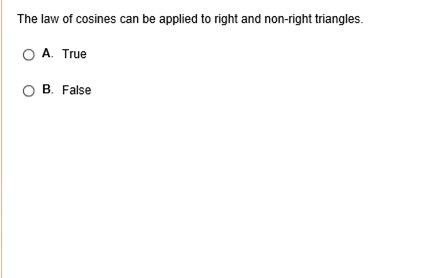 zarkam21:
True
Vocaloid:
good
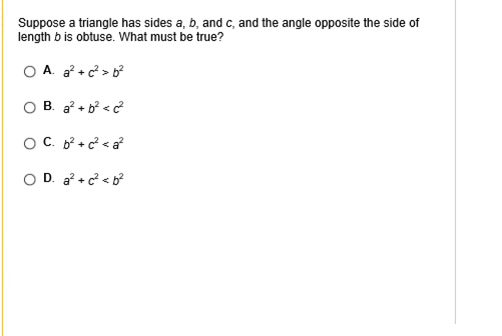 zarkam21:
B
Vocaloid:
hm. I got something a little different if theta (the angle across from b) is obtuse, then it must be at least 90 right try applying the law of cosines b^2 > a^2 + c^2 - 2ac * cos(90) lmk what you get when you simplify this
zarkam21:
I got D
Vocaloid:
awesome that's what i got too
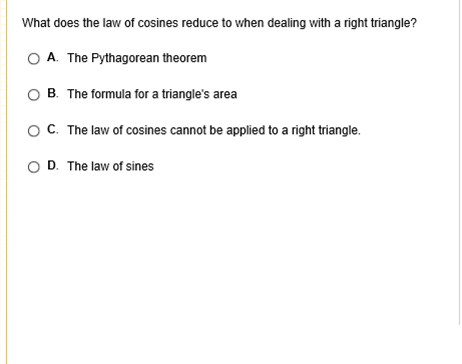
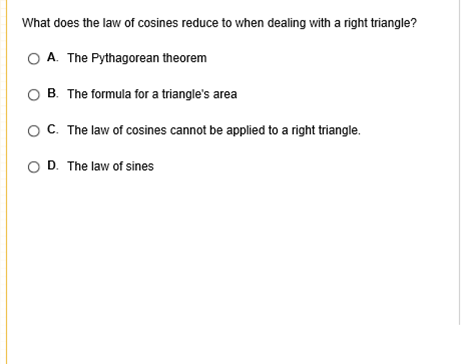 zarkam21:
idk if its a or c :/
Vocaloid:
well when you plug in 90 for the right angle we get c^2 = a^2 + b^2 - 2ac(cos*90)) look like any familiar formula to you?
zarkam21:
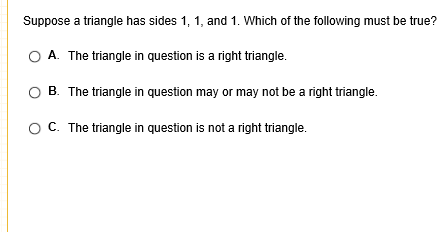
pyth?
zarkam21:
A
Vocaloid:
awesome so A
 zarkam21:
C
Vocaloid:
awesome
 zarkam21:
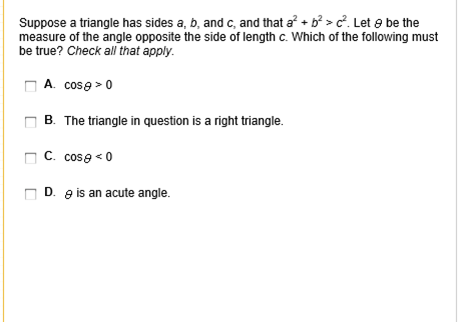
B and C
Vocaloid:
keep in mind pythagorean states that c^2 = a^2 + b^2, it has to be an equal sign not a less than/greater than sign so pyth. is already out if a^2 + b^2 > c^2 c^2 = a^2 + b^2 - 2ac*cos(theta) we can plug in the formula a^2 + b^2 - 2ac*cos(theta) into the first equation to get a^2 + b^2 - 2ac*cos(theta) < a^2 + b^2 try cancelling out like terms on both sides of the inequality and solve the inequality for cos(theta)
Vocaloid:
a^2 + b^2 - 2ac*cos(theta) < a^2 + b^2 if you take away the a^2 and b^2 terms from both sides you get -2ac*cos(theta) < 0 what happens when you divide both sides by -2ac? remember the rules for inequality operations
zarkam21:
0-2ac
zarkam21:
on the right side
Vocaloid:
-2ac is being muliplied not subtracted, so dividing by -2ac would leave us with cos(theta)>0 since the inequality flips directions when you multiply/divide by a neg. number anyway, if cos(theta) > 0 then is theta acute or obtuse?
zarkam21:
um
zarkam21:
acute
Vocaloid:
good so cos(theta) > 0 and theta = acute (A+D)
 Vocaloid:
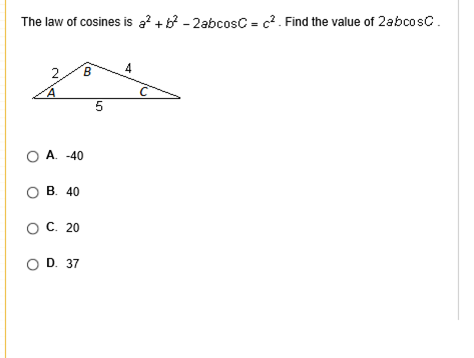
as a hint try solving for 2abcos(theta) first, then plug in a, b, and c as needed
zarkam21:
C
zarkam21:
B?
Vocaloid:
a^2 +b^2 - 2abcos(theta) = c^2 therefore 2abcos(theta) = a^2 + b^2 - c^2 = ?
zarkam21:
D
zarkam21:
:/
Vocaloid:
well done, D
Join our real-time social learning platform and learn together with your friends!
 KBaby:
Verse 1 We left our names in the dust of the driveway Watched the old town shrink
KBaby:
Lyrics Generator Use AI to write the lyrics for a song. Suggested Genres: Pop Hip
KBaby:
Verse 1 We left our names in the dust of the driveway Watched the old town shrink
KBaby:
Lyrics Generator Use AI to write the lyrics for a song. Suggested Genres: Pop Hip

 aitexturegenerator:
How are you all handling AI-generated textures for 3D models and game assets without losing the hand-made feel? I've been doing a small stylized environment
aitexturegenerator:
How are you all handling AI-generated textures for 3D models and game assets without losing the hand-made feel? I've been doing a small stylized environment

 Demon25:
Woke up feeling like that girl and that dude well he still aint crap pluse the du
Demon25:
Woke up feeling like that girl and that dude well he still aint crap pluse the du
 playtsec:
how do I get rid of stress from teachers... I just feel like running out the classroom and leaving on my own.
playtsec:
how do I get rid of stress from teachers... I just feel like running out the classroom and leaving on my own.
 JohnnyLFowler0812:
What type of gamer would play something and then get off for a while. Why not sta
JohnnyLFowler0812:
Which is better? Metallica Rap Country R&B hiphop Medal Gospel Chill Which 3 opti
JohnnyLFowler0812:
What type of gamer would play something and then get off for a while. Why not sta
JohnnyLFowler0812:
Which is better? Metallica Rap Country R&B hiphop Medal Gospel Chill Which 3 opti